Improve Your Purchase to Pay - Requisition

Your 6-step guide to optimize P2P Requisition in SAP ECC
Improve Your Purchase to Pay - Requisition

Optimize Purchase to Pay Requisition in SAP ECC

This platform helps you pinpoint critical inefficiencies and bottlenecks within your processes. Easily uncover delays, rework, and deviations from standard procedures. By identifying these areas, you can streamline workflows, reduce lead times, and ensure better operational compliance.

Download our pre-configured data template and address common challenges to reach your efficiency goals. Follow our six-step improvement plan and consult the Data Template Guide to transform your operations.

Show detailed description

Why Optimize Your Purchase to Pay - Requisition Process?

The Purchase to Pay (P2P) process is the backbone of an organization's procurement, and the requisition phase, specifically within SAP ECC, is its crucial starting point. An inefficient or delayed requisition process doesn't just impact procurement, it ripples across your entire organization, affecting project timelines, operational continuity, and ultimately, your bottom line. Without clear visibility, organizations often struggle with excessive cycle times, non-compliant spending, and high administrative costs directly stemming from a poorly managed requisition lifecycle. Delays in converting a business need into an approved request can lead to lost opportunities, expedited shipping fees, and frustrated stakeholders. Understanding how to improve Purchase to Pay - Requisition is paramount for a robust and cost-effective procurement function.

Optimizing your SAP ECC Purchase Requisition process is not merely about speed, it's about ensuring that every request for goods or services follows the correct path, gains necessary approvals promptly, and aligns with your organizational policies. Whether it is identifying where requisitions stall, understanding why some are frequently amended, or ensuring compliance with spending limits, a detailed analysis of this initial P2P step is essential for overall process health.

How Process Mining Unlocks Requisition Efficiency

Process mining offers an unparalleled lens into the actual execution of your Purchase to Pay - Requisition process in SAP ECC. Instead of relying on assumptions or anecdotal evidence, process mining uses the raw event data from your SAP ECC system, specifically from tables like EBAN, EBKN, CDHDR, and CDPOS, and transactions such as ME51N, ME52N, and ME54N. By reconstructing every step a Purchase Requisition ID takes, from creation to approval or rejection, process mining reveals the true process flow, including all deviations and rework loops.

This technology highlights how Purchase Requisition activities, such as "Requisition Created," "Requisition Submitted," "Approval Step 1 Started," "Requisition Amended," and "Purchase Order Created from Requisition," actually occur. It automatically identifies bottlenecks by pinpointing exactly where requisitions spend too much time, which approval steps are causing delays, or which departments struggle with timely submissions. You can analyze approval workflow paths, understand the impact of different requisition types, and assess the efficiency of your procurement policies based on actual execution data, not just theoretical models. This deep insight empowers you to effectively reduce Purchase to Pay - Requisition cycle time and increase operational transparency.

Key Improvement Areas in Requisition Management

Leveraging process mining for your SAP ECC Purchase to Pay - Requisition process enables targeted improvements across several critical dimensions:

  • Bottleneck Resolution: Pinpoint specific users, roles, or approval stages that consistently cause delays. For example, identify if a particular approver frequently holds up requisitions or if a specific type of requisition consistently requires multiple rounds of amendments before approval.
  • Workflow Streamlining: Discover redundant steps, unnecessary approval levels, or non-value-added activities. Process mining can reveal instances where requisitions are routed incorrectly or where parallel approvals could be implemented to accelerate the process.
  • Compliance Enforcement: Detect policy deviations such as requisitions bypassing standard approval limits, direct purchase order creation without an approved requisition, or instances of maverick buying. This helps ensure that all procurement activities adhere to internal controls and external regulations.
  • Cycle Time Reduction: Accurately measure the time spent at each stage of the requisition lifecycle. Identify the root causes of extended cycle times, enabling you to implement specific changes that lead to faster requisition processing and approval.
  • Automation Opportunities: Identify repetitive, high-volume requisitions that follow a standard path and could be candidates for automation, freeing up your team for more strategic tasks.

Expected Outcomes of Optimizing Your Requisition Process

By applying process mining to your Purchase to Pay - Requisition process in SAP ECC, you can expect significant and measurable benefits:

  • Reduced Lead Times: Streamline your requisition creation and approval processes, drastically cutting down the time from a business need arising to an approved requisition ready for procurement. This leads to faster delivery of goods and services.
  • Lower Procurement Costs: Minimize administrative overhead associated with managing complex and inefficient requisition workflows. Reduce expedited shipping costs by ensuring timely procurement actions and improve negotiation leverage with suppliers due to more predictable demand.
  • Enhanced Compliance: Guarantee that all requisitions adhere to your organization's purchasing policies and approval matrices. This mitigates risks associated with non-compliant spending and strengthens your internal control framework.
  • Improved Resource Utilization: Reallocate resources from managing process exceptions and manual follow-ups to more strategic procurement activities, boosting team productivity and satisfaction.
  • Data-Driven Decision Making: Move beyond intuition and make informed decisions about process redesign based on real, objective data from your SAP ECC system. This ensures continuous improvement and a procurement process that evolves with your business needs.

Getting Started with Requisition Process Improvement

Understanding and improving your Purchase to Pay - Requisition process in SAP ECC doesn't have to be a daunting task. With process mining, you gain the clarity and data-driven insights needed to pinpoint exactly where inefficiencies lie and how to address them. Whether your goal is to reduce cycle time, increase compliance, or simply gain a clearer understanding of your actual process, process mining provides the foundation for a more efficient and effective procurement journey. Begin your path to process excellence today by leveraging the power of process intelligence. You have the data; let process mining illuminate the path to optimization.

Purchase to Pay - Requisition P2P Requisition Requisition Management Procurement Optimization Approval Workflow Purchasing Compliance Purchasing Department Lead Time Reduction

Common Problems & Challenges

Identify which challenges are impacting you

Requisitions often get stuck in approval queues, leading to extended lead times for critical purchases. These delays can impact project timelines, cause supply chain disruptions, and potentially incur higher costs due to expedited shipping or lost early payment discounts. Without a clear view of where requisitions are held up, it's hard to address the root causes.
ProcessMind analyzes the complete journey of each Purchase Requisition in SAP ECC, pinpointing specific approval steps and individuals causing bottlenecks. By visualizing the time spent at each approval stage, we identify patterns and suggest improvements to streamline your Purchase to Pay - Requisition workflow, reducing overall cycle times and improving efficiency.

Purchase requisitions undergo numerous amendments after submission, creating rework and extending the time until a purchase order can be created. This often points to incomplete initial requests, unclear specifications, or a lack of proper review before submission, leading to inefficiencies in the SAP ECC system and increased manual effort.
ProcessMind traces every modification made to a Purchase Requisition, identifying when and by whom changes are made using SAP ECC change document data. We reveal stages where requisitions are frequently amended, helping you understand root causes like insufficient data entry or unclear forms, thus improving your Purchase to Pay - Requisition accuracy and reducing rework.

Critical purchase requisitions sometimes deviate from defined approval workflows, risking policy non-compliance and potential financial exposure. Without clear visibility into these deviations, organizations struggle to enforce governance and ensure that all purchases adhere to internal regulations and external audit requirements in SAP ECC, potentially leading to unauthorized spending.
ProcessMind maps the actual approval paths taken by every Purchase Requisition against the intended workflow configured in SAP ECC. Our analysis highlights all deviations, identifying "skip-level" approvals or unauthorized steps within your Purchase to Pay - Requisition process, enabling you to enforce compliance and strengthen internal controls.

A significant number of purchase requisitions are rejected or withdrawn after considerable effort has been expended, leading to wasted time and resources for both requesters and approvers. This often indicates issues with initial screening, budget constraints, or a disconnect between business needs and purchasing policies within SAP ECC, impacting overall productivity.
ProcessMind analyzes rejected and withdrawn Purchase Requisitions to identify common patterns, reasons, and stages of rejection. By linking rejections back to specific attributes like department, cost center, or requested amount, we uncover systemic issues in your Purchase to Pay - Requisition process, informing targeted improvements to reduce waste.

Purchase requisitions are often created with missing or incorrect information, leading to delays as approvers or procurement teams must seek clarification. This data inconsistency causes manual rework, extends cycle times, and can result in errors in subsequent purchasing documents within SAP ECC, impacting the overall Purchase to Pay flow and data quality.
ProcessMind uses attributes like Requested Item Category, Quantity, and Estimated Amount to identify requisitions with incomplete data profiles at submission. We reveal where and how often data is corrected later in the Purchase to Pay - Requisition process, helping you enforce data quality standards and streamline initial input.

While some requisitions are marked urgent, they may not always follow a faster path or receive the necessary prioritization, leading to missed deadlines for critical supplies. The lack of clear visibility into the actual processing time for urgent requests means that critical business needs might still be unmet, despite their flagged importance, causing operational disruptions.
ProcessMind compares the actual lead times of "Urgency Level" flagged Purchase Requisitions against standard requests in SAP ECC. We identify if urgent items truly accelerate through the Purchase to Pay - Requisition workflow, exposing bottlenecks specific to high-priority items and suggesting ways to ensure they receive due attention.

Even after a purchase requisition is fully approved, there can be significant delays before a corresponding purchase order is generated in SAP ECC. This gap indicates potential inefficiencies in handover processes or resource allocation within the purchasing department, impacting the speed of actual procurement and causing further delays down the line.
ProcessMind precisely measures the time elapsed between a Purchase Requisition being "Approved" and the "Purchase Order Created from Requisition" event. Our analysis highlights these hidden delays in your Purchase to Pay - Requisition process, identifying operational inefficiencies post-approval and opportunities to expedite the transition to procurement.

Some purchase requisitions go through more approval steps than necessary, often due to complex or outdated workflow configurations in SAP ECC. These redundant steps add unnecessary overhead, increase cycle times, and consume valuable time from multiple approvers without adding proportionate value or control, creating frustration.
ProcessMind visualizes the complete approval journey for each Purchase Requisition, identifying instances where requisitions navigate through redundant or excessive approval layers. We help optimize your Purchase to Pay - Requisition workflow by highlighting opportunities to consolidate or eliminate unnecessary steps, enhancing efficiency.

Requesters may find the SAP ECC requisition creation process complex or unintuitive, leading to high amendment rates, incomplete submissions, or reliance on offline processes. This poor user experience can decrease productivity, increase training needs, and ultimately slow down the initial phase of the Purchase to Pay cycle, affecting morale.
ProcessMind can analyze activities like "Requisition Created" and "Requisition Amended" alongside attributes like "Requester" and "Department" to identify patterns of user struggle. By correlating these with subsequent process issues in your Purchase to Pay - Requisition flow, we pinpoint areas where user training or system simplification could yield significant benefits.

Stakeholders, including requesters and department heads, often lack real-time visibility into the current status of their purchase requisitions within SAP ECC. This uncertainty leads to frequent inquiries, manual status checks, and a general lack of transparency, creating frustration and reducing trust in the procurement process, requiring extra effort.
ProcessMind provides end-to-end transparency of every Purchase Requisition's lifecycle. By tracking each activity and its timestamp, we offer a clear, up-to-the-minute view of where each requisition stands in the Purchase to Pay - Requisition process, reducing manual inquiries and improving communication across departments.

Different departments or cost centers experience wildly varying requisition approval times, indicating inconsistencies in workload distribution, approver responsiveness, or adherence to internal service level agreements. This disparity can lead to internal friction and uneven project execution speeds across the organization, impacting fairness and efficiency.
ProcessMind breaks down average approval cycle times by "Department" and "Cost Center" for Purchase Requisitions in SAP ECC. We identify which organizational units consistently face longer approval waits in your Purchase to Pay - Requisition process, helping target interventions to standardize performance and address resource imbalances.

The "Urgency Level" attribute is often applied indiscriminately to Purchase Requisitions, diluting its meaning and failing to genuinely expedite critical items. This over-flagging can lead to a "boy who cried wolf" scenario where actual urgent requests lose their priority, creating inefficiencies and potential delays for vital procurements.
ProcessMind analyzes the correlation between the "Urgency Level" attribute and the actual processing time of Purchase Requisitions. We identify if and when urgent flags truly lead to accelerated processing in your SAP ECC Purchase to Pay - Requisition flow, uncovering misuse patterns and helping to redefine or enforce more effective urgency criteria.

Typical Goals

Define what success looks like

This goal aims to significantly shorten the duration from a requisition's submission to its final approval. Long approval cycles directly delay subsequent procurement activities, impacting project timelines, inventory levels, and operational efficiency. Achieving this means faster access to needed goods and services, improving overall business responsiveness.
ProcessMind uncovers where delays occur within the Purchase to Pay - Requisition approval workflow in SAP ECC, identifying bottlenecks, non-value-add steps, and specific approvers or departments causing hold-ups. By analyzing event logs, it quantifies actual approval times, highlights variations, and provides data to redesign workflows for optimal speed and efficiency.

Reducing the number of times a purchase requisition is amended after its initial submission is crucial for efficiency. Frequent changes, especially late in the process, add significant administrative overhead, extend processing times, and can lead to errors in the Purchase to Pay - Requisition process. Minimizing rework ensures that requisitions are correct from the start.
ProcessMind can visualize the full lifecycle of each Purchase Requisition in SAP ECC, highlighting how often requisitions are amended, at what stages, and by whom. It identifies the root causes of these changes, such as unclear requirements or incorrect initial data entry, providing insights to improve upfront accuracy and reduce costly back-and-forth revisions.

This goal focuses on guaranteeing that all purchase requisitions strictly follow predefined approval paths and policies within the Purchase to Pay - Requisition process. Non-compliance can lead to unauthorized spending, increased risk, and audit failures. Upholding compliance ensures financial control and adherence to internal governance standards.
ProcessMind provides a clear conformance checking capability to compare actual requisition flows in SAP ECC against defined target models or business rules. It automatically highlights every instance of non-compliance, such as skipped approval steps or deviations from standard paths, allowing for targeted corrective actions and improved process adherence.

Aiming to reduce the percentage of purchase requisitions that are either rejected or withdrawn improves resource utilization and accelerates procurement. High rejection rates indicate underlying issues, such as incomplete information, policy violations, or a disconnect between requesters and approvers in the Purchase to Pay - Requisition process. Lowering this rate saves time and effort for all stakeholders.
ProcessMind analyzes the paths of rejected or withdrawn requisitions in SAP ECC, identifying common patterns, reasons for rejection, and specific points in the workflow where issues arise. It pinpoints the root causes, like specific departments, requisition types, or approvers, enabling targeted training or process adjustments to improve first-time approval success.

This goal seeks to enhance the accuracy and completeness of data entered into purchase requisitions. Poor data quality leads to errors, rework, and delays in the Purchase to Pay - Requisition process, impacting subsequent purchasing activities and reporting. Better data quality streamlines the entire procurement flow and ensures reliable decision-making.
ProcessMind, by analyzing activity attributes within the SAP ECC Purchase Requisition data, can identify instances of missing or inconsistent data at various stages. It can highlight where requisitions are frequently amended due to data issues, allowing organizations to implement measures like mandatory fields, improved user training, or automated validation rules to enhance data integrity.

Ensuring that requisitions marked as urgent are processed and approved significantly faster than standard requisitions is critical for meeting immediate business needs. Ineffective prioritization can lead to missed deadlines, operational disruptions, and increased costs within the Purchase to Pay - Requisition process. This goal guarantees that critical requests receive the attention they require.
ProcessMind allows for detailed analysis of urgent versus non-urgent requisition paths in SAP ECC, comparing their cycle times and identifying specific bottlenecks that impede urgent requests. It can reveal if urgent flags are used correctly and if the associated expedited workflows are actually effective, providing data to optimize prioritization mechanisms and ensure rapid processing for critical items.

This goal focuses on reducing the time gap between a purchase requisition receiving final approval and the subsequent creation of a purchase order. Delays in this transition point can negate the benefits of an efficient approval process, holding up the actual procurement of goods and services in the Purchase to Pay - Requisition journey. Faster PO creation translates to quicker delivery and reduced lead times.
ProcessMind can specifically track the transition from the "Requisition Approved" event to the "Purchase Order Created from Requisition" event within SAP ECC. It identifies average delays, pinpointing any manual handoffs, system integration issues, or resource constraints that prolong this critical step, providing insights to streamline the creation of purchase orders.

This goal aims to identify and eliminate redundant or unnecessary approval steps within the Purchase to Pay - Requisition process. Overly complex or lengthy approval workflows introduce delays, increase administrative burden, and can lead to frustration without adding significant value or control. Streamlining the workflow makes the process more agile and efficient.
ProcessMind discovers the actual process flow in SAP ECC, visualizing all approval steps taken for various requisition types. It can detect deviations from standard paths and identify steps that consistently add time without clear justification, allowing organizations to evaluate and redesign approval matrices, removing superfluous stages and improving overall cycle time.

This goal focuses on making the initial creation of purchase requisitions easier and more intuitive for users. Difficult or confusing creation processes lead to errors, high amendment rates, and user dissatisfaction, ultimately slowing down the start of the Purchase to Pay - Requisition lifecycle. A streamlined creation process improves user adoption and upfront data quality.
ProcessMind analyzes the frequency of specific activities like "Requisition Amended" occurring shortly after "Requisition Created" within SAP ECC. It can also help correlate specific user groups or requisition types with higher rates of rework or rejections, indicating areas where user interface improvements, better training, or guided forms could simplify the initial entry process.

This goal aims to provide all stakeholders with real-time, clear insight into the current status and progress of any purchase requisition. Limited visibility causes uncertainty, unnecessary inquiries, and delays in decision-making within the Purchase to Pay - Requisition process. Enhanced visibility empowers users and improves communication across departments.
ProcessMind provides a comprehensive, data-driven view of every Purchase Requisition's journey through SAP ECC, from creation to approval and beyond. It visualizes the current status, past activities, and upcoming steps, allowing organizations to build dashboards and reporting tools that offer transparent, real-time tracking, reducing manual status checks and improving stakeholder awareness.

This goal seeks to reduce the significant variations in requisition approval times observed across different departments. Inconsistent approval speeds can create inequities, frustrate requesters, and introduce unpredictability into the overall Purchase to Pay - Requisition process. Standardizing these times ensures fairness and consistent operational efficiency.
ProcessMind allows for direct comparison of approval cycle times for requisitions flowing through different departments or cost centers in SAP ECC. It identifies which departments consistently experience longer approval durations or have higher rates of rejections, providing the data needed to investigate root causes and implement best practices or training to achieve more uniform performance across the organization.

This goal focuses on verifying that the "Urgency Level" attribute on purchase requisitions genuinely translates into faster processing and approval. If urgent flags are used but requisitions do not move through the system more quickly, the mechanism is ineffective, leading to false expectations and potential business disruption within the Purchase to Pay - Requisition process.
ProcessMind directly compares the average cycle times of requisitions marked with different urgency levels in SAP ECC. It identifies whether truly urgent items are processed faster than standard ones, and if not, where the breakdown occurs. This analysis helps to either re-educate users on appropriate urgency flag usage or reconfigure workflows to ensure expedited paths are genuinely implemented and effective.

The 6-Step Improvement Path for Purchase to Pay - Requisition

1

Download the Template

What to do

Obtain the pre-configured Excel template designed specifically for Purchase to Pay Requisition analysis in SAP ECC. This template provides the correct structure for your historical process data.

Why it matters

Using the correct template ensures your data is uniformly structured, allowing for accurate and rapid ingestion into ProcessMind for analysis.

Expected outcome

A standardized Excel template ready to be populated with your SAP ECC Purchase Requisition data.

YOUR DISCOVERIES

Uncover P2P Requisition Flaws in SAP ECC Instantly

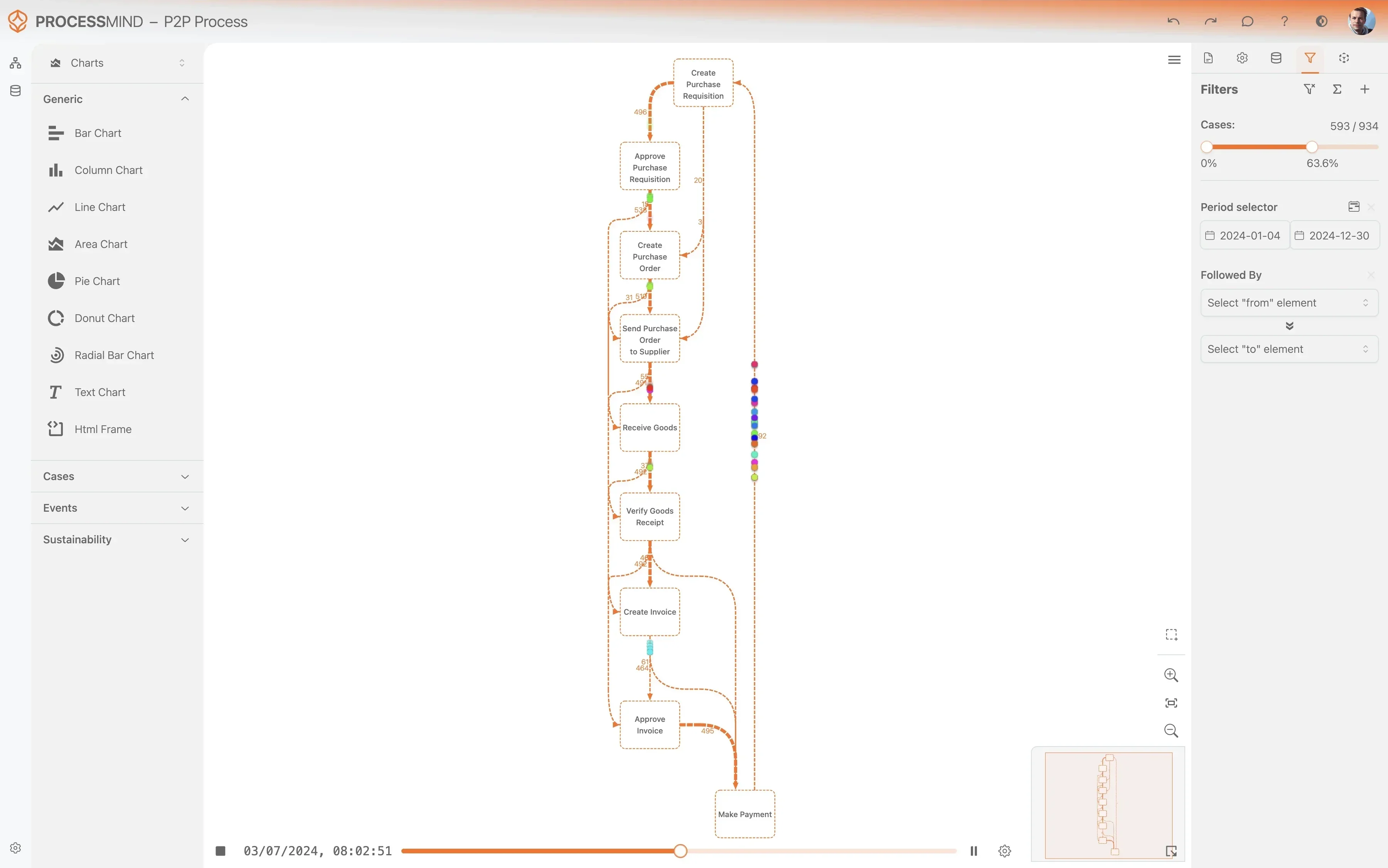
ProcessMind provides a clear visual map of your P2P Requisition process. Discover where delays occur, approvals lag, and compliance gaps exist within your SAP ECC environment.
  • Visualize end-to-end requisition flow
  • Pinpoint approval bottlenecks and delays
  • Identify policy non-compliance instantly
  • Optimize lead times and reduce costs
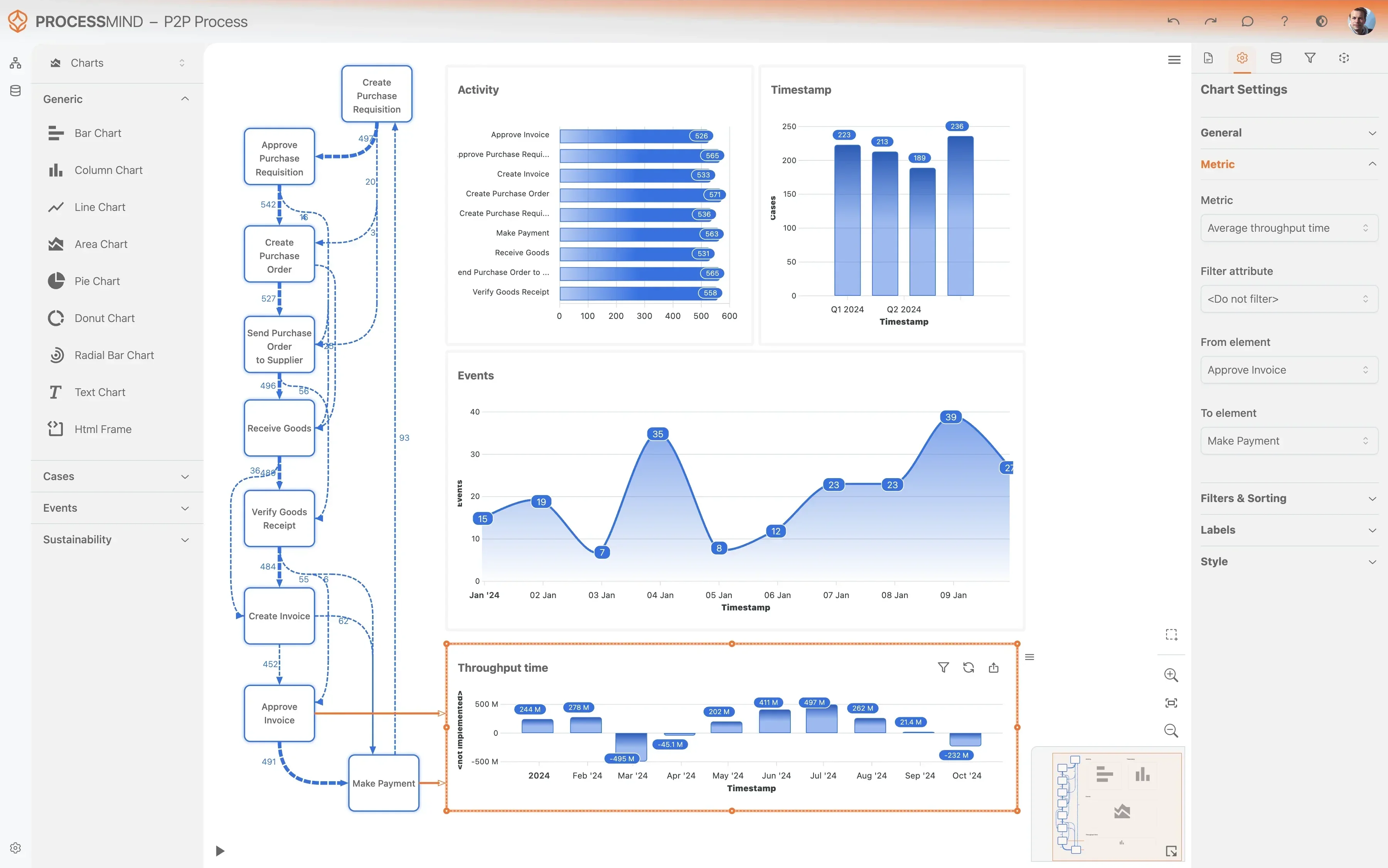
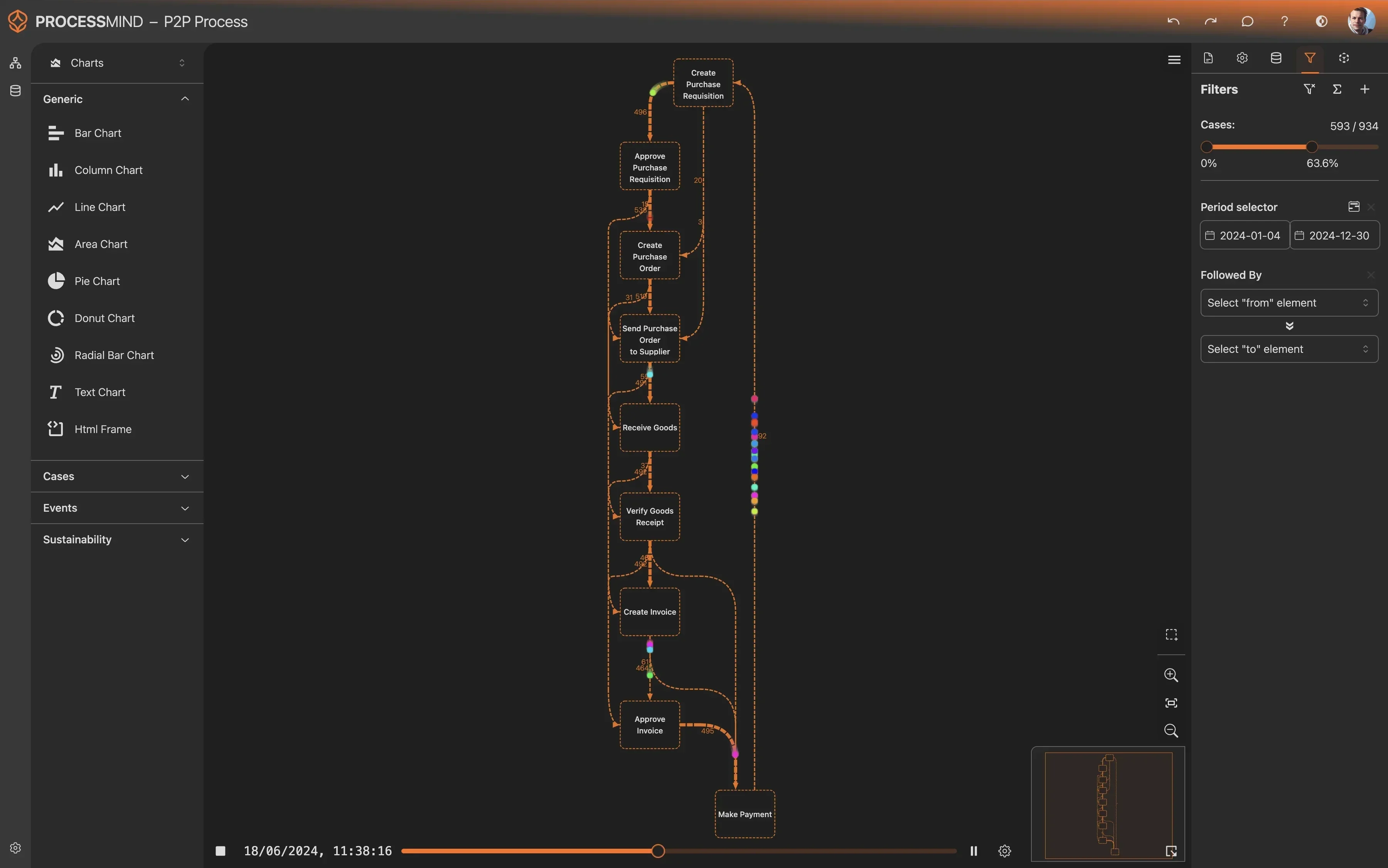
Discover your actual process flow
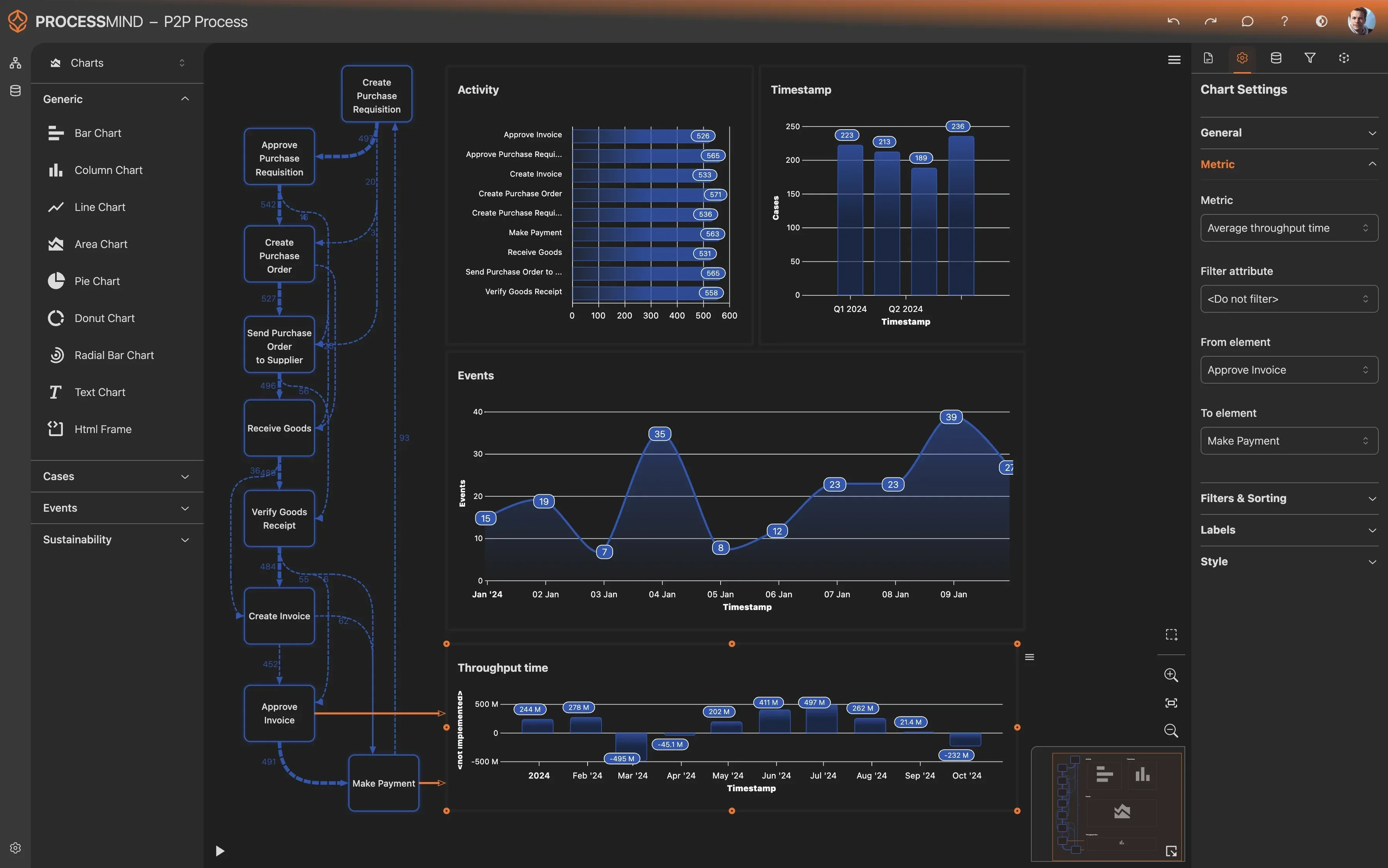
Identify bottlenecks and delays
Analyze process variants
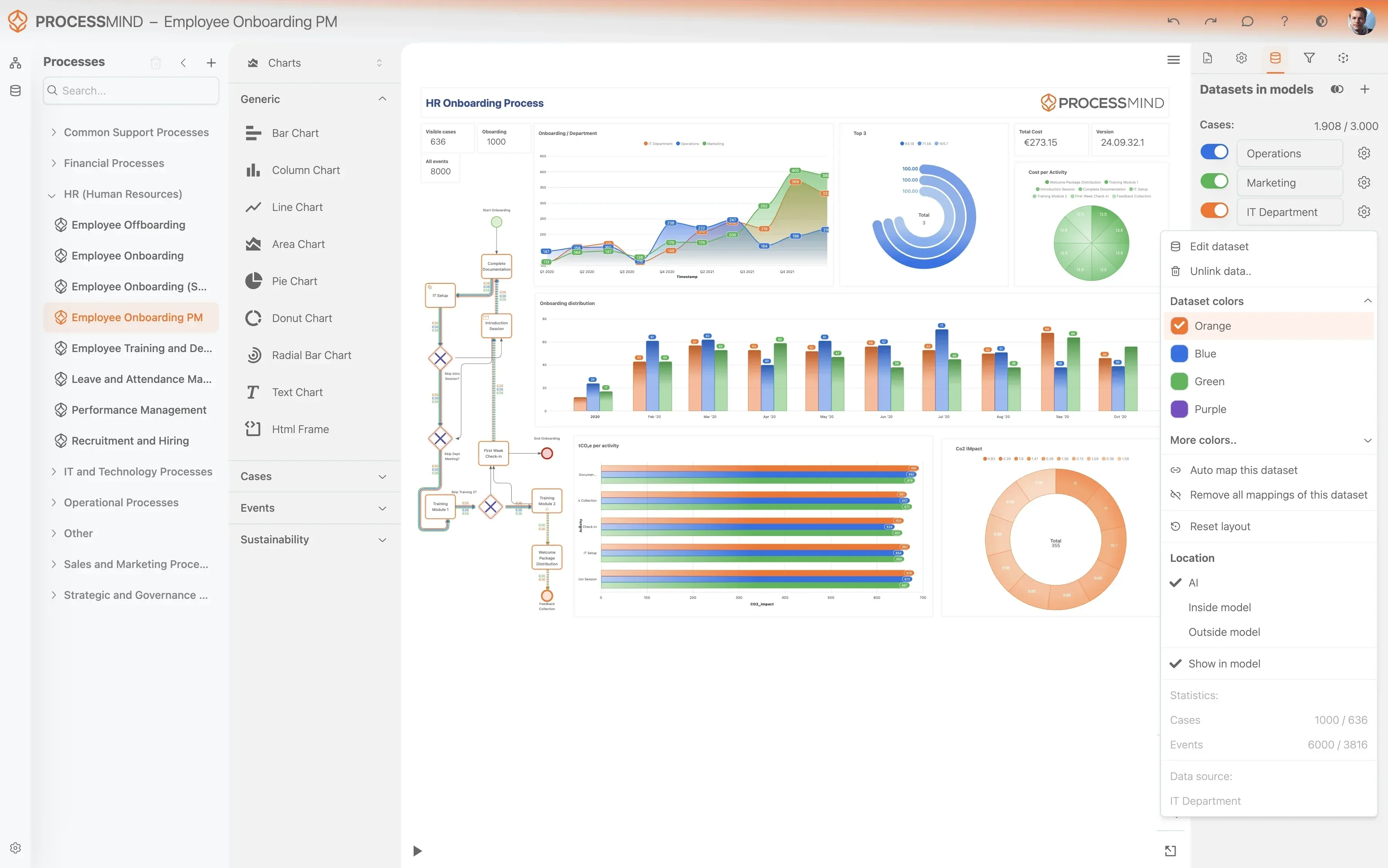
Design your optimized process

TYPICAL OUTCOMES

Measurable Impact on Purchase Requisition Efficiency

Our process mining solution helps organizations identify and eliminate bottlenecks in their Purchase to Pay - Requisition process, leading to significant improvements in cycle times, compliance, and cost efficiency. By analyzing SAP ECC data at the Purchase Requisition ID level, we uncover hidden inefficiencies and provide actionable insights.

0 %
Faster Approval Cycles

Average reduction in requisition approval time

By identifying and eliminating bottlenecks, organizations significantly reduce the time it takes for a requisition to get approved. This improves efficiency and speeds up the entire procurement process.

0 %
Reduced Rework Rates

Decrease in requisition amendments

Pinpointing the root causes of requisition amendments, such as data quality issues or unclear requirements, allows for process improvements that minimize rework and associated costs.

0 %
Enhanced Compliance

Improvement in approval workflow conformance

Process mining reveals deviations from standard approval policies, enabling organizations to enforce compliance, reduce audit risks, and ensure adherence to internal controls.

~ 0 days
Quicker PO Generation

Reduced time to Purchase Order creation

Accelerating the transition from an approved requisition to a purchase order improves overall procurement lead times, ensuring goods and services are acquired faster.

0 %
Lower Rejection Rates

Percentage decrease in rejected requisitions

Understanding why requisitions are rejected, such as policy non-compliance or incorrect item requests, allows for targeted interventions to improve submission quality and reduce wasted effort.

Results vary based on process complexity, data quality, and organizational context. These figures represent typical improvements observed across various implementations.

FAQs

Frequently asked questions

Process mining analyzes event logs to visualize the actual flow of your Purchase Requisition process in SAP ECC. It identifies deviations from standard paths, discovers bottlenecks like long approval cycles, and highlights areas for efficiency gains. This allows you to optimize workflows, reduce rework, and ensure compliance.

To accurately map the Purchase Requisition process, you typically need event log data from relevant SAP ECC tables. Key information includes Purchase Requisition ID as the case identifier, activity names, timestamps for each activity, and the user responsible. Additional attributes like requisition type or department can enrich the analysis.

Data extraction from SAP ECC for process mining often involves standard SAP tools, custom reports, or connectors specifically designed for event log retrieval. The goal is to obtain a flat file, usually CSV, containing all relevant process events in a structured format. This ensures that the chronological sequence of activities can be properly reconstructed.

By uncovering inefficiencies, you can expect to reduce requisition approval cycle times and minimize amendment rework. Process mining helps ensure better compliance with approval policies and decreases rejection rates. Ultimately, it leads to a more streamlined and transparent Purchase to Pay Requisition process.

Initial insights can often be gained within a few weeks after successful data extraction and ingestion into a process mining tool. Comprehensive analysis and the identification of actionable improvement areas typically take longer, depending on the complexity of the process and the resources available for investigation. The speed also depends on data quality.

No, process mining goes beyond traditional reporting by reconstructing the actual end-to-end process flow based on event data. While reporting shows "what happened," process mining reveals "how and why it happened" by visualizing process variants and identifying root causes of deviations. It offers a dynamic view of your process, not just static metrics.

While having dedicated experts can accelerate insights, many process mining tools are designed for business analysts with some training. Initial setup and complex analyses might benefit from specialist knowledge, but day-to-day monitoring and basic drill-downs can often be handled by process owners. Training is key for effective utilization.

The primary technical prerequisite is access to your SAP ECC system to extract the necessary event log data. This typically involves secure data transfer mechanisms and sufficient storage for the extracted files. A process mining software platform, either cloud-based or on-premise, is also required for analysis and visualization.

Unlock P2P Requisition Efficiency, Start Your Trial Now

Pinpoint and resolve P2P bottlenecks, reduce cycle time by 30% or more.

Start Your Free Trial

No credit card required, free 14-day access