Improve Your Order to Cash - Sales Order Processing

Optimize Your Order to Cash - Sales Order Processing
ProcessMind helps you uncover hidden inefficiencies and bottlenecks within your Order to Cash process. It analyzes your system's data to identify deviations, rework, and compliance issues. Gain clear insights into where your process can be streamlined, regardless of your source system.
Download our pre-configured data template and address common challenges to reach your efficiency goals. Follow our six-step improvement plan and consult the Data Template Guide to transform your operations.
Show detailed description
Unlock the true potential of your Order to Cash - Sales Order Processing with ProcessMind, gaining unparalleled transparency into every intricate step of your sales order journey, from initial customer inquiry and order creation through to final delivery and invoicing. Our platform meticulously analyzes real process data extracted directly from your operational systems, irrespective of their vendor or complexity. This deep dive reveals the actual, as-is flow of work, often differing significantly from documented processes. You will effortlessly pinpoint critical bottlenecks, such as prolonged credit checks, delayed material availability confirmations, or manual data entry errors that introduce rework. Furthermore, ProcessMind helps identify hidden rework loops, exposing instances where orders bounce between departments, and uncovers deviations from your standard operating procedures, like unauthorized discounts or inconsistent order modifications. This granular visibility empowers you to understand precisely where delays accumulate, why some orders experience significantly longer cycle times than others, and which manual interventions are inadvertently slowing down your entire operation, regardless of your ERP, CRM, or any other source system your organization relies on. Common challenges like inconsistent pricing application, repeated order entry errors, protracted approval cycles, or excessive exception handling become glaringly obvious, paving a clear path for targeted and impactful improvements across your entire sales order workflow.
The benefits of analyzing and optimizing your Sales Order Processing with ProcessMind are extensive, multifaceted, and directly impactful on your organization's performance. You gain the power to make truly data-driven decisions, moving beyond intuition to implement changes that directly translate into significantly faster order fulfillment and measurably improved customer satisfaction. By understanding the precise root causes of inefficiencies, you can proactively eliminate wasteful activities such as redundant checks or unnecessary approval steps, standardize best practices across all your business units, and substantially reduce operational costs associated with manual effort and error correction. Our actionable insights enable much better resource allocation, ensuring your valuable teams are consistently focused on high-value-adding tasks rather than being consumed by chasing exceptions or resolving preventable issues. ProcessMind is expertly designed to integrate seamlessly and non-disruptively with your existing IT infrastructure, providing these profound process insights without requiring costly upgrades or disruptive changes to your current IT landscape or specific system configurations. It's about empowering you to optimize your critical Order to Cash process comprehensively, leveraging your existing data, rather than demanding a complete overhaul of your underlying technology stack.
Embarking on your journey to optimize Order to Cash - Sales Order Processing with ProcessMind is designed to be straightforward and highly accessible. Our platform is built to be welcoming and inclusive of all systems, ensuring you can quickly and effectively connect your valuable process data. Simply leverage our comprehensive and easy-to-use data template, which guides you in extracting relevant event logs from your ERP, CRM, supply chain management system, or any other source system involved in your sales order process. This template simplifies the data collection, ensuring that all necessary information, such as activity names, timestamps, and case identifiers like Sales Order ID, is captured accurately. Once your data is ingested, ProcessMind's intelligent engine automatically generates a dynamic, visual process map of your actual operations, immediately highlighting variations, performance metrics, and key performance indicators like lead times and rework rates. This immediate, data-backed visualization empowers your teams to collaboratively identify precise areas for improvement, simulate potential changes, and implement optimizations that not only drive efficiency but also significantly enhance your bottom line and overall customer experience. Discover the hidden potential within your sales order process today.
The 6-Step Guide to Optimizing Sales Order Processing
Connect & Discover Data
What to do
Extract event log data from your system, ensuring all relevant activities and case identifiers, like the Sales Order ID, are included. Prepare the data for analysis by cleaning and structuring it.
Why it matters
This foundational step provides the raw material for process insights. Accurate data ensures that subsequent analyses reflect the true state of your Order to Cash process.
Expected outcome
A clean, structured event log ready for process mining, containing all relevant sales order activities.
Map Your Process Flow
What to do
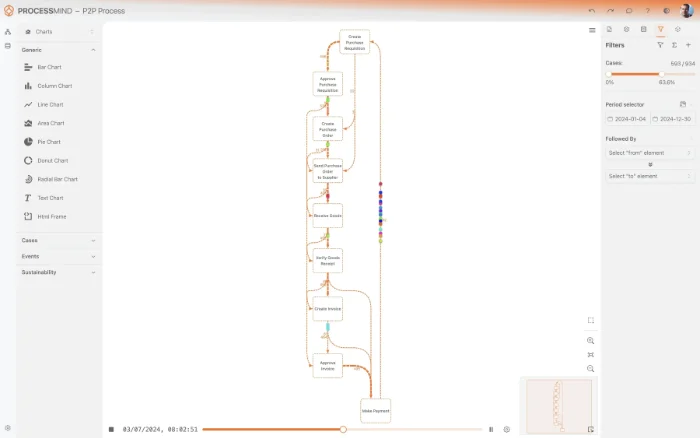
Visualize the actual path sales orders take, from creation to closure. Identify all variants and deviations from the ideal process, understanding how work truly flows.
Why it matters
Seeing the process as it is, not as it's assumed to be, reveals hidden complexities, rework loops, and non-value-adding activities that impact efficiency.
Expected outcome
A comprehensive visual map of your Order to Cash process, showing all major and minor process variants.
Identify Process Bottlenecks
What to do
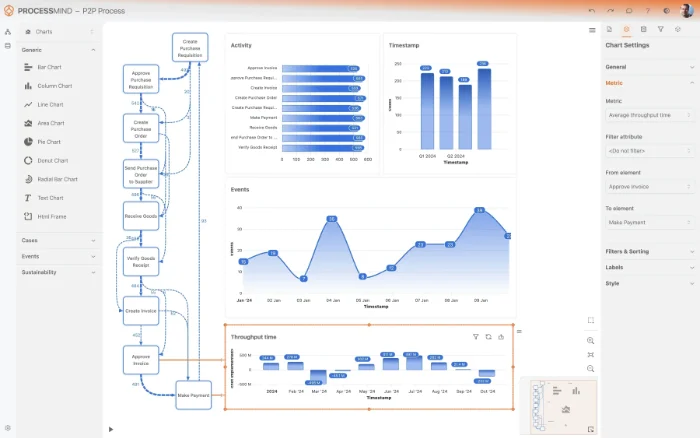
Pinpoint specific activities or transitions within the sales order process where delays frequently occur or where cases accumulate, causing slowdowns.
Why it matters
Locating bottlenecks is crucial for targeted improvement efforts. Addressing these choke points can significantly reduce cycle times and improve overall flow.
Expected outcome
A prioritized list of identified bottlenecks, highlighting their location and impact on the Order to Cash process.
Analyze Root Causes
What to do
Delve deeper into the identified bottlenecks to uncover the underlying reasons for delays, rework, or non-conformance. Use filtering and drill-down techniques on your data.
Why it matters
Understanding the "why" behind process issues prevents superficial fixes. It ensures that solutions address the fundamental problems, leading to lasting improvements.
Expected outcome
A clear understanding of the root causes contributing to each major bottleneck and process deviation.
Design Process Improvements
What to do
Based on your root cause analysis, formulate concrete, actionable strategies to eliminate or mitigate process inefficiencies and deviations identified.
Why it matters
This step translates insights into tangible action plans. Well-designed improvements lead to a more efficient, compliant, and customer-satisfying Order to Cash process.
Expected outcome
A detailed plan of proposed process changes, including expected benefits and implementation steps, targeting key pain points.
Monitor & Iterate
What to do
Implement the designed improvements and continuously track key performance indicators to assess their effectiveness. Be prepared to adjust and refine as needed.
Why it matters
Process improvement is an ongoing journey, not a one-time event. Continuous monitoring ensures sustained gains and allows for agile adaptation to changing business needs.
Expected outcome
Sustained improvement in Order to Cash KPIs, with a feedback loop for ongoing optimization and adaptation of the process.
WHAT YOU WILL GET
Uncover Hidden Insights in Your Order to Cash Process
- Visualize your actual process flow
- Identify bottlenecks and delays
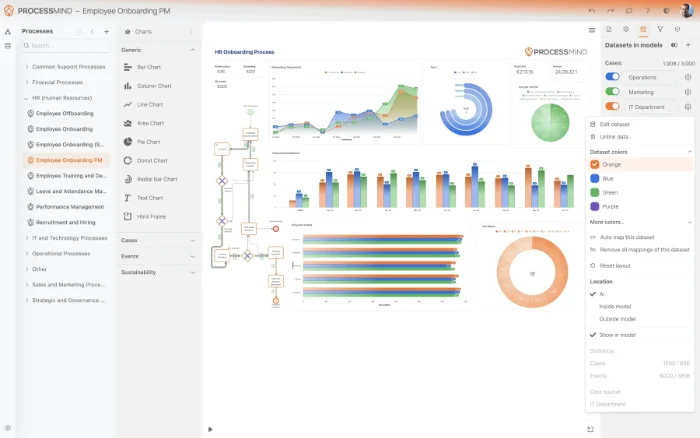
- Reduce manual effort and rework
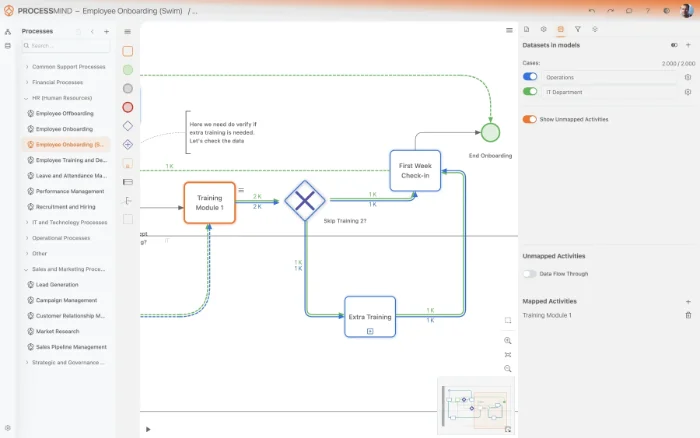
- Enhance customer satisfaction
TYPICAL OUTCOMES
Realizing Value Through Optimized Sales Order Processing
These outcomes represent the measurable improvements organizations commonly achieve by identifying and eliminating inefficiencies within their sales order processing workflows, leading to enhanced operational performance and customer satisfaction.
Average reduction in end-to-end time
By identifying and eliminating process bottlenecks, organizations significantly shorten the time from order placement to cash receipt, improving working capital and operational speed.
Decrease in errors and manual corrections
Process mining uncovers the root causes of rework and manual interventions, leading to a substantial decrease in errors, associated costs, and redundant activities within sales order processing.
Increase in orders delivered on schedule
Pinpointing and resolving bottlenecks in fulfillment and logistics ensures more sales orders are delivered by their promised dates, significantly enhancing customer satisfaction and trust.
Increase in payments received on time
Optimizing the invoice-to-payment process leads to a significant rise in the percentage of payments received by their due date, improving cash flow and reducing collection efforts.
Reduction in unauthorized process variations
Process mining identifies deviations from standard procedures, allowing businesses to enforce consistent execution, reduce operational risks, and improve audit readiness across all sales orders.
Actual results vary depending on process complexity, system landscape, and data quality. The figures presented here illustrate typical improvements observed across various implementations.
Recommended Data
For customized data recommendations, choose your specific process.
FAQs
Frequently asked questions
Process mining analyzes event logs from your operational system to visualize the actual flow of your Order to Cash process. It identifies bottlenecks, rework loops, and deviations from the standard path, revealing where inefficiencies prolong cycle times and impact cash flow. This data-driven insight helps streamline operations and enhance customer satisfaction.
You primarily need event logs containing a case identifier, such as the Sales Order ID, an activity name, and a timestamp for each activity. Additional attributes like sales organization, customer ID, or material can enrich the analysis. This data is typically extracted from tables or objects related to sales orders, invoices, and logistics in your source system.
Initial setup, including data extraction and ingestion into a process mining tool, can often be completed within a few weeks, depending on data complexity and availability. You can typically see the first actionable insights and process visualizations within 4-8 weeks, with deeper analysis providing continuous optimization opportunities thereafter.
The primary technical requirement is access to your operational system's database or an equivalent data export mechanism to extract the necessary event logs. You will need a process mining tool, which can be cloud-based or on-premise, and potentially a data preparation tool. Basic data modeling skills are also beneficial for configuring the event log.
You can expect accelerated order confirmation, optimized inventory allocation, and reduced sales order delivery lead times. Process mining helps eliminate invoice discrepancies, streamline credit hold releases, and enhance real-time order status visibility, leading to improved customer satisfaction and operational efficiency.
Yes, process mining can effectively detect non-compliant process variations by comparing actual execution against predefined ideal or regulatory models. It highlights every deviation, allowing you to identify instances where orders bypass critical steps like credit checks or approvals. This ensures standardized sales process execution and helps maintain compliance.
Process mining visualizes all sales order rework loops and exceptions, identifying their frequency, root causes, and impact on overall cycle time. By pinpointing where rework occurs and the conditions that trigger it, you can develop targeted strategies to minimize these costly deviations. This leads to reduced rework rates and a more streamlined process.
No, process mining goes beyond traditional reporting by reconstructing the actual end-to-end process flow from event data, rather than just showing aggregated metrics. It discovers hidden variations and non-conformances, providing diagnostic insights into why certain problems occur. This allows for data-driven process optimization, not just monitoring.
Process mining is scalable and beneficial for organizations of all sizes, from small teams to large enterprises. While larger organizations may have more complex processes and data, even smaller teams can gain significant insights into their operational efficiency and identify areas for improvement with targeted analysis. The key is having sufficient event data.
No, process mining is a non-invasive analytical technique. It operates on historical data extracted from your operational system, meaning there is no direct impact or change to your live processes. The analysis happens independently, providing insights without interfering with daily transactions.
Start Optimizing Your Sales Order Processing Today
Gain immediate insights, eliminate delays, and boost your cash flow.
No credit card required, set up in minutes.