Improve Your Purchase to Pay - Purchase Order

Optimize Purchase to Pay: Streamline Your PO Process
Our platform helps you uncover hidden inefficiencies and bottlenecks within your Purchase Order process. It visualizes process variations, identifies root causes of delays, and highlights opportunities for automation and compliance improvement. Gain clear insights into where your process can be streamlined and optimized for better performance.
Download our pre-configured data template and address common challenges to reach your efficiency goals. Follow our six-step improvement plan and consult the Data Template Guide to transform your operations.
Show detailed description
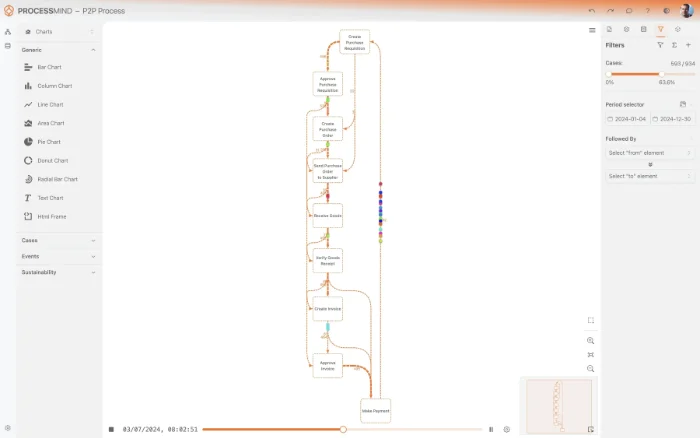
The Purchase to Pay, P2P, process is a foundational pillar of any organization's operations, and its Purchase Order, PO, sub-process is often where efficiency gains or significant inefficiencies take root. While you might have a designed, idealized process flow, the reality on the ground can be vastly different, fraught with manual interventions, workarounds, and hidden complexities. ProcessMind's process mining capabilities offer an unparalleled lens into the true execution of your Purchase Order operations. We reveal the authentic journey each purchase order takes, from initial requisition to final receipt, regardless of your existing ERP or any source system you use. Our platform identifies hidden delays that inflate cycle times, pinpointing bottlenecks in approval workflows or procurement stages. We highlight non-compliant steps, where established policies or contractual agreements are bypassed, potentially leading to increased costs or compliance risks. Furthermore, ProcessMind uncovers rework loops and unnecessary activities, exposing areas where resources are wasted due to errors, incomplete information, or repeated tasks. By illuminating these previously opaque aspects, you gain a clear, data-driven understanding of how your PO process actually functions, providing the foundation for meaningful transformation.
Many organizations grapple with common challenges within their Purchase Order processes, irrespective of the underlying technology. These often include a high degree of manual touchpoints, which introduce errors and slow down processing. Approval workflows can become significant bottlenecks, especially when relying on sequential approvals or when approvers are unavailable, delaying critical purchases. Maverick buying, purchases made outside of approved channels or without proper authorization, can lead to higher prices, reduced supplier leverage, and difficulty tracking expenses. Contract non-compliance, where terms or preferred suppliers are ignored, further erodes cost savings and increases risk. Issues such as duplicate orders, incorrect goods receipts, or discrepancies between purchase orders and invoices are also prevalent, leading to time-consuming reconciliation efforts. These systemic issues not only inflate operational costs and extend cycle times but also contribute to supplier friction, hamper cash flow management, and expose your organization to unnecessary financial and regulatory risks. Understanding these universal pain points is the first step towards rectifying them and creating a more robust, efficient procurement environment.
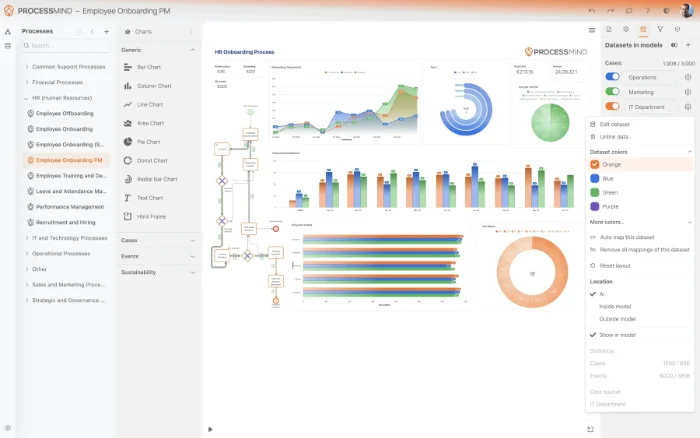
Analyzing your Purchase Order process with ProcessMind delivers a multitude of tangible benefits, empowering your organization to achieve operational excellence. Firstly, you gain significantly enhanced efficiency by identifying and eliminating process steps that add no value. This leads to streamlined operations, reduced PO cycle times, and the potential for greater automation in routine tasks, freeing up your team to focus on strategic procurement activities. Secondly, ProcessMind drives substantial cost-effectiveness. By uncovering maverick buying, optimizing payment terms, and ensuring adherence to negotiated contracts, you can realize significant savings. Eliminating rework and improving first-time right processing also directly reduces operational expenditure. Thirdly, our platform fortifies your compliance posture. By visually mapping every deviation from your standard operating procedures, you can enforce policies more effectively, mitigate risks, and ensure regulatory adherence. The transparency provided by ProcessMind allows for data-driven decisions, enabling you to standardize best practices across departments, continuously improve your processes, and foster a culture of efficiency and accountability within your procurement function.
Embarking on your journey to optimize your Purchase Order process with ProcessMind is designed to be straightforward and accessible. Our platform seamlessly ingests data from your existing systems, whether it is your primary ERP, a specialized procurement system, or any other source that generates event logs for your PO process. There is no need for complex integrations or disruptive changes to your current IT landscape. To facilitate this initial step and ensure you can quickly uncover valuable insights, we provide a comprehensive data template. This template guides you through the necessary data points, helping you prepare and submit the information required to build a detailed, interactive map of your Purchase Order process. By leveraging this template, you can rapidly transform raw data into actionable intelligence, revealing opportunities for improvement within days. Start today and unlock the full potential of your P2P operations, transforming challenges into strategic advantages and driving measurable value for your organization.
The 6-Step Guide to Optimizing Your Purchase Order Process
Connect & Discover Data
What to do
Connect to your data sources and import event logs from your ERP or other systems. Ensure data quality and completeness for accurate analysis.
Why it matters
Accurate and comprehensive data is the foundation for revealing the true state of your Purchase Order process and identifying improvement opportunities.
Expected outcome
Clean, structured event data ready for process analysis.
Map Your Process
What to do
Visualize the end-to-end Purchase Order process flow based on your event data, identifying common paths and variations.
Why it matters
A clear visual map reveals how your process truly operates, highlighting deviations from documented procedures and standard paths.
Expected outcome
A comprehensive, data-driven visual representation of your Purchase Order process.
Identify Bottlenecks
What to do
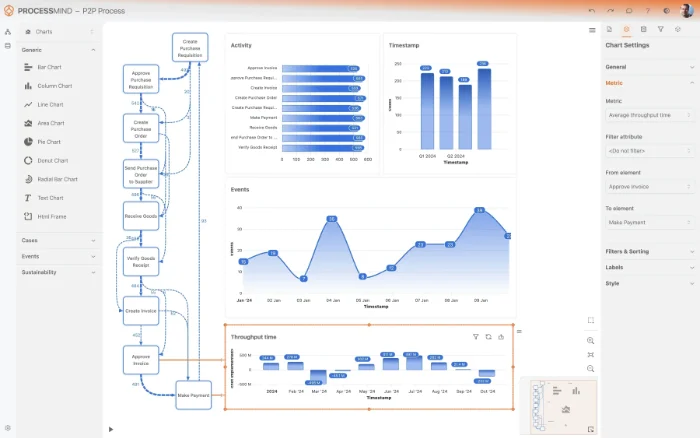
Use process mining to pinpoint specific delays, reworks, and compliance issues within the Purchase Order flow, quantifying their impact.
Why it matters
Identifying precise problem areas allows for targeted interventions to reduce cycle times, decrease costs, and improve efficiency.
Expected outcome
A clear understanding of critical delay points and process inefficiencies.
Analyze Root Causes
What to do
Drill down into identified bottlenecks to determine the underlying reasons for delays or deviations, such as manual steps or approval loops.
Why it matters
Understanding 'why' issues occur is crucial for developing effective, lasting solutions rather than simply treating the symptoms.
Expected outcome
Detailed insights into the causes of your process inefficiencies and deviations.
Design Improvements
What to do
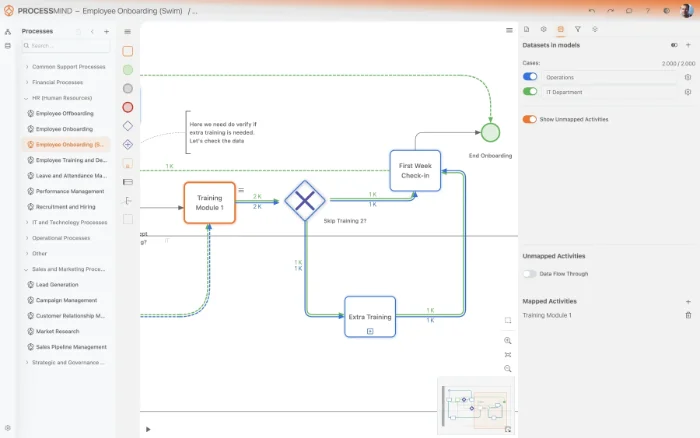
Brainstorm and plan process changes based on your root cause analysis, such as automating approvals or standardizing requisition processes.
Why it matters
Well-designed improvements directly address identified problems, leading to tangible efficiency gains, cost reductions, and better compliance.
Expected outcome
A structured plan for implementing targeted Purchase Order process optimizations.
Monitor & Iterate
What to do
Continuously track key performance indicators after implementing changes and make further adjustments as needed for ongoing optimization.
Why it matters
Continuous monitoring ensures that improvements are sustained, allows for quick adaptation to new challenges, and drives a culture of excellence.
Expected outcome
Sustained process performance and a framework for continuous improvement.
WHAT YOU WILL GET
Uncover Hidden Insights in Your Business Processes
- Visualize your actual process flow
- Identify bottlenecks and delays
- Eliminate rework and manual effort
- Optimize resource allocation
TYPICAL OUTCOMES
Unlocking Efficiency and Savings in Purchase Orders
These outcomes represent the measurable improvements and efficiencies organizations typically achieve by applying process mining to analyze and optimize their Purchase Order processes, identifying bottlenecks, compliance issues, and opportunities for automation.
Average reduction in approval time
By pinpointing bottlenecks and inefficiencies in approval workflows, organizations can significantly cut down the time it takes to get purchase orders authorized. This accelerates procurement and ensures timely order placement.
Decrease in post-creation changes
Identifying the root causes of purchase order modifications after initial creation or approval minimizes manual rework, improves data accuracy, and reduces administrative overhead. This leads to greater efficiency.
Higher adherence to policies
Process mining uncovers deviations from established purchasing procedures, allowing businesses to enforce compliance policies more effectively and reduce non-conforming purchase orders. This minimizes risks and improves audit readiness.
Overall process acceleration
Streamlining the entire purchase order lifecycle, from initial requisition to final completion, eliminates hidden delays and inefficient handoffs. This boosts overall operational speed and agility.
Better supplier performance
Gain clear insights into supplier performance variances to ensure goods are received by or before requested delivery dates. This enhances planning, reduces stock-out risks, and strengthens supplier relationships.
Accelerated processing of incoming goods
By analyzing the goods receipt process, organizations can identify and eliminate delays, accelerating the availability of goods, improving inventory management, and speeding up payment cycles. This optimizes cash flow.
Results, of course, vary based on the specific process complexity, data quality, and organizational context. The figures presented here represent typical improvements observed across various implementations.
Recommended Data
For customized data recommendations, choose your specific process.
FAQs
Frequently asked questions
Process mining provides a data-driven X-ray of your actual Purchase Order flow, identifying bottlenecks, non-compliant activities, and inefficiencies like lengthy approval cycle times. It reveals where the process deviates from the ideal path, highlighting areas for optimization and automation. This helps visualize the actual process flow and pinpoint areas for efficiency improvements and cost reduction within your Purchase Order operations.
For each purchase order, we need a unique case identifier, an activity name, and a timestamp for each event that occurred. This data is typically extracted from tables recording Purchase Order creation, approval, modification, goods receipt, and finalization events within your procurement system. Additional attributes like requester, approver, value, and item details can enhance the analysis.
Data is typically extracted from your system's reporting functionalities, API capabilities, or by exporting data into structured formats like CSV. The specific approach depends on your system's configuration and the volume of data. Our experts can guide you in setting up efficient, secure extraction methods to ensure data completeness.
You can expect tangible improvements such as significantly reduced Purchase Order approval and overall cycle times, and enhanced adherence to compliance regulations. This leads to a noticeable decrease in Purchase Order amendment rates, more streamlined requisition-to-PO conversions, and greater opportunities for task automation. Ultimately, process mining leads to a more efficient, compliant, and transparent Purchase to Pay process.
The initial setup, including data extraction and model configuration, typically takes a few weeks, depending on data availability and complexity. Once configured, you can often see initial insights and identify major bottlenecks within days. Continuous monitoring then provides ongoing performance and compliance visibility.
Yes, process mining excels at identifying the underlying root causes, not just the symptoms, of Purchase Order bottlenecks. By correlating process deviations with specific attributes, it can pinpoint why certain steps take longer. This granular insight allows for targeted interventions that resolve the core issues, leading to lasting process improvements.
Absolutely, process mining is highly effective at identifying unapproved purchases and deviations from established procurement policies. By visualizing actual process execution, it highlights instances where controls are bypassed, enabling you to pinpoint the root causes. This insight is critical for reinforcing compliance and reducing non-compliant spend incidents.
The primary technical requirement is secure access to your source system's data, typically through its native reporting features or APIs, to export the necessary event log. No direct integration or complex system changes within your live system are usually needed for the analysis phase. Data needs to be provided in a structured format, such as CSV or database tables.
Process mining complements, rather than replaces, traditional reporting and BI tools. While BI typically shows "what happened," often in aggregate summaries, process mining visualizes "how and why it happened" by mapping the actual end-to-end flow of each purchase order. This uncovers hidden variations and deviations, providing deeper, process-centric views for targeted improvements.
While some initial IT support for data extraction is beneficial, modern process mining tools are designed for business users. They feature intuitive interfaces that allow your procurement and process teams to analyze insights without extensive data science backgrounds. Training and support are typically provided to ensure your team's success.
Optimize Your Purchase Order Process, Get Started Today
Works with any system, identify bottlenecks, and accelerate PO cycles.
No credit card required. Setup in 5 minutes.