Improve Your Purchase to Pay - Purchase Order

Optimize Your Purchase Order Process in SAP ECC for Efficiency
Our platform helps you uncover bottlenecks and inefficiencies within your Purchase to Pay process. Pinpoint areas where delays occur, where manual efforts lead to errors, and where resources are not optimally utilized. This allows you to streamline operations, reduce errors, and ensure timely procurement.
Download our pre-configured data template and address common challenges to reach your efficiency goals. Follow our six-step improvement plan and consult the Data Template Guide to transform your operations.
Show detailed description
Why Optimizing Your Purchase to Pay - Purchase Order Process Matters
The Purchase to Pay, P2P, process, particularly the Purchase Order, PO, segment within SAP ECC, is a critical backbone for any organization. An inefficient P2P - Purchase Order process can quietly erode profitability, delay critical operations, and strain supplier relationships. Imagine the ripple effect of a single delayed purchase order: production schedules are pushed back, inventory levels become unbalanced, and urgent needs go unfulfilled. Within the complexities of SAP ECC, identifying these hidden inefficiencies without clear visibility can feel like searching for a needle in a haystack. The cost of inefficiency is not just financial, it also impacts compliance, increases risk, and diminishes your organization's agility. Understanding the complete lifecycle of each Purchase Order, from initial requisition to goods receipt, is fundamental to ensuring smooth operations and strategic resource allocation. Without optimization, you risk extended cycle times, unnecessary manual interventions, and a lack of transparency that can hinder effective decision-making.
How Process Mining Unlocks P2P - Purchase Order Efficiency
Process mining offers a revolutionary approach to understanding and improving your Purchase to Pay - Purchase Order process in SAP ECC. Instead of relying on assumptions or anecdotal evidence, process mining uses the actual event data from your SAP ECC system to reconstruct the precise journey of every Purchase Order. This data-driven approach allows you to visualize the real process flow, identify all variants, and pinpoint exact bottlenecks, regardless of how deeply they are buried within your system. For instance, you can discover why some Purchase Orders take significantly longer to approve, or why goods receipts for certain vendors consistently face delays. Process mining goes beyond simple reporting, it allows you to see where your process deviates from the ideal, uncover the root causes of these deviations, and understand their impact on cycle time and costs. By transforming raw SAP ECC data into actionable insights, process mining shows you precisely how to improve Purchase to Pay - Purchase Order performance, offering an unprecedented level of transparency into your procurement operations.
Key Improvement Areas Identified Through Process Mining
Applying process mining to your Purchase to Pay - Purchase Order flow reveals several crucial areas for improvement. Firstly, it excels at identifying and reducing purchase order cycle time. You can pinpoint specific stages, such as approval queues or goods receipt processing, where orders consistently get delayed, allowing you to streamline those steps. Secondly, it enhances compliance by highlighting unauthorized process deviations, such as Purchase Orders being changed after approval without proper re-authorization or unusual payment terms being applied. This ensures adherence to internal policies and external regulations. Thirdly, process mining helps in optimizing resource allocation by revealing where manual efforts are disproportionately high or where automation opportunities exist. For example, it can identify repetitive tasks suitable for robotic process automation, RPA. Finally, it provides insights into supplier performance, enabling you to identify vendors with consistent lead time issues or quality control problems, fostering better strategic sourcing decisions. These detailed insights are crucial for any organization looking to reduce Purchase to Pay - Purchase Order cycle time and improve overall operational efficiency within their SAP ECC environment.
Expected Outcomes: Measurable Benefits for Your Organization
By leveraging process mining to optimize your Purchase to Pay - Purchase Order process, you can expect a range of tangible, measurable benefits. You will achieve significant reductions in Purchase Order cycle time, leading to faster fulfillment of requisitions and improved operational responsiveness. This directly translates into cost savings by minimizing expedited shipping fees, reducing inventory holding costs, and optimizing working capital. Improved process compliance minimizes financial risks and strengthens your organization's audit posture. Furthermore, enhanced transparency allows for better negotiation with suppliers and improved supplier relationships due to more predictable and efficient interactions. Ultimately, these improvements lead to more efficient procurement operations, better resource utilization, and an enhanced ability to meet organizational demands proactively. You gain the power to make data-backed decisions that drive continuous improvement in your SAP ECC P2P environment, moving from reactive problem-solving to proactive process optimization.
Getting Started with Your P2P - Purchase Order Optimization Journey
Embarking on your Purchase to Pay - Purchase Order process optimization journey in SAP ECC with process mining is more accessible than ever. This approach demystifies complex process flows, providing clear, actionable insights that empower your team to drive meaningful change. You do not need to be a technical expert to understand the visual representations and data-driven recommendations that process mining provides. By leveraging these powerful tools, you can transform your procurement process from a potential bottleneck into a strategic asset. Start uncovering the hidden potential within your SAP ECC Purchase Order data today and pave the way for a more efficient, compliant, and cost-effective procurement future.
The 6-Step Improvement Path for Purchase to Pay - Purchase Order
Download Process Template
What to do
Obtain the pre-structured Excel template designed for Purchase to Pay Purchase Order processes, ensuring compatibility with SAP ECC data fields.
Why it matters
This step ensures you collect all necessary data elements in the correct format, laying a robust foundation for accurate process analysis and insights.
Expected outcome
A standardized Excel template ready for populating with your SAP ECC Purchase Order data.
Export P2P PO Data
What to do
Extract 3-6 months of historical Purchase Order data from your SAP ECC system, including relevant tables like EKKO, EKPO, EKBE, and BKPF. Populate the downloaded template.
Why it matters
Utilizing a substantial historical dataset allows for comprehensive identification of recurring patterns, inefficiencies, and compliance deviations within your procurement process.
Expected outcome
A complete, anonymized dataset reflecting your Purchase Order process, formatted according to the template.
Upload Your Dataset
What to do
Securely upload your populated Purchase Order dataset to ProcessMind. The system will automatically ingest and prepare your data for analysis.
Why it matters
Effortlessly transform raw SAP ECC data into an analyzable format, enabling rapid visualization and discovery without manual data manipulation.
Expected outcome
Your Purchase Order data successfully uploaded and undergoing automatic preparation within ProcessMind.
Analyze Process Performance
What to do
Explore auto-generated dashboards and interactive process maps highlighting your Purchase Order flows, bottlenecks, and deviations. Review AI-driven recommendations.
Why it matters
Gain deep insights into your P2P PO execution, identify root causes of delays or non-compliance, and uncover hidden inefficiencies impacting cost and delivery times.
Expected outcome
A clear understanding of your Purchase Order process's actual performance and actionable insights for improvement.
Implement Actionable Insights
What to do
Prioritize and implement the identified optimization opportunities, such as streamlining approval workflows in SAP ECC or standardizing vendor communication practices.
Why it matters
Translating insights into action directly addresses process pain points, leading to measurable improvements in efficiency, compliance, and cost savings across your P2P PO operations.
Expected outcome
Tangible changes in your Purchase Order process, aimed at resolving bottlenecks and enhancing operational effectiveness.
Monitor Process Progress
What to do
Periodically re-export and re-upload updated Purchase Order data from SAP ECC to ProcessMind to track the impact of your implemented improvements.
Why it matters
Continuous monitoring ensures sustained process health, allows for timely adjustments, and verifies that improvements deliver expected KPI enhancements over time.
Expected outcome
A clear view of KPI improvements, confirming the positive impact of your changes and supporting ongoing optimization efforts.
WHAT YOU WILL GET
Unlock Key Insights in Your Purchase Order Process
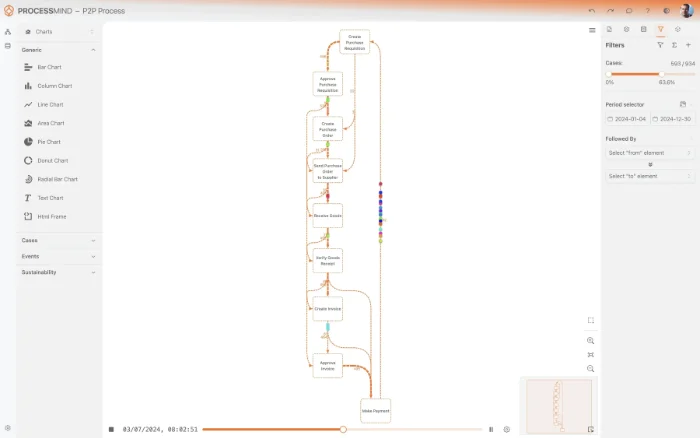
- Visualize your actual Purchase Order flow
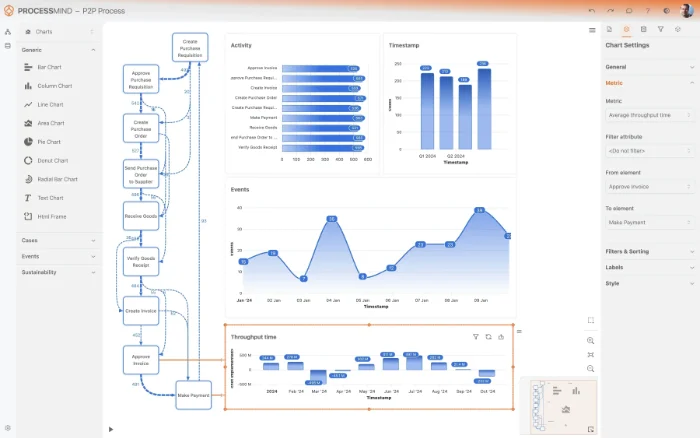
- Identify bottlenecks and delays in P2P
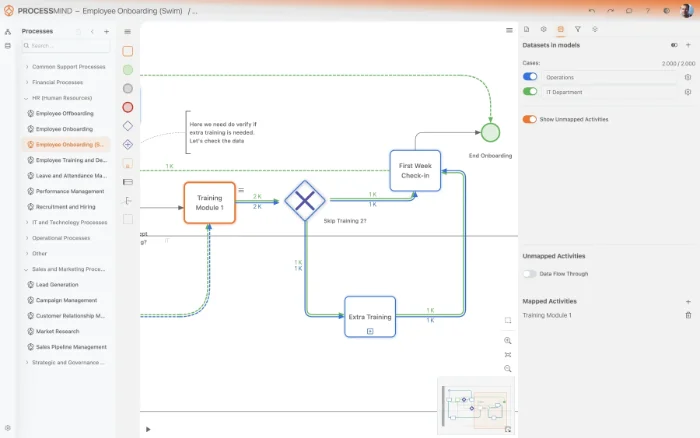
- Pinpoint compliance gaps in SAP ECC
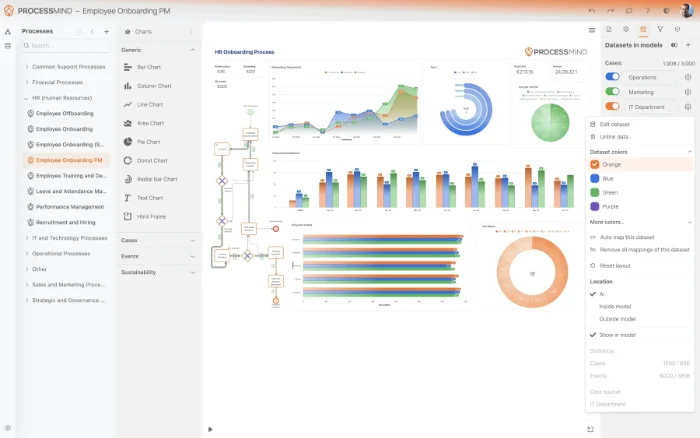
- Optimize order processing for faster cycles
TYPICAL OUTCOMES
Realizing Value in Purchase Order Management
These outcomes illustrate the significant operational and financial improvements organizations typically achieve by optimizing their Purchase Order processes. Through data-driven insights from process mining, inefficiencies are identified and eliminated, leading to measurable gains.
Accelerate approval workflows
Streamlining approval paths with process mining reduces the time it takes for purchase orders to get approved, preventing delays in procurement.
Minimize rework and errors
By identifying root causes of changes after approval, organizations significantly decrease costly rework and ensure higher data quality in purchase orders.
Ensure adherence to policies
Process mining uncovers non-compliant purchase order creation, such as missing prerequisite steps, allowing for better enforcement of procurement policies and reducing audit risks.
Overall procurement acceleration
Analyzing the complete Purchase-to-Pay process reveals and eliminates bottlenecks, leading to a faster overall completion time for purchase orders from requisition to completion.
Reduce process variability
Process mining identifies and eliminates inconsistencies in processing steps, leading to more predictable and uniform cycle times across all purchase orders.
Results vary based on process complexity and data quality. These figures represent typical improvements observed across implementations.
Recommended Data
FAQs
Frequently asked questions
Process mining analyzes actual execution data from SAP ECC to visualize the complete P2P - PO flow. It identifies bottlenecks, compliance deviations, and inefficiencies, such as slow approvals or frequent post-approval changes. This allows you to pinpoint root causes and target specific areas for optimization.
You typically need event logs from your SAP ECC system, including transaction data related to purchase requisitions, purchase orders, goods receipts, and invoices. Key fields include PO number, activity name, timestamp, and user ID. This data helps reconstruct the exact sequence of events.
No, process mining is a non-invasive analytical technique. It operates on historical data extracted from your SAP ECC system, meaning there is no direct impact or disruption to your live operational processes. The analysis happens entirely outside your production environment.
You can expect tangible improvements such as reduced purchase order approval cycle times, minimized post-approval changes, and enhanced compliance adherence. The insights gained help standardize processing, accelerate procurement workflows, and optimize vendor performance.
Extracting data from SAP ECC for process mining is generally straightforward with standard tools or custom ABAP reports. We can provide templates and guidance to help identify the relevant tables and fields, ensuring you capture all necessary event information efficiently.
Initial insights can often be generated within a few weeks, once data extraction and initial modeling are complete. The speed depends on data availability and complexity. Deeper analysis and actionable recommendations typically follow within one to two months.
Beyond data extraction capabilities, the primary technical requirement is access to a process mining platform. No modifications to your SAP ECC system are needed. The platform handles data ingestion, modeling, and visualization, requiring minimal internal IT overhead.
Process mining complements, rather than replaces, traditional reporting and BI tools. While BI shows "what happened," process mining explains "how and why it happened" by focusing on the actual sequence of events and process flows. It offers deeper diagnostic insights into process execution.
Optimize P2P Purchase Order: Start Your Free Trial Today
Eliminate bottlenecks and reduce cycle time by 30% or more.
No credit card needed, get started in minutes