Improve Your Incident Management

Optimize Incident Management in Jira Service Management for Faster Resolution
Effectively managing incidents requires understanding where delays and inefficiencies occur. Our analytics help you precisely identify bottlenecks, understand rework patterns, and ensure better SLA adherence. This allows you to streamline your entire process, leading to faster resolution and improved satisfaction.
Download our pre-configured data template and address common challenges to reach your efficiency goals. Follow our six-step improvement plan and consult the Data Template Guide to transform your operations.
Show detailed description
Why Optimizing Incident Management is Critical
Effective incident management is the backbone of reliable IT services, directly impacting user satisfaction, operational continuity, and your organization's bottom line. In today's fast-paced environment, the ability to rapidly identify, resolve, and prevent incidents is paramount. Yet, many organizations struggle with hidden inefficiencies and bottlenecks within their incident management processes, even when utilizing robust systems like Jira Service Management. These inefficiencies can lead to extended downtime, missed service level agreement, SLA, targets, frustrated users, and ultimately, increased operational costs. Understanding the true flow of incidents, beyond theoretical process maps, is essential for making data-driven improvements that genuinely accelerate resolution times and enhance service delivery. Unseen reworks, unnecessary handovers, and overlooked delays can silently erode efficiency, making a compelling case for a deeper analytical approach to Incident Management.
Unlocking Deeper Insights with Process Mining for Jira Service Management
Process mining offers a powerful lens to view and understand the actual execution of your incident management process within Jira Service Management. Unlike traditional reporting or dashboard views, process mining reconstructs the complete journey of every incident, from its initial report to final closure, based on event logs. This capability allows you to visualize the real process flow, identify deviations from the intended path, and expose exactly where delays occur. You can pinpoint specific activities or transition points that consistently cause bottlenecks, whether it is prolonged investigation phases, repeated assignments between support groups, or delays in user confirmation. By providing an objective, data-driven X-ray of your incident handling, process mining helps you move beyond assumptions and focus your improvement efforts where they will have the most significant impact on how to improve Incident Management.
Pinpointing Key Improvement Areas in Incident Resolution
Applying process mining to your Jira Service Management incident data reveals specific areas ripe for optimization. You can analyze the cycle time for different incident types, severity levels, or affected services, uncovering which incidents take the longest to resolve and why. For example, you might discover that incidents requiring transfer to a specialized team frequently experience significant idle time, or that the diagnosis phase for high-priority incidents is consistently longer than expected. Process mining also highlights rework loops, where incidents are repeatedly reopened or reassigned, indicating potential issues with initial diagnosis, resolution quality, or user communication. By understanding these patterns, you can address root causes such as inadequate agent training, unclear escalation paths, or inefficient communication protocols, all contributing to reducing your overall Incident Management cycle time.
Realizing Tangible Outcomes and Continuous Optimization
By leveraging process mining for Jira Service Management incident analysis, your organization can achieve measurable improvements. Expect to see a substantial reduction in average incident resolution times, leading to decreased downtime for critical services and enhanced user satisfaction. Improved understanding of process adherence will help you meet or even exceed your SLA targets consistently. Furthermore, by identifying and eliminating bottlenecks and reworks, you can optimize resource allocation, reducing operational costs and allowing your support teams to focus on more strategic initiatives. This continuous process optimization approach fosters a culture of efficiency and proactive problem-solving, ensuring your incident management capabilities evolve to meet future demands and continually improve service delivery. It provides the necessary insights to refine workflows and deliver better, faster service.
Getting Started with Your Incident Management Improvement Journey
Embarking on this optimization journey is straightforward. With the right tools and a clear understanding of your incident data from Jira Service Management, you can quickly begin to uncover the hidden truths within your processes. This detailed analysis empowers you to make informed decisions that transform your incident management capabilities, leading to more resilient services and happier users. Start exploring your incident data with process mining today to unlock its full potential for efficiency and effectiveness. It's an accessible path to truly understanding and improving Incident Management performance.
The 6-Step Improvement Path for Incident Management
Download the Template
What to do
Obtain the pre-structured Excel template designed for Incident Management data. This template ensures you capture all necessary information for accurate analysis.
Why it matters
Using the right data structure from the start prevents rework and ensures a smooth, effective analysis of your incident management process.
Expected outcome
A ready-to-use data template, perfectly aligned with Incident Management in Jira Service Management.
Export Your Data
What to do
Extract 3-6 months of historical incident data from Jira Service Management. Populate the downloaded template with your real-world incident records.
Why it matters
Comprehensive historical data provides a realistic view of past performance, crucial for identifying recurring issues and areas for improvement.
Expected outcome
A populated Excel template containing your incident management history, ready for upload.
Upload Your Dataset
What to do
Upload your completed incident management data template to the ProcessMind platform. The system will then automatically begin its analysis.
Why it matters
Securely uploading your data initiates the powerful process mining analysis, transforming raw data into actionable insights without manual effort.
Expected outcome
Your Incident Management data securely processed and ready for in-depth analysis on the platform.
Analyze Your Process
What to do
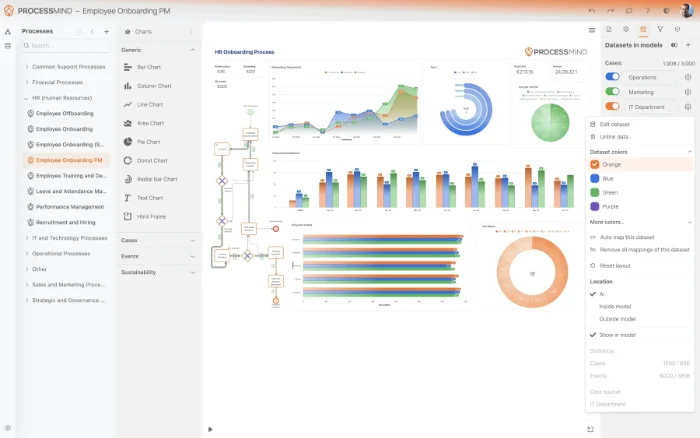
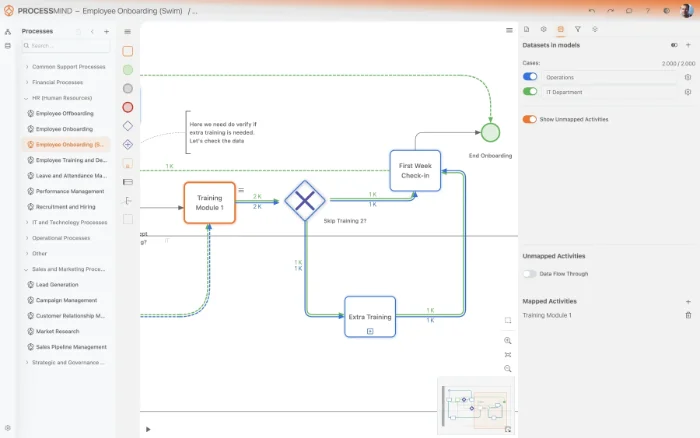
Explore the auto-generated dashboards and visual process maps for your Incident Management. Review AI-driven recommendations for bottlenecks and deviations.
Why it matters
Uncover hidden inefficiencies and compliance gaps in your incident handling. Gain clarity on actual process flows versus intended ones.
Expected outcome
Clear understanding of process bottlenecks, root causes, and AI-powered recommendations for optimizing incident resolution.
Implement Improvements
What to do
Prioritize the identified improvement opportunities, such as streamlining steps in Jira Service Management workflows or reallocating resources. Take action based on the insights.
Why it matters
Translating insights into action directly leads to faster incident resolution, reduced downtime, and improved service quality for users.
Expected outcome
Concrete changes implemented within your Jira Service Management workflows to enhance efficiency and effectiveness.
Monitor Your Process
What to do
Periodically re-upload updated incident data to track the impact of your implemented changes. Continuously measure key performance indicators over time.
Why it matters
Sustained monitoring ensures improvements hold, identifies new areas for optimization, and demonstrates the ongoing value of process excellence.
Expected outcome
Quantifiable proof of improved incident resolution times, SLA adherence, and overall process efficiency.
WHAT YOU WILL GET
Uncover Key Incident Management Bottlenecks Now
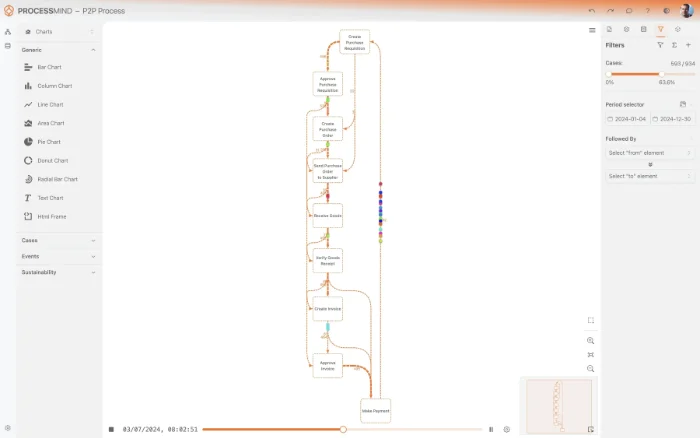
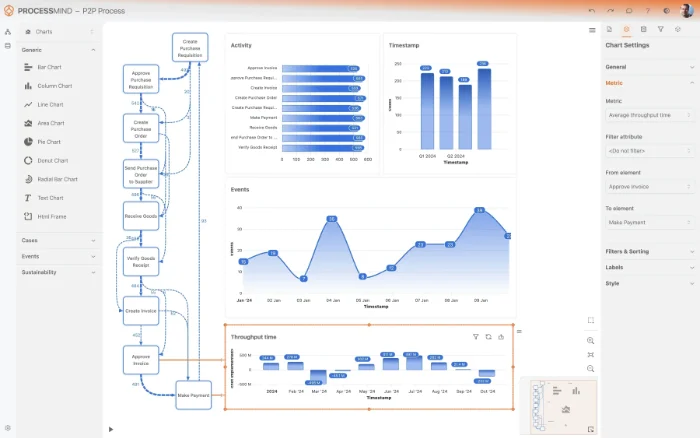
- Visualize true incident resolution journeys
- Pinpoint hidden delays and workflow bottlenecks
- Monitor SLA adherence and prevent breaches
- Streamline your incident management process
TYPICAL OUTCOMES
Real-World Impact on Incident Resolution
These outcomes represent significant improvements in incident resolution efficiency and effectiveness, achieved by applying process mining to identify bottlenecks and optimize workflows within your Jira Service Management system.
Average reduction in end-to-end time
Process mining helps identify and eliminate bottlenecks, leading to a significant decrease in the overall time it takes to resolve incidents, improving service delivery.
Decrease in incidents missing targets
By identifying root causes of delays and non-compliance, organizations can proactively address issues, ensuring more incidents meet their service level agreement targets.
Streamlined process flow efficiency
Unnecessary transfers and repeated work steps are pinpointed and removed, leading to a smoother, more direct incident resolution process and higher operational efficiency.
Fewer unique incident paths
Process mining highlights all variations in incident handling, enabling teams to standardize best practices and reduce the number of divergent process paths, improving predictability.
Improved verification & root cause
Ensuring critical steps like incident verification and root cause analysis are consistently followed, leading to more robust solutions and preventing recurrence of similar issues.
Results vary depending on process complexity, data quality, and specific organizational context. These figures illustrate typical improvements observed across various incident management implementations.
Recommended Data
FAQs
Frequently asked questions
Process mining helps you visualize the actual flow of your incidents, revealing hidden bottlenecks, rework loops, and non-compliant steps. It can pinpoint reasons for persistent SLA breaches and excessive handoffs, guiding targeted improvements. This allows you to make data-driven decisions to optimize your incident resolution process.
You primarily need an incident ID as the case identifier, an activity name describing each step, a timestamp for when each activity occurred, and a resource or user associated with the activity. Additional attributes like priority, category, or assignee can enrich your analysis. This core data forms the event log for process mining.
You can anticipate significant reductions in Incident SLA breaches and diagnosis times, alongside a decrease in excessive handoffs and rework loops. The insights gained help standardize incident prioritization and streamline transfers to specialized teams. Ultimately, this leads to a more efficient and effective incident resolution process.
You will need access to your Jira Service Management data, typically through its API, direct database access, or export functionalities. A suitable process mining software platform is also required, along with basic data engineering capabilities for extraction and transformation. Secure data handling and privacy compliance are also critical considerations.
Process mining excels at identifying where problems occur in the process, such as bottlenecks, deviations, or specific steps causing delays. While it does not perform a traditional root cause analysis itself, it provides the precise evidence and context needed for your experts to determine the underlying causes efficiently. This evidence-based approach significantly speeds up RCA.
Data extraction usually involves leveraging Jira's REST API, direct database queries if you host Jira on-premise, or using its built-in export features for relevant tables or custom reports. This raw data is then cleaned, transformed, and formatted into an event log, which is a standardized structure suitable for process mining tools. This preparation is a crucial step for accurate analysis.
Initial insights can often be generated within a few days or weeks, depending on data availability and complexity. Deeper, more refined analysis and the identification of significant optimization opportunities usually develop over several weeks as you iterate and refine your data models. The speed depends heavily on data readiness and team collaboration.
Traditional reporting provides static snapshots or aggregated metrics, showing "what" happened. Process mining, however, reconstructs the complete end-to-end journey of every incident, revealing the actual sequence of events, hidden process variations, and deviations from ideal paths, showing "how" and "why" things occurred. It provides a dynamic, data-driven view of your process execution.
It is common for raw data to require some cleaning and transformation before process mining. Process mining tools are designed to handle real-world data, and the initial analysis often highlights data quality issues themselves, allowing for targeted improvements. An iterative approach to data preparation and refinement is typically used to achieve the best results.
Optimize Incident Management, Resolve Incidents Faster Now
Reduce MTTR by 35% and boost user satisfaction with streamlined processes.
No credit card required • Setup in 5 minutes