Improve Your Claims Processing

Streamline Claims Processing: Boost Efficiency & Compliance
ProcessMind helps you uncover hidden inefficiencies and bottlenecks in your claims processing. Identify root causes of delays, rework loops, and non-compliant steps, no matter your source system. Gain insights to streamline operations, reduce costs, and enhance customer satisfaction. Start your journey to optimized claims processing today.
Download our pre-configured data template and address common challenges to reach your efficiency goals. Follow our six-step improvement plan and consult the Data Template Guide to transform your operations.
Show detailed description
Streamline Claims Processing: Boost Efficiency & Compliance
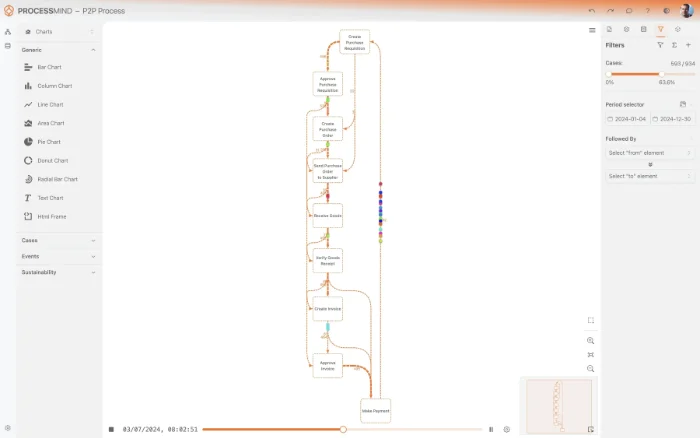
Claims processing is often a labyrinthine journey, fraught with complexities, manual interventions, and regulatory hurdles. From the initial submission to the final settlement, every step holds the potential for delays, errors, and increased costs. At ProcessMind, we understand that true efficiency isn't found by simply tweaking your existing tools, but by understanding the actual execution of your process. Our platform delves deep into your Claims Processing flow, using 'Claim ID' as the central case identifier, to reveal the ground truth of how claims are handled within your organization, regardless of the underlying system or systems you use. We uncover hidden delays, identify critical bottlenecks, and expose deviations from standard operating procedures that often remain invisible in traditional reporting. By mapping every event, activity, and handover, ProcessMind provides an unparalleled, data-driven view into the real-world performance of your claims operations, allowing you to move beyond assumptions and start making decisions based on concrete evidence.
Organizations grapple with numerous challenges in claims processing that hinder both efficiency and customer satisfaction. These include protracted resolution times, high operational costs driven by reworks and manual tasks, inconsistent application of policies, and potential compliance breaches due to unmanaged process variations. Furthermore, the lack of end-to-end visibility often makes it difficult to pinpoint the exact root causes of these issues, leading to reactive instead of proactive problem-solving. ProcessMind addresses these challenges head-on. By analyzing your claims event data, we highlight exactly where delays occur, which activities consume the most resources, and where process deviations are most common. This insight empowers you to identify opportunities for automation, standardize best practices, and enforce compliance more effectively. The benefits are tangible: accelerate claim resolution, significantly reduce processing costs, improve regulatory adherence, and ultimately, enhance customer satisfaction through faster, more transparent service – all without requiring changes to your existing IT infrastructure.
ProcessMind's powerful analytics engine offers a comprehensive suite of discoveries tailored for claims processing. You'll gain clarity on the most frequent process paths, comparing them against ideal models to spot inefficiencies instantly. Discover the impact of different departmental handovers or specific agent assignments on processing times. Uncover the prevalence of manual workarounds and their effect on compliance and cycle times. Identify critical rework loops that inflate costs and delay settlements. Our platform also illuminates opportunities for intelligent automation by showing you which steps are repetitive and ripe for optimization. Whether your claims data resides in a legacy system, a modern ERP, or a custom application, ProcessMind is built to be system-agnostic, integrating seamlessly with data from any of your source systems to provide a unified, actionable view of your entire claims lifecycle. This empowers you to drive continuous improvement and achieve a state of operational excellence.
Getting started with ProcessMind for your Claims Processing is straightforward. You don't need to rip and replace your existing systems; simply provide us with your claims event data – typically consisting of a 'Claim ID', activity description, and timestamp – from any of your source systems. To make this process as easy as possible, we offer a simple data template and expert guidance to help you extract and prepare your data swiftly. Within a short time, you'll be able to visualize your entire claims process, identify key inefficiencies, and start implementing targeted improvements that yield significant results. Transform your claims processing from a cost center into a competitive advantage with ProcessMind.
The 6-Step Path to Optimize Claims Processing
Connect & Discover Data
What to do
Gather claims data from your system, data warehouse, or other relevant data sources. Ensure all necessary event logs are captured to reconstruct the process.
Why it matters
A complete and accurate dataset is the foundation for any meaningful process analysis. Without it, insights will be incomplete or misleading.
Expected outcome
Comprehensive and clean event log data for your Claims Processing.
Map Your Process
What to do
Visualize the actual flow of your claims process based on event data. Identify all activities, their sequence, and how often paths are taken.
Why it matters
An objective, data-driven map reveals the true process, uncovering deviations and reworks that manual mapping often misses.
Expected outcome
A detailed, objective process map of your Claims Processing.
Identify Bottlenecks
What to do
Use the process map to pinpoint areas where claims get stuck, take too long, or frequently loop. Look for high waiting times and reworks.
Why it matters
Identifying bottlenecks directly highlights where efficiency is lost, leading to increased operational costs and slower service delivery.
Expected outcome
Clear identification of critical performance inhibitors within your claims workflow.
Analyze Root Causes
What to do
Dig deeper into identified bottlenecks using variants, attributes, and deviations to understand why delays or reworks occur. Correlate with business dimensions.
Why it matters
Understanding the underlying reasons for process issues is crucial for implementing effective, sustainable solutions rather than superficial fixes.
Expected outcome
A clear understanding of the 'why' behind process inefficiencies.
Design Improvements
What to do
Based on root cause analysis, brainstorm and design specific changes to eliminate bottlenecks, reduce rework, or optimize activity sequences. Define clear targets.
Why it matters
Well-designed improvements directly address identified issues, leading to tangible gains in efficiency, compliance, and customer satisfaction.
Expected outcome
A structured plan with actionable steps and measurable targets for process optimization.
Monitor & Iterate
What to do
Implement your designed improvements and continuously track their impact using key performance indicators. Be ready to adjust and iterate as needed.
Why it matters
Continuous monitoring ensures that improvements deliver the expected value and allows for agile adaptation to new challenges or opportunities.
Expected outcome
Sustained process performance improvement and an adaptive, optimized Claims Processing workflow.
WHAT YOU WILL GET
Unlock Hidden Insights in Your Claims Processing
- Visualize end-to-end claims journeys
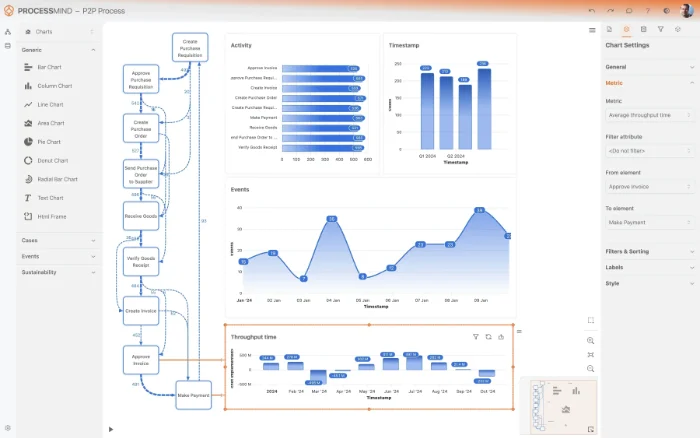
- Spot inefficiencies and rework loops
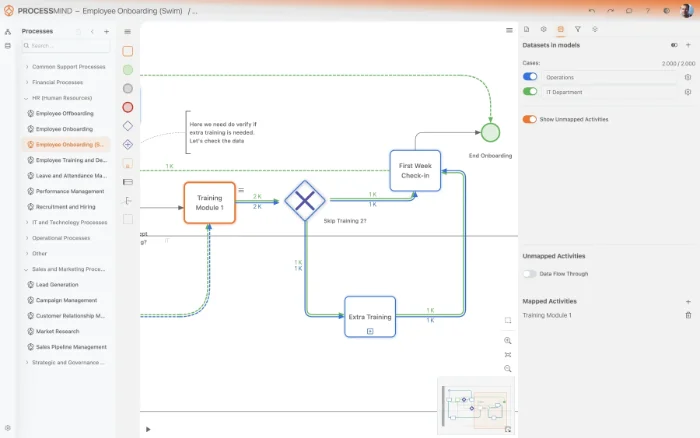
- Ensure compliance and mitigate risks
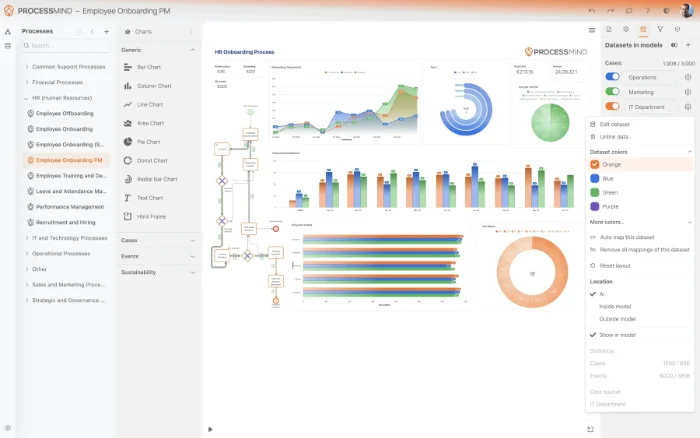
- Optimize resource allocation effectively
TYPICAL OUTCOMES
Transforming Claims Processing with Measurable Results
Process mining for claims processing reveals hidden inefficiencies and bottlenecks, leading to data-driven optimizations. These outcomes showcase the tangible benefits organizations typically achieve by enhancing their claims workflows.
Average reduction in end-to-end processing
Identify and eliminate bottlenecks across the entire claims process, significantly cutting down the time from claim submission to final resolution, thereby improving efficiency and claimant satisfaction.
Decrease in errors and re-processing steps
Pinpoint the root causes of rework loops and errors, enabling targeted improvements that reduce unnecessary re-processing, save resources, and ensure higher first-pass resolution.
Higher adherence to regulations and policies
Gain clear visibility into process deviations and non-conformance, allowing organizations to enforce standard operating procedures and regulatory requirements more effectively, mitigating risks and ensuring consistent service.
Reduction in processing expenses per claim
Identify and eliminate inefficient steps, redundant activities, and manual efforts within the claims process, leading to a measurable decrease in the overall cost associated with handling each claim.
Quicker processing of required claim data
Streamline the exchange of information by understanding when and why additional data is requested. This reduces delays caused by incomplete submissions and accelerates critical decision-making points.
Results may vary based on the specific claims process complexity, existing system infrastructure, and data quality. The figures presented reflect common improvements observed in similar implementations.
Recommended Data
For customized data recommendations, choose your specific process.
FAQs
Frequently asked questions
Process mining analyzes event logs from your claims system to visualize the actual end-to-end process flow. It uncovers hidden bottlenecks, rework loops, and deviations from standard procedures. This leads to faster resolution times, reduced operational costs, and enhanced efficiency.
For effective process mining, you primarily need event logs from your claims system. This includes a unique case identifier (Claim ID), an activity name (what happened), and a timestamp (when it happened) for each step. Additional attributes like adjuster details or claim type can enrich the analysis.
By mapping the actual process, process mining highlights where claims get stuck or repeatedly re-enter previous stages, pinpointing the root causes of delays and rework. This allows for targeted interventions to streamline workflows and eliminate inefficiencies. You gain clear insights into the steps contributing most to extended cycle times.
No, process mining is non-intrusive as it only requires read-access to historical data from your claims system. It doesn't interfere with live operations or require changes to your current IT infrastructure during the analysis phase. Implementation of identified improvements is a separate step.
Yes, process mining can effectively audit claims against predefined compliance models, identifying instances where processes deviate from mandatory rules or standard operating procedures. This helps to proactively detect non-compliant claim handling pathways. It provides evidence of adherence and flags areas needing attention.
You generally need read-access to your claims processing system's database or data warehouse to extract event log data. A process mining software platform, either cloud-based or on-premise, is then used to ingest and analyze this data. Basic data transformation skills might be required to prepare the data in the correct format.
Initial data extraction and model setup can typically be completed within a few weeks, depending on data availability and complexity. Once the initial model is established, initial insights can often be generated within days or weeks. Deeper analysis and actionable recommendations will naturally take more time.
The initial step is to identify a clear business problem or improvement goal, such as reducing claim cycle time or improving compliance. Then, work with your IT team to identify the relevant event data sources within your claims system and establish a method for data extraction. This foundational work ensures the analysis is targeted and effective.
No, process mining goes beyond traditional reporting or business intelligence. While reporting shows "what happened," process mining reveals "how and why" it happened by reconstructing the actual process flow from event data. It discovers process variations, compliance gaps, and root causes of inefficiencies that standard reports often miss.
Absolutely. By associating activities with specific resources in your event data, process mining can visualize individual and team workload patterns. It identifies imbalances and highlights areas where training or process adjustments could improve efficiency across your team. This provides actionable insights for resource optimization.
Gain Control: Optimize Processes, Boost Performance Now
Pinpoint inefficiencies, drive innovation, and achieve your goals faster.
No credit card required, begin optimizing today.