Improve Your Purchase to Pay - Purchase Order

Optimize Purchase Order Efficiency in Oracle Fusion Financials
Complex procurement workflows often conceal hidden inefficiencies and compliance risks. Our platform helps you pinpoint delays in ordering and receiving, evaluate supplier lead times, and enhance overall procurement efficiency. You can discover practical ways to optimize your operations and ensure timely fulfillment of needs.
Download our pre-configured data template and address common challenges to reach your efficiency goals. Follow our six-step improvement plan and consult the Data Template Guide to transform your operations.
Show detailed description
Why Optimize Your Purchase to Pay - Purchase Order Process?
In the intricate landscape of procurement, the Purchase to Pay, P2P, process, specifically the Purchase Order, PO, segment, serves as a critical backbone for any organization. Within sophisticated financial systems like Oracle Fusion Financials, the complexity of transactions and configurations can often mask inefficiencies, leading to significant financial and operational drawbacks. An unoptimized Purchase Order process can result in extended lead times, increased operational costs, strained supplier relationships, and even compliance risks.
Delays in creating, approving, or processing Purchase Orders directly impact project timelines and inventory levels. Bottlenecks can accumulate at various stages, from initial requisition to goods receipt, preventing timely fulfillment and potentially forcing costly expedited orders. Furthermore, a lack of clear process visibility makes it challenging to identify why certain orders take longer, which departments struggle the most, or where automation could provide the most value. Effective process optimization of your Purchase to Pay - Purchase Order cycle in Oracle Fusion Financials is not just about cost savings, it is about enhancing the entire operational efficiency and responsiveness of your organization.
Unlocking Insights with Process Mining for Purchase Orders
Process mining offers a revolutionary approach to understanding and improving your Purchase Order process within Oracle Fusion Financials. Instead of relying on assumptions or aggregated reports, process mining uses event data, such as timestamps and activity logs, to reconstruct the actual journey of every single Purchase Order. This technique allows you to visualize the real process flow, revealing how Purchase Orders move through your system, from their inception as a requisition or direct order, through approvals, changes, to goods or services receipt.
By applying process mining, you can precisely identify where bottlenecks occur in the Purchase Order lifecycle. Is the delay in the approval stage? Or perhaps after the Purchase Order is sent to the vendor? This analytical power helps you pinpoint specific steps or individuals causing slowdowns, understand common deviations from your ideal process, and detect frequent rework loops. You gain an objective, data-driven view of your operations, allowing you to answer crucial questions about how to reduce Purchase to Pay - Purchase Order cycle time and improve overall efficiency.
Key Areas for Purchase Order Process Improvement
Leveraging process mining, you can target several critical areas within your Purchase to Pay - Purchase Order flow for significant improvement:
- Bottleneck Identification and Resolution: Discover exactly where Purchase Orders get stuck. This could be slow approvals, delays in goods receipt processing, or prolonged quality inspections. Understanding these specific points allows you to implement targeted interventions, like automating routine approvals or re-training staff on critical steps.
- Supplier Performance Evaluation: Analyze the actual supplier lead times from the moment a Purchase Order is sent to the vendor until goods are received and posted. This insight helps you identify reliable suppliers and negotiate better terms, ultimately improving your supply chain predictability.
- Rework and Deviation Analysis: Many Purchase Orders undergo changes after initial creation or approval. Process mining reveals how often this happens, the reasons behind it, and the impact on cycle time. By reducing unnecessary rework, you streamline operations and save valuable resources.
- Compliance and Audit Readiness: Ensure that every Purchase Order adheres to internal procurement policies and external regulations. Process mining can highlight instances where policies are bypassed or ignored, providing invaluable data for internal audits and maintaining robust governance within your Oracle Fusion Financials environment.
Realizing Tangible Outcomes for Your Procurement
By strategically applying process mining to your Purchase to Pay - Purchase Order process, your organization can expect to achieve a range of measurable and impactful outcomes:
- Reduced Purchase Order Cycle Time: Streamline the entire process, from requisition to goods receipt, leading to faster fulfillment and improved operational responsiveness.
- Lower Operational Costs: Eliminate inefficiencies, reduce rework, and minimize the need for expedited orders, directly impacting your bottom line.
- Enhanced Compliance: Proactively identify and rectify deviations from procurement policies, strengthening internal controls and reducing audit risks.
- Improved Supplier Relationships: With clearer insights into lead times and performance, you can better manage expectations, foster stronger vendor partnerships, and ensure timely delivery of goods and services.
- Better Resource Utilization: Free up your procurement team from manual tracking and firefighting, allowing them to focus on strategic initiatives and value-added tasks.
These improvements contribute to a more agile, cost-effective, and compliant procurement function, directly enhancing your overall business performance.
Starting Your Journey to Optimized Purchase Orders
Embarking on the path to optimizing your Purchase to Pay - Purchase Order process with process mining does not require extensive technical expertise. Our approach provides a clear and actionable framework to extract insights from your existing Oracle Fusion Financials data, transforming complex process information into understandable visualizations and actionable recommendations. By leveraging these powerful analytics, you can move beyond guesswork and implement data-driven improvements that yield real, measurable results. Discover how to improve Purchase to Pay - Purchase Order effectiveness and achieve significant process optimization in your organization today.
The 6-Step Improvement Path for Purchase to Pay - Purchase Order
Download the Template
What to do
Obtain the pre-defined Excel template, designed for Purchase Order data extraction from systems like Oracle Fusion Financials, to ensure data consistency.
Why it matters
Using the correct data structure from the start prevents reformatting issues and streamlines the analysis, ensuring accurate insights.
Expected outcome
A ready-to-fill Excel template structured perfectly for your P2P Purchase Order data.
Export Your Data
What to do
Extract 3-6 months of historical Purchase Order data directly from Oracle Fusion Financials. Populate the downloaded template with this relevant transaction history.
Why it matters
Comprehensive historical data provides a solid foundation for discovering patterns, identifying inefficiencies, and understanding process variations over time.
Expected outcome
A populated data template with your organization's Purchase Order transaction history, ready for upload.
Upload Your Dataset
What to do
Securely upload your filled data template to ProcessMind. The platform will automatically process and prepare your Purchase Order data for analysis.
Why it matters
A swift and secure upload process ensures your data is quickly transformed into an actionable format, enabling immediate commencement of analysis.
Expected outcome
Your Purchase Order process data ingested and automatically prepared within ProcessMind.
Analyze Your Process
What to do
Explore the automatically generated dashboards and visual process maps. Utilize AI-driven recommendations to pinpoint bottlenecks and deviations in your Purchase Order flow.
Why it matters
Visualizing the actual process flow reveals hidden inefficiencies, compliance gaps, and areas where Purchase Order cycle times can be significantly reduced.
Expected outcome
A clear understanding of your Purchase to Pay Purchase Order process, including key bottlenecks and optimization opportunities.
Implement Improvements
What to do
Based on insights from your analysis, prioritize and implement targeted changes to streamline your Purchase Order process within Oracle Fusion Financials.
Why it matters
Taking action on data-driven insights ensures that improvements are effective and directly address root causes, leading to tangible operational enhancements.
Expected outcome
Actionable strategies and changes applied to improve the efficiency and compliance of your Purchase Order management.
Monitor Your Process
What to do
Periodically re-upload updated Purchase Order data to track the impact of your implemented changes and monitor key performance indicators over time.
Why it matters
Continuous monitoring validates the effectiveness of improvements and allows for further iterative optimization, ensuring sustained process excellence and compliance.
Expected outcome
Ongoing visibility into process performance, enabling continuous improvement and measurable KPI enhancements for Purchase Orders.
WHAT YOU WILL GET
Uncover Hidden PO Inefficiencies in Oracle Fusion
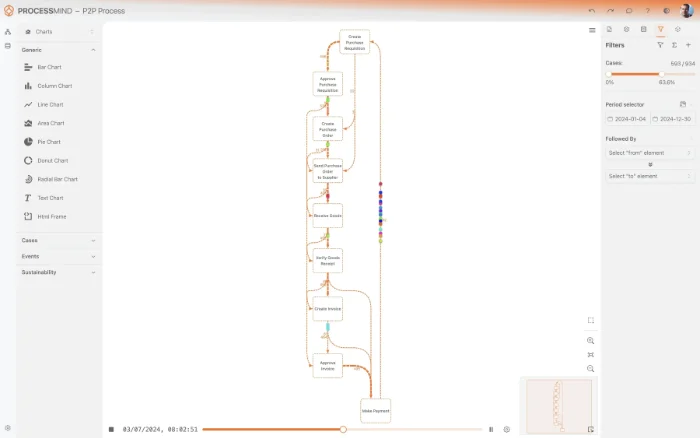
- Visualize actual PO process flows
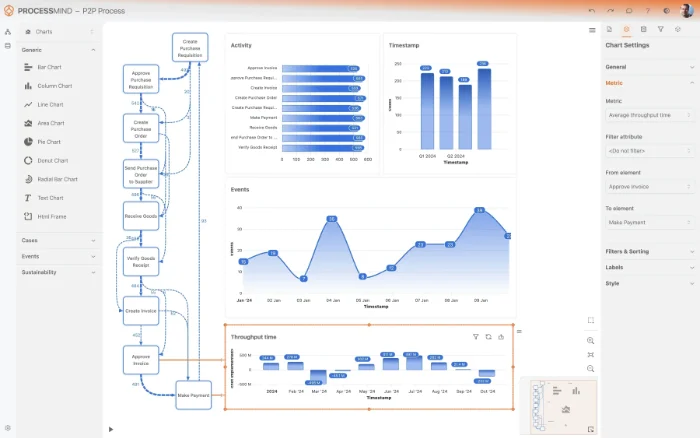
- Identify costly bottlenecks and delays
- Evaluate supplier lead time variations
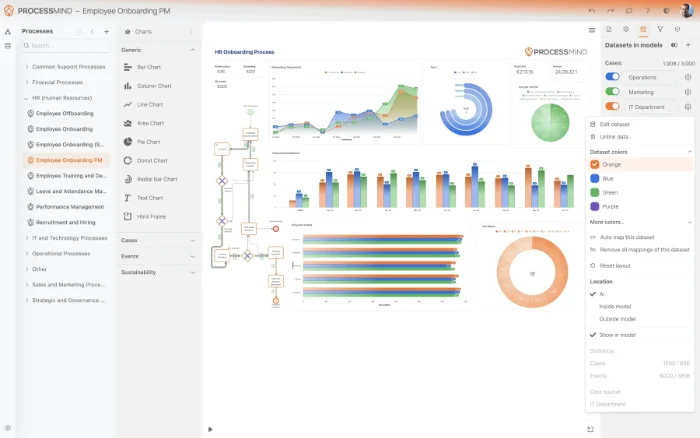
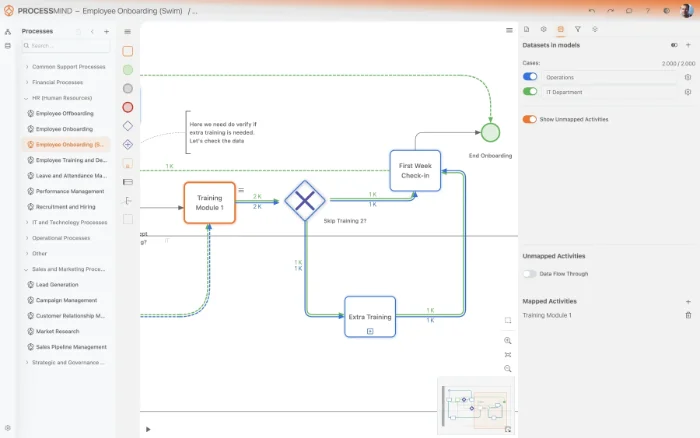
- Enhance procurement efficiency and compliance
TYPICAL OUTCOMES
Achieving Excellence in Purchase Order Processing
These outcomes represent common improvements realized by organizations leveraging process mining to analyze and optimize their Purchase Order process within Oracle Fusion Financials. By identifying bottlenecks, rework, and compliance gaps, businesses can achieve significant operational efficiencies and cost savings.
Average reduction in approval time
By identifying and removing bottlenecks, organizations significantly reduce the time taken for Purchase Order approvals, leading to quicker procurement cycles.
Decrease in order modification rate
Process mining pinpoints the root causes of Purchase Order changes, leading to fewer modifications, lower administrative burden, and improved data accuracy.
Increase in supplier delivery adherence
Gain insights into supplier performance variances to foster better collaboration and ensure goods are received as scheduled, minimizing production delays.
Increase in approval before vendor send
Automated monitoring identifies non-compliant Purchase Orders, ensuring all approvals are in place before vendor engagement, reducing risk and improving audit readiness.
Reduction in receiving process time
By analyzing the goods receipt process, organizations can identify and eliminate delays, accelerating the availability of goods and improving inventory management.
Results vary based on process complexity, data quality, and specific organizational goals. These figures represent typical improvements observed across various implementations.
Recommended Data
FAQs
Frequently asked questions
It analyzes event logs to visualize the actual process flow, revealing hidden inefficiencies like slow approvals or frequent modifications. This helps pinpoint specific bottlenecks and non-compliant deviations that hinder operational performance.
You typically need event log data related to purchase orders, including case IDs, activity names, timestamps, and resource information. This data is extracted from relevant Oracle Fusion tables, such as PO_HEADERS_ALL, PO_LINES_ALL, and associated approval and workflow tables, to reconstruct the complete process.
You can expect to identify specific bottlenecks, quantify their impact, and uncover root causes for delays or non-compliance within weeks. Within a few months, organizations often see measurable improvements in approval times, reduction in manual rework, and enhanced process efficiency.
Yes, process mining excels at visualizing and analyzing approval flows, identifying exact approval steps causing delays and uncovering patterns. It can show which resources or conditions lead to extended cycles, allowing for targeted optimization of workflows.
Process mining maps the actual execution of your Purchase Order process against defined rules and ideal paths. It can automatically detect deviations, such as unauthorized steps or skipped approvals, providing clear evidence of non-compliance and highlighting areas for control enforcement.
Process mining tools typically do not integrate directly with or modify your live Oracle Fusion Financials workflows. Instead, they extract historical event log data for analysis. The insights gained can then inform targeted improvements to your existing system and processes.
You'll need access to your Oracle Fusion Financials database for data extraction, often requiring SQL skills. The process mining software itself typically runs on dedicated platforms, either cloud-based or on-premise, with minimal local technical overhead beyond data management.
Absolutely. By reconstructing every step a purchase order takes from creation to receipt, process mining offers end-to-end visibility into its journey. This allows you to track precise statuses, identify where an order is stalled, and understand average cycle times for different PO types.
Optimize Your Purchase to Pay - Purchase Order Today
Pinpoint costly bottlenecks and reduce cycle time by 30% with ease.
No credit card required, start optimizing today.