Improve Your Purchase to Pay - Purchase Order

Optimize Coupa Purchase Orders: Boost P2P Efficiency
Managing purchase orders can often be complex, leading to approval delays and missed delivery dates. Our platform helps you pinpoint exact inefficiencies within your process. It guides you to make data-driven improvements, ultimately streamlining operations and enhancing your procurement efficiency.
Download our pre-configured data template and address common challenges to reach your efficiency goals. Follow our six-step improvement plan and consult the Data Template Guide to transform your operations.
Show detailed description
Why Optimize Your Coupa Purchase Orders?
Effectively managing your Purchase to Pay, P2P, process, particularly the Purchase Order, PO, lifecycle, is crucial for financial health and operational efficiency. In a system like Coupa, which handles critical business spend management, an inefficient Purchase Order process can lead to significant financial leakage, operational bottlenecks, and strained supplier relationships. When Purchase Orders move slowly or encounter frequent rework, your organization faces delayed access to necessary goods and services, increased administrative costs, potential penalties for late payments, and even compliance risks.
Optimizing your Coupa Purchase Order process is not just about speeding things up, it is about gaining control over your spend, ensuring timely fulfillment, and empowering your procurement team. Understanding the true flow of a Purchase Order, from its initial requisition to final goods receipt, reveals opportunities to streamline operations, reduce manual effort, and improve the overall effectiveness of your procurement function. Without clear insights into process performance, identifying the root causes of delays or deviations in your Purchase Order workflow can feel like an impossible task, directly impacting your ability to manage working capital and secure favorable vendor terms.
How Process Mining Enhances Purchase Order Improvement
Process mining provides a powerful, data-driven approach to dissect and understand the intricate journey of every Purchase Order within your Coupa system. Instead of relying on assumptions or anecdotal evidence, process mining reconstructs the actual execution path of each Purchase Order by leveraging event log data from Coupa. This allows you to visualize the real process flow, identify all variants, and pinpoint exactly where Purchase Orders get delayed or deviate from the standard path. For example, you can see if Purchase Requisition Approved consistently takes too long before Purchase Order Drafted, or if Goods Receipt Posted is frequently delayed after Goods Receipt Initiated.
By focusing on the Purchase Order as the case identifier, process mining highlights critical areas such as approval cycle times, the frequency of Purchase Order changes, or the lead time from Purchase Order Sent to Vendor to Purchase Order Confirmed by Vendor. This objective insight is essential for effective process optimization. You can uncover hidden bottlenecks, detect unauthorized activities or Purchase Order Changed events, and quantify the impact of process deviations. This empirical understanding is key to formulating targeted improvements and truly understanding how to improve Purchase to Pay - Purchase Order processes.
Key Improvement Areas Identified Through Process Mining
Process mining for Coupa Purchase Orders uncovers specific areas ripe for improvement. You might discover that certain departments consistently experience longer Purchase Order Approved times, indicating a need for targeted training or revised approval workflows. Another common finding is a high volume of Purchase Order Changed events post-approval, which often signals issues with initial requisition accuracy or communication breakdowns between departments and procurement. Identifying these frequent changes helps you address the root cause, for instance, by improving requisition templates or enforcing stricter initial data quality.
Furthermore, process mining can highlight inefficiencies in the receiving phase, such as extended delays between Goods Receipt Initiated and Goods Receipt Posted, impacting inventory accuracy and payment cycles. It can also reveal variations in vendor lead times, specifically from Purchase Order Sent to Vendor to the actual Goods Receipt Posted or Services Confirmation Entered, enabling better vendor selection and negotiation. By visualizing these patterns, you gain the knowledge to implement concrete changes that streamline the end-to-end Purchase Order flow, enhancing your overall procurement efficiency and control over spend.
Expected Outcomes of Optimizing Your P2P - Purchase Order Process
Optimizing your Purchase to Pay - Purchase Order process with process mining in Coupa delivers tangible and measurable benefits. You can expect a significant reduction in Purchase Order cycle time, from requisition creation to goods receipt, leading to faster access to resources and improved operational responsiveness. This directly addresses the goal of how to reduce Purchase to Pay - Purchase Order cycle time. Reduced cycle times also mean a quicker turnaround for supplier payments, potentially unlocking early payment discounts and strengthening vendor relationships.
Beyond speed, you will achieve greater process compliance, ensuring all Purchase Orders adhere to internal policies and external regulations, thereby mitigating financial and reputational risks. Improved data quality and reduced rework translate into lower administrative costs for your procurement team, freeing them to focus on more strategic activities. Ultimately, by eliminating bottlenecks and standardizing best practices across your Coupa Purchase Order process, you will enhance overall procurement efficiency, achieve better spend management, and contribute directly to your organization's bottom line.
Getting Started with Your Purchase Order Optimization Journey
Embarking on the journey to optimize your Coupa Purchase Order process with process mining does not require extensive prior expertise. This approach provides you with the tools and insights needed to easily analyze your current workflow, identify critical areas for improvement, and implement data-driven solutions. By focusing on the real execution data from your Coupa system, you can move beyond assumptions and make informed decisions that will directly impact your procurement efficiency. Start transforming your Purchase to Pay - Purchase Order process today and unlock the full potential of your Coupa investment.
The 6-Step Improvement Path for Purchase to Pay - Purchase Order
Get Your Data Template
What to do
Download the pre-built Excel template designed for Purchase Order data from Coupa to ensure proper structuring and compatibility for analysis.
Why it matters
A standardized template ensures your Coupa Purchase Order data is correctly formatted, preventing mapping errors and accelerating the analysis setup.
Expected outcome
A ready-to-use Excel template, perfectly structured for your Coupa Purchase Order data.
Extract Coupa PO Data
What to do
Export 3-6 months of historical Purchase Order data from Coupa, including all relevant activities and attributes, then populate the provided template.
Why it matters
Comprehensive historical data provides a realistic view of your Coupa Purchase Order process, revealing recurring patterns and improvement areas.
Expected outcome
A populated data template with accurate, comprehensive Purchase Order history from Coupa.
Upload Your PO Data
What to do
Securely upload your completed Purchase Order data template to ProcessMind for automated processing and initial analysis.
Why it matters
Fast and secure data ingestion means you quickly move from raw data to actionable insights without manual processing delays.
Expected outcome
Your Coupa Purchase Order data is securely uploaded and ready for in-depth process analysis.
Discover PO Bottlenecks
What to do
Explore the automatically generated dashboards and process maps to visualize your Coupa Purchase Order flow and identify inefficiencies.
Why it matters
Visualizing the real process flow reveals deviations and bottlenecks, offering clarity on where your Coupa Purchase Orders get stuck.
Expected outcome
Clear identification of critical bottlenecks and non-compliant paths in your Coupa Purchase Order process.
Optimize PO Workflows
What to do
Prioritize and implement improvements based on the identified insights, such as automating approval steps or refining Coupa configurations.
Why it matters
Taking action on data-driven insights directly translates to reduced cycle times, lower costs, and enhanced Purchase Order compliance.
Expected outcome
Streamlined Coupa Purchase Order processes, leading to measurable improvements in efficiency and compliance.
Track PO Performance
What to do
Periodically re-upload updated Purchase Order data from Coupa to continuously track the impact of your changes and identify new trends.
Why it matters
Ongoing monitoring ensures sustained optimization, allowing you to adapt to new challenges and maintain peak operational efficiency in Coupa.
Expected outcome
Continuous improvement and sustained high performance of your Purchase to Pay - Purchase Order process in Coupa.
WHAT YOU WILL GET
Uncover Hidden Delays in Your Coupa P2P Process
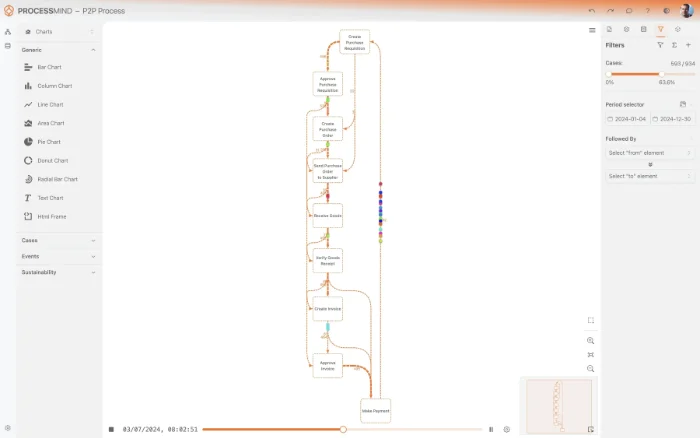
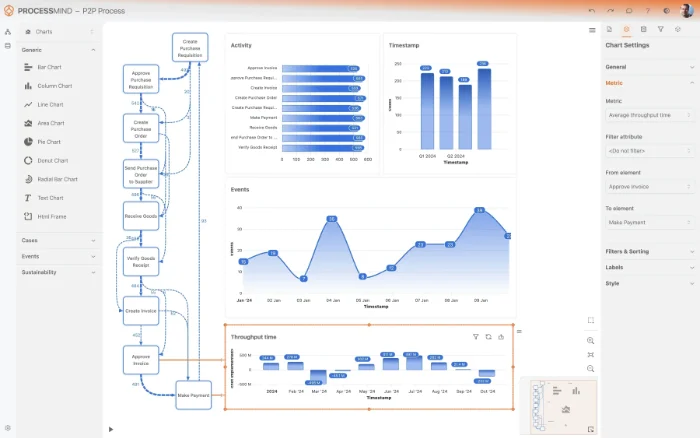
- Visualize end-to-end PO flow in Coupa
- Pinpoint exact approval delays and bottlenecks
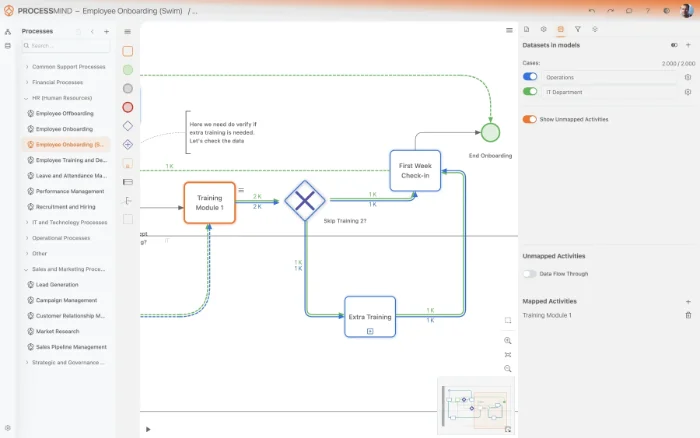
- Identify non-compliant Purchase Order paths
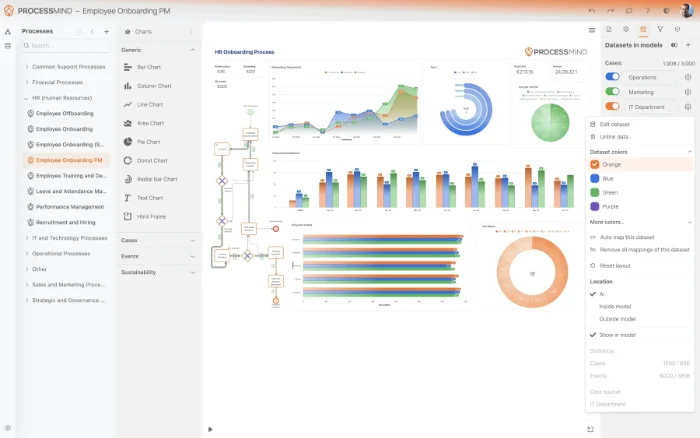
- Optimize P2P efficiency with data-driven actions
TYPICAL OUTCOMES
Transforming Purchase Order Efficiency
These outcomes highlight the measurable improvements organizations commonly achieve by optimizing their Purchase Order processes. By leveraging data-driven insights from Coupa, businesses can identify and eliminate bottlenecks, leading to significant operational enhancements.
Average cycle time reduction
Organizations achieve quicker turnaround times for Purchase Order approvals, reducing bottlenecks and accelerating the entire procurement process from requisition to order.
Fewer reworks post-drafting
By identifying root causes of changes, businesses significantly decrease the number of Purchase Orders requiring modifications after initial drafting, leading to greater efficiency and accuracy.
Reduction in non-compliant POs
Process mining helps uncover deviations from standard purchasing procedures, allowing companies to enforce compliance policies and reduce the rate of non-conforming Purchase Orders.
Shorter end-to-end cycle
Streamline the entire process from initial requisition creation to the final Purchase Order being sent to the vendor, drastically reducing lead times and improving operational agility.
Higher on-time delivery rates
Gain insights into supplier performance to ensure goods are received by or before the requested delivery dates, improving planning and reducing stock-out risks.
Redirected spend to preferred vendors
Identify and minimize spend allocated to non-preferred vendors, allowing for better negotiation power, stronger supplier relationships, and significant cost savings.
Actual results may vary depending on specific organizational structures, process complexities, and data quality. The figures presented here illustrate typical improvements observed across a range of implementations.
Recommended Data
FAQs
Frequently asked questions
Process mining can identify bottlenecks in approvals, track non-compliant paths, and highlight delays in goods receipt. This helps visualize the actual process flow and pinpoint areas for efficiency improvements and cost reduction within your Coupa Purchase Order operations.
Data is typically extracted from Coupa's reporting functionalities or API capabilities. Key data points include purchase order creation dates, approval timestamps, status changes, and goods receipt dates. We usually need an event log, which lists all activities related to each purchase order.
For each purchase order, we need a unique case ID, an activity name, and a timestamp for each event that occurred. Additional attributes like requester, approver, value, and item details enhance the analysis. This structured data forms the event log essential for accurate process discovery.
Initial data extraction and model setup can take a few weeks, depending on data availability and complexity. The discovery and analysis phase can then begin almost immediately, with initial insights emerging within another 2-4 weeks. Continuous monitoring provides ongoing benefits.
You can expect accelerated purchase order approvals, reduced non-compliant spending, and shorter requisition-to-order cycles. Improved visibility into bottlenecks and deviations leads to more efficient operations, better supplier management, and significant cost savings.
Yes, data security is paramount throughout the process mining analysis. We implement robust data anonymization, pseudonymization, and strict access controls to protect sensitive information. All data handling and processing comply with relevant data privacy regulations and industry best practices.
The primary technical requirement is secure access to Coupa's data, typically through its native reporting features or APIs, to export the necessary event log. No direct integration or complex system changes within Coupa are usually needed for the analysis phase. Data needs to be provided in a structured format, such as CSV or database tables.
Absolutely, process mining can highlight purchasing patterns that lead to non-strategic spend, such as off-contract purchases or fragmented ordering. By visualizing these deviations, you can identify root causes and implement strategies to consolidate vendors, enforce contract compliance, and optimize your overall spend.
Traditional BI reports typically show 'what' happened, often in aggregate summaries. Process mining, however, visualizes 'how' it happened by mapping the actual end-to-end flow of each purchase order. This uncovers hidden variations and deviations, providing a deeper, process-centric view for targeted improvements rather than just high-level metrics.
Optimize Your P2P Purchase Orders, Boost Efficiency Today
Reduce your P2P cycle time by 30%, start seeing results fast.
No credit card required, setup in minutes.