Improve Your Change Management

Select a process
Choose a process to continue working in your connected workspace.
Optimize Change Management in BMC Helix ITSM for Faster, Compliant Releases
Our platform helps you uncover hidden inefficiencies in your change management process. Easily identify bottlenecks, understand approval delays, and pinpoint resource conflicts that slow down your operations. Track deviations from established policies to ensure compliance and reduce risks. Implement practical improvements to accelerate deployments and achieve smoother operations.
Download our pre-configured data template and address common challenges to reach your efficiency goals. Follow our six-step improvement plan and consult the Data Template Guide to transform your operations.
Show detailed description
Why Optimize Change Management in BMC Helix ITSM?
Change Management is the backbone of stable IT operations, ensuring that modifications to your services and infrastructure are introduced smoothly and with minimal disruption. In a complex environment powered by BMC Helix ITSM, effective Change Management is crucial for maintaining service reliability, enhancing security, and accelerating the delivery of new features or critical updates. However, managing change can often become a source of frustration, leading to approval backlogs, unexpected service outages, and compliance violations. Inefficient processes within your BMC Helix ITSM environment can directly impact your organization's agility, increase operational costs, and even damage your reputation. Understanding the true flow of changes, from "Change Request Created" to "Change Closed", is the first step toward transforming your IT service delivery.
How Process Mining Unlocks Change Management Efficiency
Process mining offers a unique, data-driven lens into your BMC Helix ITSM Change Management process, moving beyond subjective reports to show you the actual journey each change request takes. By analyzing event logs from your BMC Helix ITSM system, specifically data from forms like CHG:Change, CHG:Task, and CHG:Activity, process mining reconstructs the complete end-to-end process flow. This allows you to visually identify where change requests get stuck, which approval steps cause the most delays, or if specific teams consistently struggle with implementation. You can pinpoint bottlenecks in your approval workflows, such as excessive handoffs or specific approver groups becoming chokepoints. Furthermore, process mining helps you uncover deviations from your defined change policies, revealing instances where risk assessments are skipped or testing phases are circumvented. This deep analytical capability is essential for any organization looking to reduce Change Management cycle time and improve overall process compliance.
Key Improvement Areas Identified Through Process Mining
Leveraging process mining on your BMC Helix ITSM Change Management data can highlight several critical areas for improvement:
- Streamlined Approvals: Identify which approval steps or groups are causing the longest delays. You can then re-evaluate approval matrixes, automate certain low-risk changes, or provide targeted training to reduce approval cycle times.
- Reduced Rework and Failures: By tracing the paths of failed or re-opened changes, you can uncover common root causes such as insufficient impact analysis, poor implementation planning, or inadequate testing. This insight allows you to implement preventative measures and improve change success rates.
- Optimized Resource Allocation: Understand the workload distribution across different implementation teams and resource types. This helps you identify over-utilized or under-utilized resources, leading to better capacity planning and more efficient task assignments.
- Enhanced Compliance and Risk Mitigation: Automatically detect instances where changes deviate from established policies, for example, changes implemented without proper risk assessment or unauthorized modifications. This enables proactive compliance enforcement and significantly reduces change-related risks.
- Accelerated Cycle Time: Pinpoint the exact activities and transitions that contribute most to lengthy change request cycle times, enabling you to focus your optimization efforts where they will have the greatest impact.
Expected Outcomes of Optimizing Your Change Management Process
Implementing process mining for your BMC Helix ITSM Change Management can yield substantial, measurable benefits for your organization. You can expect to see a significant reduction in your overall Change Management cycle time, leading to faster deployment of critical updates and new services. This translates directly into improved service stability and higher customer satisfaction. Furthermore, by ensuring stricter adherence to change policies, you will enhance your regulatory compliance posture and drastically lower the risk of service disruptions and security incidents. Improved resource utilization will lead to cost savings and more efficient operations. Ultimately, this approach empowers you to foster a culture of continuous improvement, where every change contributes positively to your IT landscape.
Ready to Transform Your Change Management?
Discover the hidden inefficiencies and untapped potential within your BMC Helix ITSM Change Management process. Our specialized approach provides you with the insights needed to make data-driven decisions, reduce change-related risks, and accelerate your path to more agile and compliant IT operations. Begin your journey toward a truly optimized Change Management process today.
The 6-Step Improvement Path for Change Management
Download the Template
What to do
Get the Excel template specifically designed for Change Management process data. This template ensures your data is structured correctly for analysis.
Why it matters
A standardized template simplifies data preparation, reducing errors and ensuring that all necessary information is captured for comprehensive process analysis.
Expected outcome
A ready-to-fill Excel template for Change Management process data.
Export Your Change Data
What to do
Extract 3-6 months of historical Change Request data from BMC Helix ITSM, focusing on forms like CHG:Change, CHG:Task, and CHG:Activity. Fill the downloaded template with this real data.
Why it matters
Using recent historical data provides an accurate snapshot of current Change Management operations, allowing for meaningful insights and identification of real-world bottlenecks.
Expected outcome
A populated Excel template with comprehensive historical Change Management data from BMC Helix ITSM.
Upload Your Dataset
What to do
Upload the meticulously filled Change Management data template to ProcessMind's secure platform. The system will automatically prepare your data for analysis.
Why it matters
A secure and automatic upload ensures data integrity and saves time, quickly transforming raw data into an analyzable format without manual processing.
Expected outcome
Your Change Management data successfully processed and ready for in-depth process mining analysis.
Analyze Your Change Process
What to do
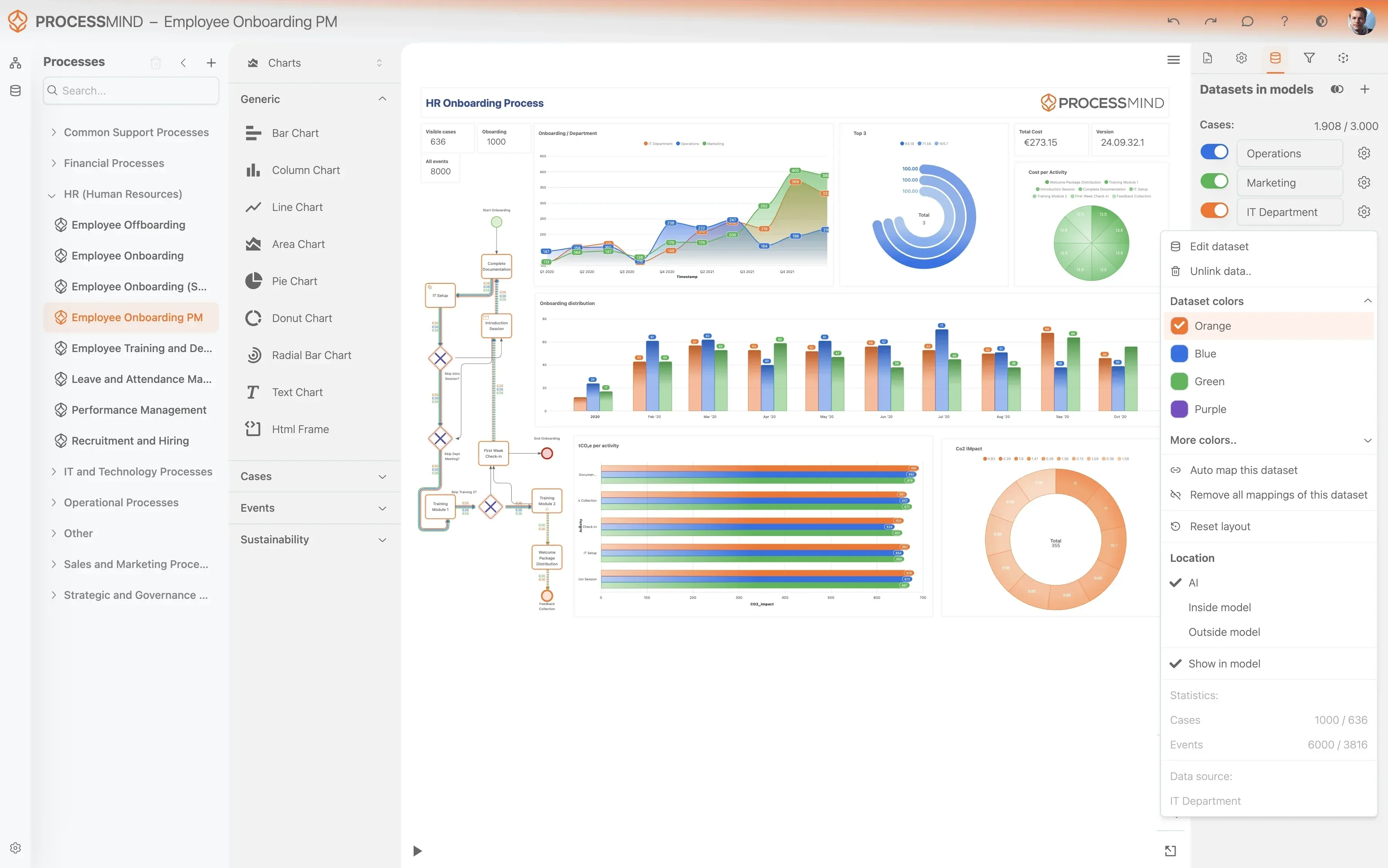
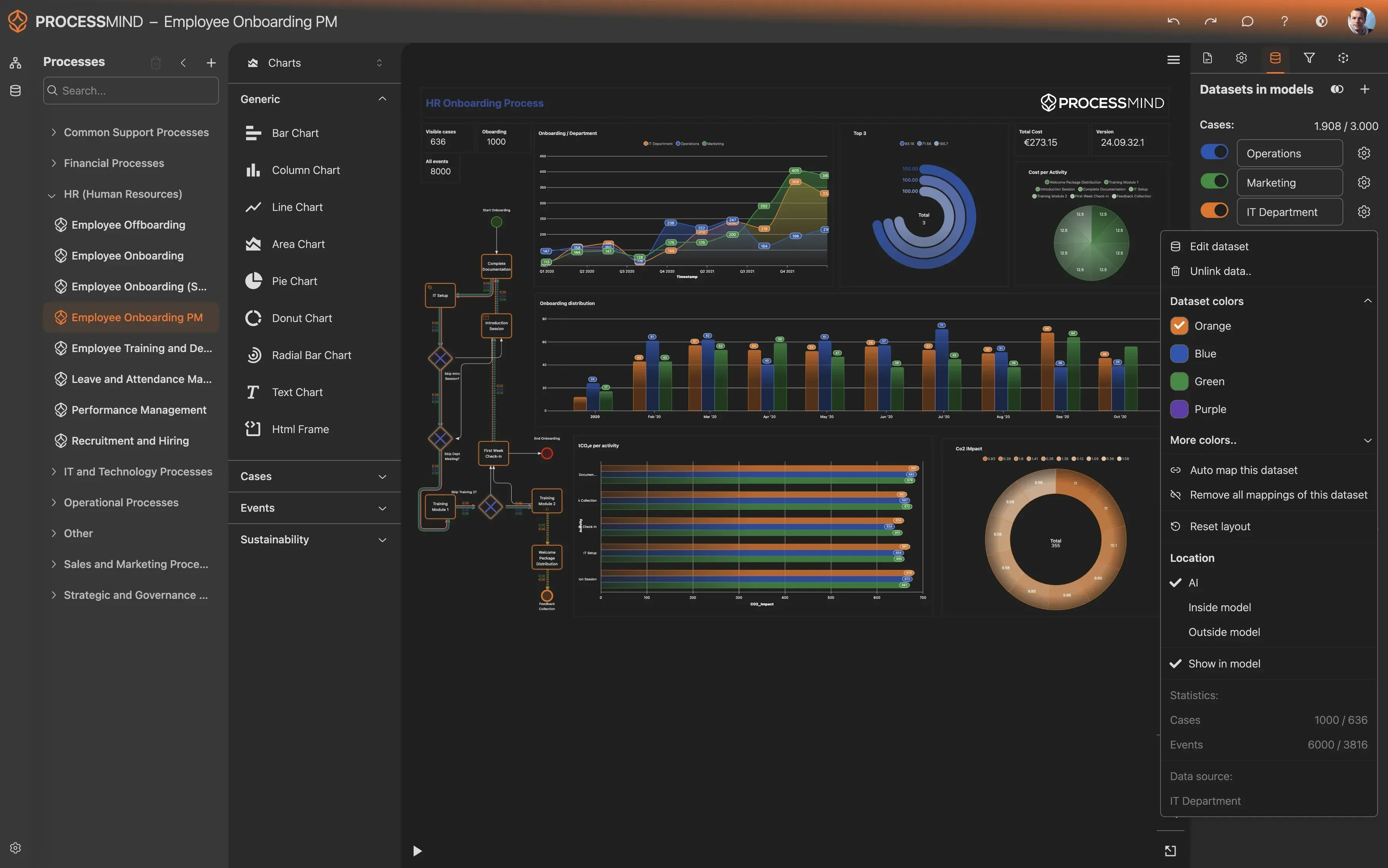
Explore the automatically generated dashboards and visual insights for your Change Management process. Review AI-driven recommendations for bottlenecks and deviations.
Why it matters
This step reveals hidden inefficiencies, compliance gaps, and performance variations, providing a clear, data-driven understanding of your entire Change Management workflow.
Expected outcome
A comprehensive understanding of your Change Management process performance, including key bottlenecks and optimization insights.
Implement Improvements
What to do
Prioritize the identified opportunities from the analysis. Apply targeted changes to your Change Management procedures in BMC Helix ITSM, focusing on streamlining approvals or task execution.
Why it matters
Acting on insights directly translates to tangible improvements, such as reduced lead times, fewer errors, and enhanced compliance within your Change Management process.
Expected outcome
Initiated changes within your Change Management process aimed at improving efficiency, compliance, and risk reduction.
Monitor Your Process
What to do
Periodically re-export and re-upload updated Change Management data from BMC Helix ITSM to ProcessMind. Continuously track the impact of your implemented improvements.
Why it matters
Ongoing monitoring ensures that improvements are sustained, new issues are quickly identified, and the Change Management process continues to align with organizational goals.
Expected outcome
Clear evidence of KPI improvements, sustained process efficiency, and continuous optimization of Change Management over time.
TYPICAL OUTCOMES
Achieving Operational Excellence in Change Management
These outcomes highlight the tangible improvements organizations achieve by applying process mining to their Change Management data within BMC Helix ITSM. By analyzing real-world Change Request IDs, businesses gain insights to streamline workflows and enhance efficiency.
Average reduction in approval time
Streamline decision-making processes by identifying and removing bottlenecks in the change approval workflow, accelerating critical changes to production.
Increase in standard process conformance
Ensure changes follow defined policies and procedures, reducing non-compliant activities and strengthening governance across all change requests.
Decrease in reactive changes
Gain insights into the root causes of emergency changes, enabling proactive planning and scheduling to minimize disruptions and enhance service stability.
Reduction in re-opened changes
Pinpoint areas where initial assessments are incomplete or planning is inadequate, drastically cutting down the need for changes to return to earlier stages.
Average reduction in implementation time
Optimize the entire change implementation lifecycle, from scheduling to verification, to deliver changes faster and reduce associated operational costs.
Decrease in change-induced disruptions
Identify risky change patterns and improve pre-implementation validation to significantly reduce the number of service incidents directly caused by changes.
Results vary based on process complexity, data quality, and specific organizational context. These figures represent typical improvements observed across various implementations.
Recommended Data
FAQs
Frequently asked questions
Process mining analyzes your Change Request ID data to visualize the actual flow of changes. It identifies bottlenecks, uncovers non-standard paths, and highlights compliance gaps, helping you accelerate approvals and standardize workflows. This leads to more efficient resource allocation and faster implementation cycles, ultimately reducing rework and service disruptions.
To start, you will need event logs related to your Change Requests from BMC Helix ITSM. Key data points include the Change Request ID as the case identifier, activity names, and timestamps for each activity. Information on the responsible user or group is also highly beneficial for analyzing resource allocation and team performance.
You can expect significant improvements like accelerated change approval cycle times and reduced emergency change volumes. Process mining also leads to enhanced compliance, minimized change-induced service impacts, and lower operational costs due to identified inefficiencies. Many organizations achieve better resource utilization and improved real-time visibility into change progress, making the process more predictable and effective.
You will primarily need access to your BMC Helix ITSM system to extract the relevant Change Management data. The process mining solution itself handles the analytical heavy lifting, often delivered as a cloud-based service, requiring only a standard web browser for access. No complex on-premise software installation is typically necessary for our platform.
Data extraction typically involves using BMC Helix ITSM's built-in reporting features, direct database queries, or integration tools. We guide you on identifying the relevant tables and fields, such as CHG:Infrastructure Change, to ensure all required event log attributes are captured. The primary goal is to obtain a complete, chronological sequence of events for every change request.
The initial setup, including data extraction and model creation, can typically be completed within a few weeks, depending on data availability and complexity. You can often see preliminary insights and identify immediate improvement opportunities within the first month of analysis. Continuous monitoring then provides ongoing optimization suggestions, allowing for sustained process improvement.
While process mining involves advanced analytics, modern tools streamline much of the complexity. Our approach simplifies the setup by focusing on your specific Change Management data from BMC Helix ITSM. We provide expert guidance, minimizing the need for extensive in-house technical skills beyond basic data access and understanding of your process.
It is common for real-world data to have inconsistencies, and process mining tools are designed to handle this. They often reveal data quality issues themselves, which is a valuable insight for improving data governance. We work with you to clean and transform the data, ensuring reliable analysis even with initial imperfections.
Optimize Your Change Management Now and Stop Disruptions
Boost your change success rate to 95% and avoid costly service disruptions.
No credit card required. Setup takes minutes.