ProcessMind Configuration and Setup Guide
Set up ProcessMind: learn configuration, environments, billing, SSO, and more for business process management.
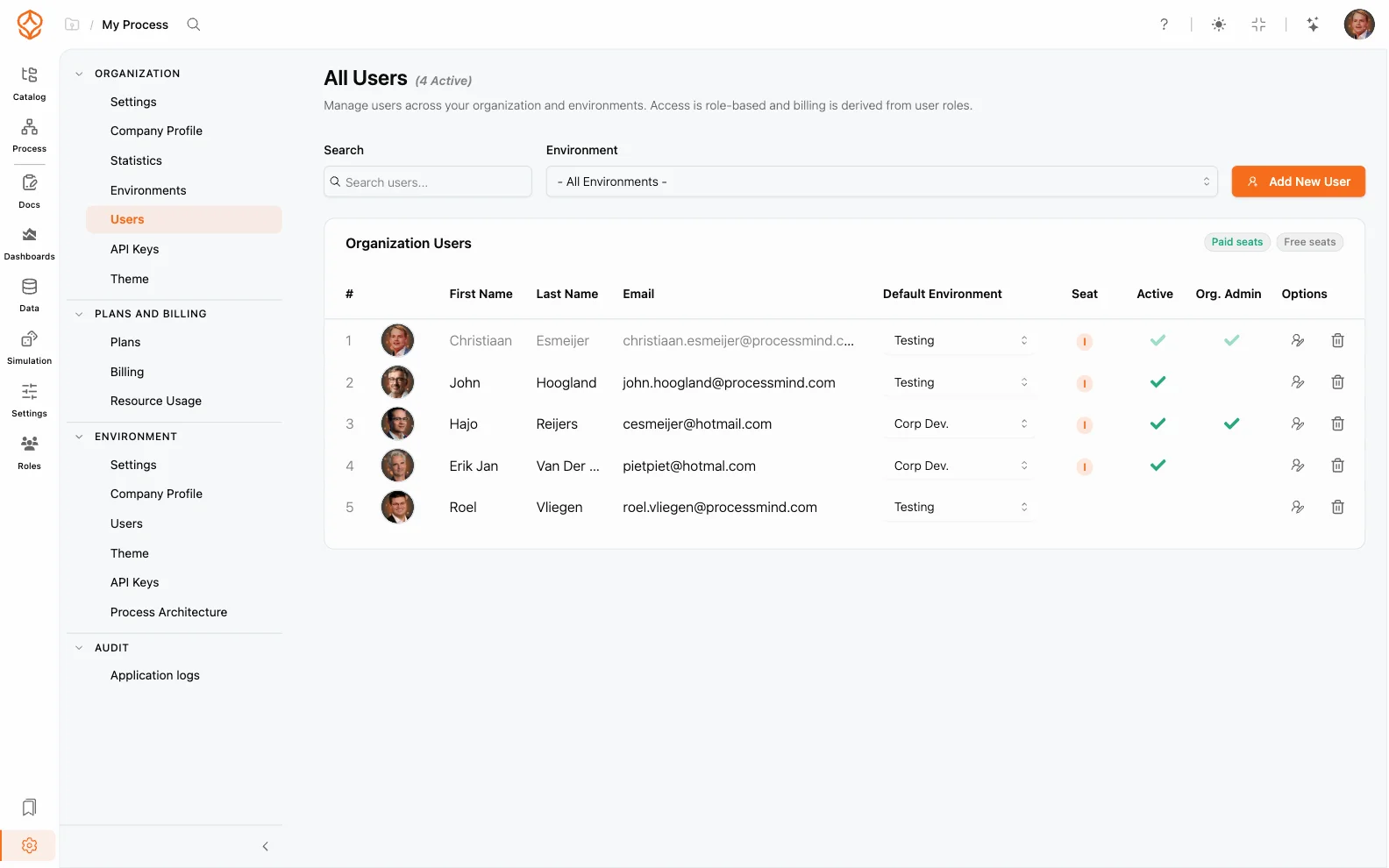
Every member of your organization has an access level for each environment and, optionally, admin rights. The access level is also the seat: it decides what the user can do and how the user is billed. This page explains the roles, how to invite and manage users, and where the permission boundaries are.
A user’s access level is set per environment:
| Access level | What it unlocks |
|---|---|
| None | No access to this environment. |
| Portal Viewer | Free, limited access to shared portal content. |
| Process Foundation | Model and dashboard viewing, plus process modeling and editing. |
| Process Architecture | Everything in Process Foundation, plus advanced process modeling. |
| Process Intelligence | All access levels, plus Process Intelligence features and dashboard creation. |
Admin rights are separate from the access level — they grant settings access, not model access:
A user can be an admin without an access level. Such admin-only users can manage settings, but they cannot open the catalog, models, dashboards, or documents.
Users are managed in two places under Settings:
To invite someone new:
To add someone who is already a member of the organization to another environment, use the environment selector on the organization screen and pick them under Add (existing) users… — no new email is sent.
You cannot remove or de-admin yourself; another admin has to do it.
| Action | Required role |
|---|---|
| View the catalog, models, and documents | Portal Viewer or higher |
| Edit models | Process Foundation seat or higher |
| Create dashboards and run simulations | Process Intelligence |
| Manage environment settings | Environment admin or org admin |
| Manage organization settings, users, and billing | Org admin |
| Open portal content | Portal Viewer |
For the portal side of viewer access, see Viewer Users. For seat management and billing, see Billing and Payments.
We use cookies to improve your experience, personalize content, and analyze traffic. By clicking "Accept All," you consent to our use of cookies.