On This Page

Conformance Checking

Process Intelligence Process Intelligence Available with a Process Intelligence seat or higher. Only seats on this plan or a higher one can use this feature. Compare plans Available with a Process Intelligence seat or higher

Your process model describes how work is supposed to happen; your event log records how it actually happens. Conformance checking puts the two side by side to measure how well reality matches the model, and where, how often, and why it does not.

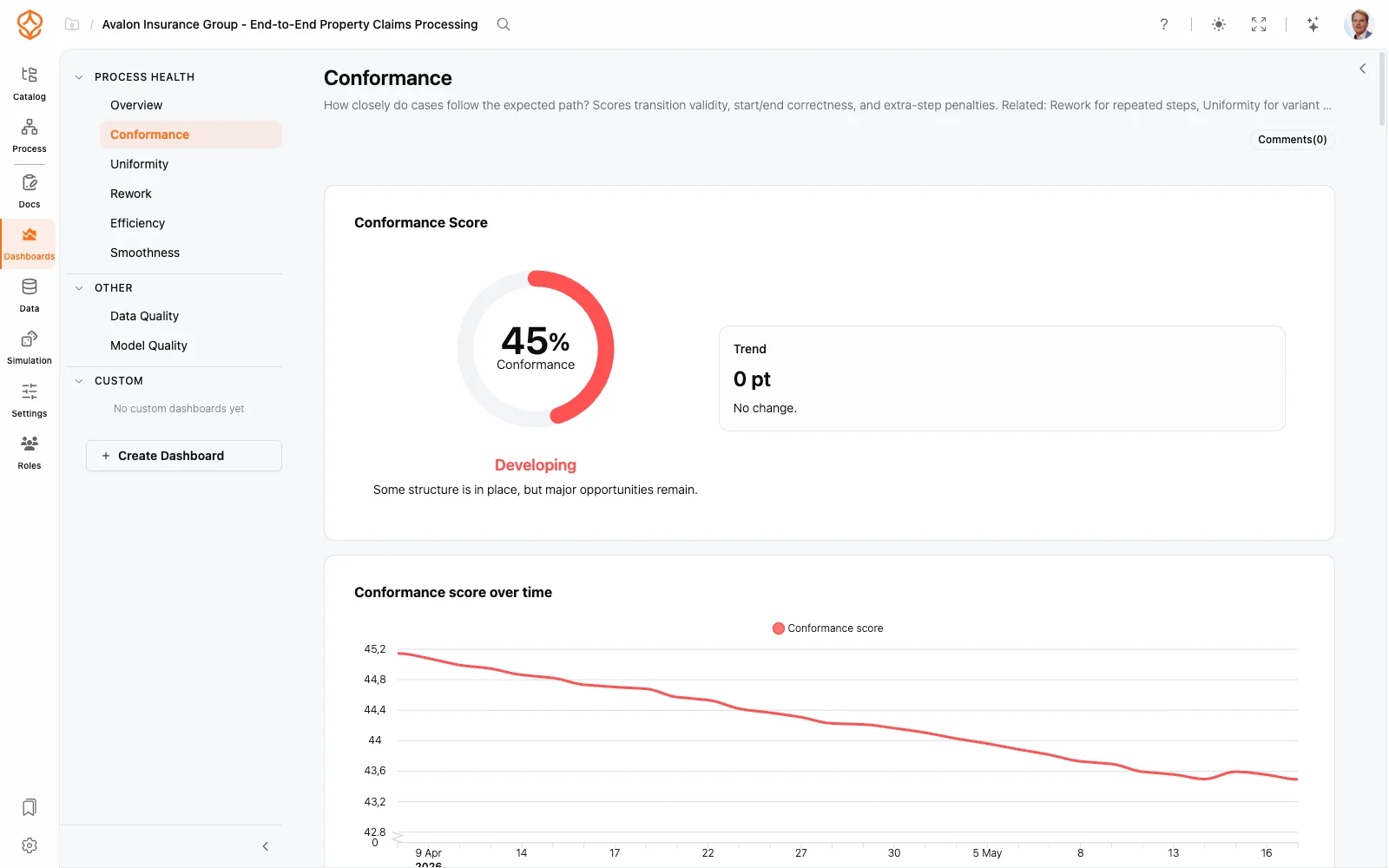
ProcessMind conformance checking view with conformance rate

What Conformance Checking Measures

Conformance checking compares each case in your dataset against your process model and reports:

  • Conformance rate: the share of cases that follow the model without deviation.
  • Non-conforming cases: the cases that deviate, and exactly where they deviate.
  • Deviation frequency: which steps are skipped, repeated, or executed out of order.

The higher the conformance, the more predictable your process, and the lower your operational risk.

Running a Conformance Check

  1. Prepare your model: your BPMN model represents the intended flow.
  2. Select your dataset: the event log with the configured mapping you want to check.
  3. Run the check: ProcessMind aligns every case with the model and flags deviations.

For best results, make sure your data is cleaned and prepared before you start.

Interpreting the Results

  • Low conformance usually signals a gap between the documented process and reality: the model may be outdated, or the process may have drifted.
  • Frequent deviations at the same step point to a structural problem, such as a missing approval or a system limitation.
  • Rare deviations often represent legitimate exceptions that your model should tolerate.

Combine the results with process variants to see which deviation paths are most common and most costly.

Improving Conformance

  • Update your model to reflect how the process actually runs.
  • Remove obstacles that force people to work around the process.
  • Standardize, then verify: rerun the check after a change to measure improvement.
  • Test changes first with simulation to avoid trading one deviation for another.