Analyzing Processes in ProcessMind
Learn how to explore, filter, and understand your process data using ProcessMind dashboards. A guide for dashboard viewers and analysts.
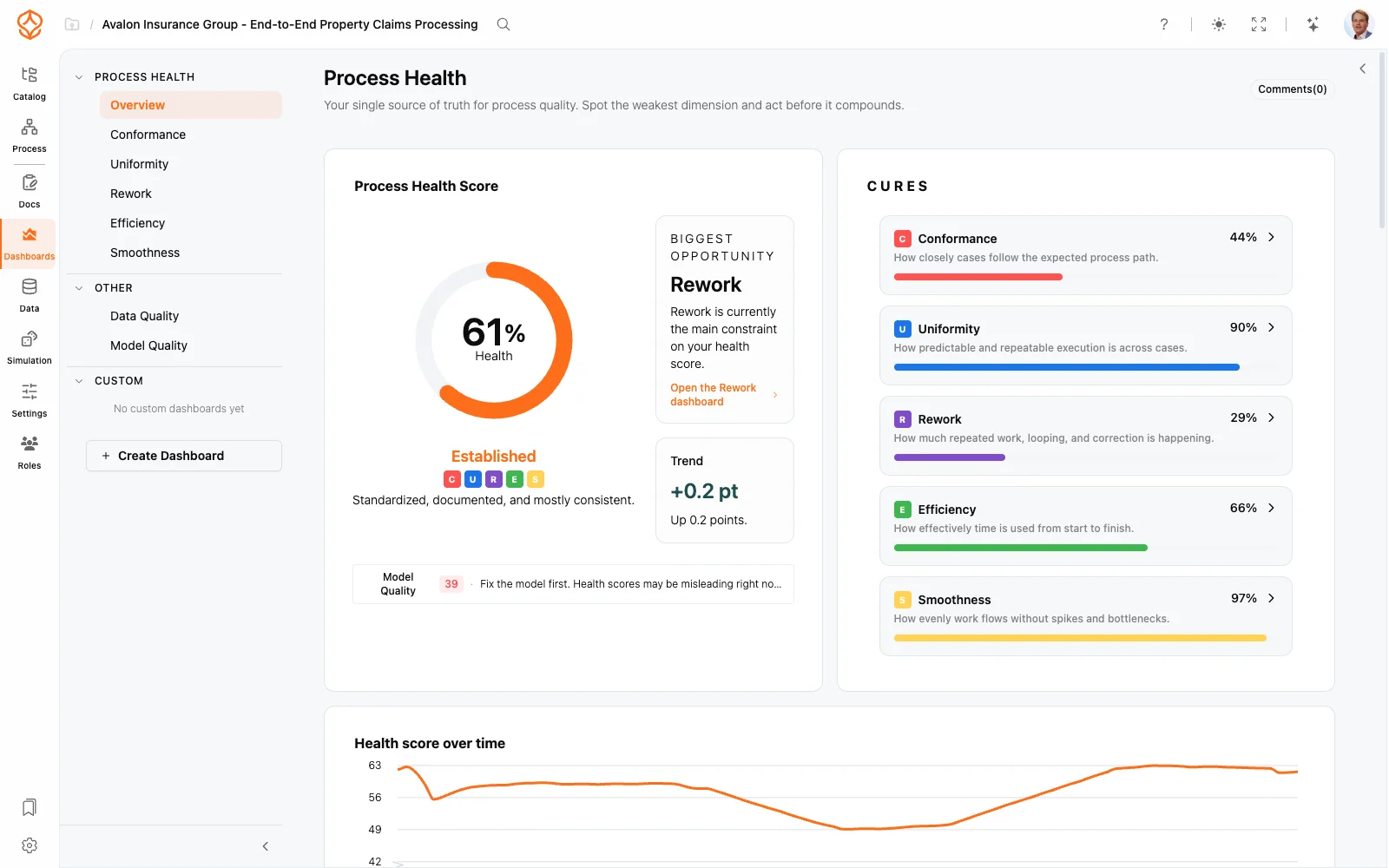
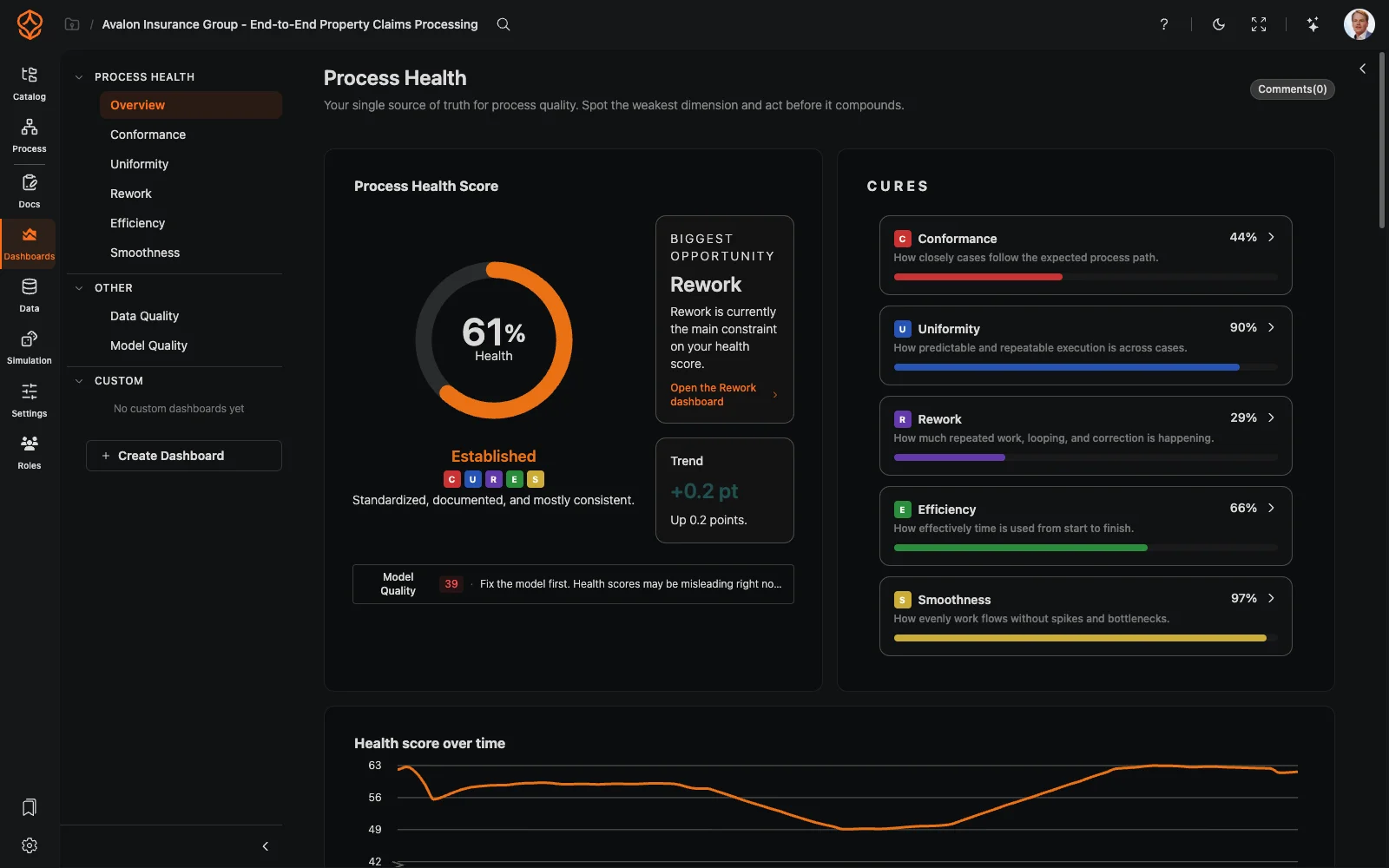
CURES is the framework ProcessMind uses to score the health of your processes. It stands for five dimensions (Conformance, Uniformity, Rework, Efficiency, and Smoothness) that together describe how well a process is actually performing.
The CURES score is the basis of Process Health. Instead of comparing many separate metrics, you get one repeatable score per process, and you can always drill into a dimension to see what is driving it.
Conformance measures how closely cases follow the intended process model.
Use conformance checking to see exactly where cases deviate from the model.
Uniformity measures how consistent and similar process executions are.
Rework measures how much work is repeated or redone before a case completes.
Efficiency measures how quickly work flows through the process.
Use process animation and simulation to see where time is lost.
Smoothness measures how smoothly cases move through the process without delays or interruptions.
The dimensions carry different weights in the overall score. Together they paint a balanced picture: a process can be fast but non-conforming, or smooth but inefficient. A single high-scoring dimension does not make a process healthy; the overall score reflects all five.
We use cookies to improve your experience, personalize content, and analyze traffic. By clicking "Accept All," you consent to our use of cookies.