ProcessMind Configuration and Setup Guide
Set up ProcessMind: learn configuration, environments, billing, SSO, and more for business process management.
In this documentation, environments are the names used in the app. Technically, they are tenants: separate instances with their own configurations, users, and data.
Environments are used to separate data, configurations, and users within an organization. Each environment has its own settings, theme, and URL, allowing for customization and data separation.
info
The environment settings and statistics are only visible to environment admins and organization admins.
All users, data, and configurations are isolated per environment, so there is no cross-contamination of information between environments. This separation protects privacy and security, as each tenant operates independently, even though they belong to the same overarching organization.
By setting up environments in this way, ProcessMind ensures a secure, customized, and scalable workspace for each tenant while allowing centralized control for the organization admin.
tip
Environments share common limits set by the organization, such as the number of users, storage, and the number of environments. If you need more resources, you can always upgrade your plan.
In the environment, you can configure the following:
Environment Name: The name of the environment, used for identifying unique environments in the system. This will also show on the login page when entering the environment.
Environment URL: The URL of the environment, used for accessing the environment. The URL must be unique for each environment.
Example:
https://environmentx.processmind.comis for an environment with the short nameenvironmentx.
Login Options: Choose which identity providers users can use to sign in. The options are:
info
If the field is disabled, it means the organization admin has disabled the option for the environment to change the setting. Environment admins cannot remove themselves from the environment. If you want to remove an environment admin, you need to do this as an organization admin or assign someone else as an environment admin.
Organization admins manage environments from Settings → Environments:
Inside the environment settings, Copy URL to clipboard copies the environment URL. Changing the short name asks for confirmation (Continue) because the URL changes: you and your users then sign in on the new subdomain.
You can customize your environment to match your local preferences using the Regional and Localization Settings panel.
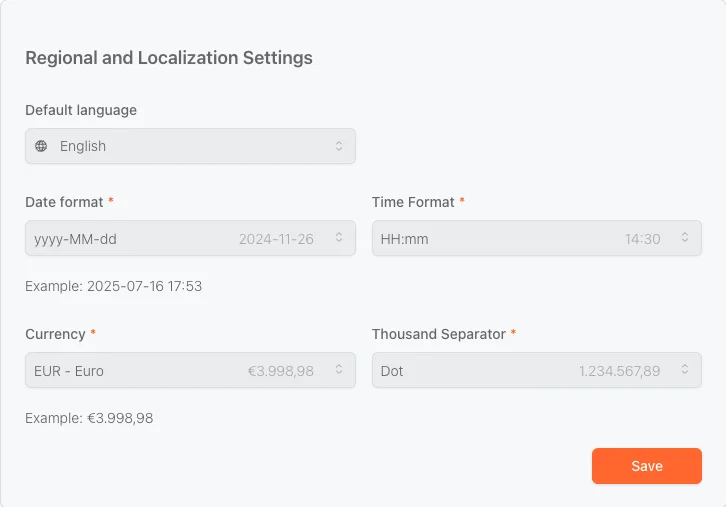
The following options are available:
Default Language
Set the language for your ProcessMind interface (for example, English, Dutch, German).
Date Format
Choose how dates should be displayed (for example, yyyy-MM-dd → 2025-07-16).
Time Format
Set your preferred time format (for example, HH:mm → 14:30).
Currency
Define the default currency for all financial values (for example, EUR, USD).
Thousand Separator
Choose how large numbers are formatted (for example, Dot → 1.234.567,89).
Once your preferences are set, click Save to apply them across your workspace.
These settings will be used for all users in the environment, ensuring a consistent experience tailored to your regional needs.
By default an environment inherits the organization’s company profile. Switch on Use custom company profile for this environment to give the environment its own description, industry, and Company Size. This is useful when a sandbox, a department, or a partner environment represents a different business. Click Save when you are done.
We use cookies to improve your experience, personalize content, and analyze traffic. By clicking "Accept All," you consent to our use of cookies.