Time Metrics: Throughput, Processing, and Waiting
Throughput time, processing time and waiting time measure different things. See what each one counts, whether it is counted per case or per step, and the wordin
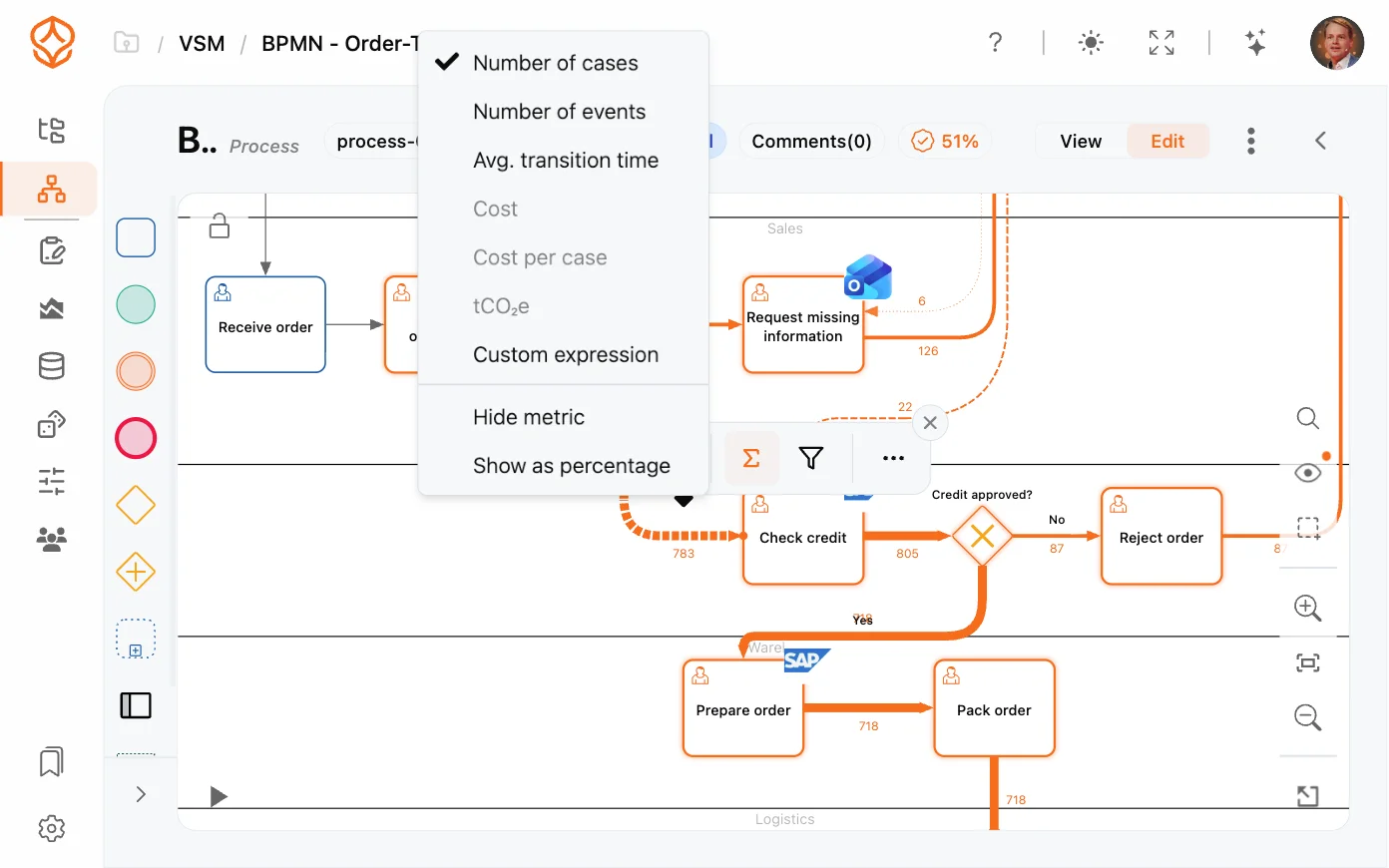
When you apply data to your process model, ProcessMind displays your chosen metric on the connections between activities. Click any connection to open a context menu and select the metric [Σ] you want to display. A connection shows the number of cases, the number of events, the average transition time between the two connected activities, cost, tCO₂e, or a custom expression — the transition time is measured per transition, not per case.
The following metrics are available for charts and KPI tiles. Throughput time metrics always describe the whole case — or the segment between the selected from/to elements — and are averaged per case:
Count Cases
Displays the total number of cases in the dataset or for a specific attribute. Useful for understanding the overall workload or case volume.
Count Events
Shows the total number of events recorded in the dataset. Ideal for tracking activity occurrences or event frequency.
Count Activities
Counts the total number of activity executions across all cases. Helps analyze workload distribution and activity intensity.
Sum Per Event
Calculates the total sum of a numeric attribute per event (for example, total duration, total cost). Useful for cumulative insights.
Avg Per Event
Computes the average value of a numeric attribute per event (for example, average activity duration). Highlights typical performance levels.
Count Distinct
Counts the number of unique values for a selected attribute (for example, unique users, systems, or resources). Useful for diversity analysis.
Min (Minimum)
Shows the smallest value of a numeric attribute (for example, shortest activity time). Benchmarks best-case scenarios.
Max (Maximum)
Displays the largest value of a numeric attribute (for example, longest activity time). Highlights bottlenecks or extreme cases.
Median
Returns the middle value of a numeric attribute to reduce the impact of outliers.
Modus
Identifies the most frequently occurring value in a dataset. Useful for spotting dominant behaviors or attributes.
Measures the total elapsed time from case start to case end, per case. Cases without both boundaries (for example, still open cases) are left out.
See Time Metrics for what is counted per case versus per step, and the wording used for each measure.
Measures the time spent actively processing cases or activities, excluding idle times.
Measures the time cases or activities spend waiting, excluding active work.
Measures the cost associated with cases or activities, based on a mapped cost attribute.
Ratio Cases
Proportion of cases meeting a specific condition relative to the total. Useful for case-level comparisons.
Ratio Events
Proportion of events meeting a condition relative to the total. Useful for analyzing event distributions.
By selecting the right metric, you can tailor your process graph to highlight the insights most relevant to your analysis.
A process KPI is a metric you commit to improving, with a named owner and a target. The metrics above are the raw measures; choosing which of them become KPIs is a decision about what this process is for.
A workable first set for a single process, and the reason each one earns its place:
| KPI | Built from | What it tells the process owner |
|---|---|---|
| Cycle time (P50 and P90) | Throughput time | Typical experience, and worst-case experience |
| Waiting vs active ratio | Waiting time / processing time | Whether the process is slow or the queues are |
| Rework rate | Cases that loop back | Where quality fails, and at what cost |
| First-time-right share | Cases with no rework | The same story, easier to communicate |
| Conformance rate | Deviation from the intended model | Whether the approved standard is followed |
| Throughput | Cases completed per period | Capacity, not speed |
Two cautions that decide whether these get used. Report P90 next to the average, because averages hide exactly the cases that generate complaints. And attach every KPI to a process rather than to a department, because a KPI owned by a function drifts away from the process it is supposed to describe.
Define the KPIs on the process model so they follow the model as it changes, instead of rebuilding a dashboard each time. Process health covers the built-in aggregates, and custom dashboards covers building your own.
Get instant access with no credit card and no waiting. Turn the way your organization works into clear, connected process designs.
Build your process architecture, define ownership and controls, and align roles and responsibilities across every level.
Start your free trial and create one reliable foundation for governing, managing, and continuously improving your processes.
We use cookies to improve your experience, personalize content, and analyze traffic. Anonymous page measurement happens without them; analytics consent adds an identifier that links your visits. By clicking "Accept All," you consent to our use of cookies.