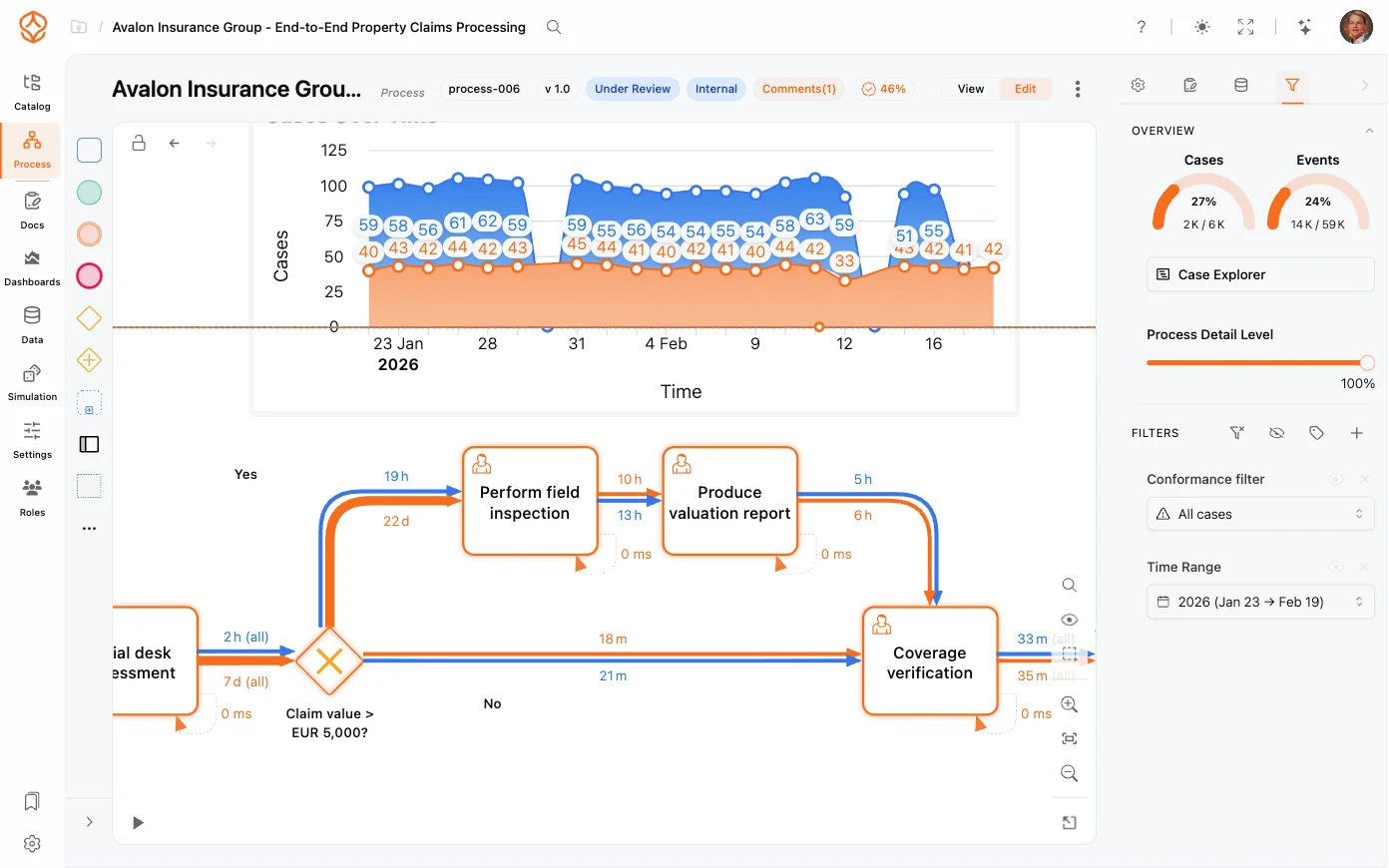
In ProcessMind, you can designate a primary dataset and a comparison dataset to analyze differences in flow, performance, and outcomes across time periods, regions, systems, or any other segmentation.
Setting Up a Comparison
- Choose your primary dataset: the dataset you want to analyze in detail. On the Data page the data sidebar marks it as Primary.
- Add a comparison dataset: in the data sidebar’s Comparison section, click Add comparison and pick the dataset. On a process’s mapping panel you can also use Add Data to Compare under Comparison Datasets.
- Swap or reorder: from a dataset’s menu you can Set as Primary, Move Up, or Move Down to change which side is which.
- Remove one: hover a comparison row in the sidebar and click ✕, or use Remove data from model on the mapping panel.
- Align the mappings: make sure both datasets use the same case ID, activity, and timestamp configuration, or the comparison will not be meaningful.
For how the dataset roles themselves work — switching primary, promoting, or removing datasets — see Primary and Comparison.
Common pairings include last month vs. this month, before vs. after a change, and region A vs. region B.
What You Can Compare
With a comparison in place, ProcessMind highlights the differences:
- Flow differences: activities that appeared, disappeared, or changed frequency between the two datasets.
- Performance differences: time and cost per activity, per case, and per variant.
- Outcome differences: how the distribution of cases changed across the process.
Interpreting the Comparison
- Look for structural changes: a new step or a removed step usually points to a system or policy change.
- Focus on performance gaps: a slower variant in one dataset is a concrete lead for investigation.
- Validate with filters: narrow both datasets with the same filters to compare like with like.
Acting on the Results
Use the comparison to prove impact:
- Before/after analysis: did the change you made actually improve the process?
- Benchmarking: how does one region or team compare to another?
- Forecasting: feed the results into simulation to project what the trend means for the future.