On This Page

Dataset Attributes

Process Intelligence Process Intelligence Available with a Process Intelligence seat or higher. Only seats on this plan or a higher one can use this feature. Compare plans Available with a Process Intelligence seat or higher

Dataset Attributes

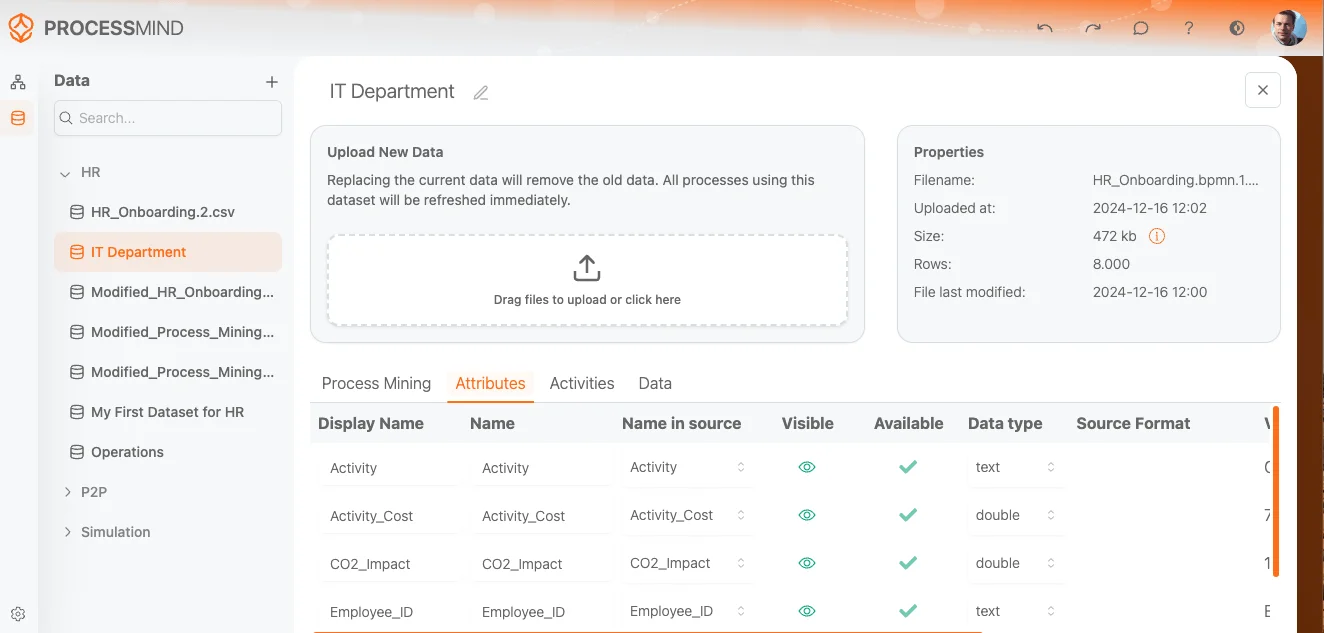
Under the Attributes tab, the screen displays the following columns for mapping and configuring the attributes from the uploaded dataset:
image

Configurable Columns

1. Display Name

Indicates how each attribute will be labeled in the process mining section of the tool (for example, “ACTIVITY”, “Case ID”, “EVENTTIME”). Editing this also renames the attribute.

2. Column in source

Shows the original column name from the uploaded dataset (for example, “ACTIVITY”, “Case ID”, “EVENTTIME”).

3. Mapping / Expression

Shows how the attribute is mapped. Attributes can either reference a column in the source or be computed from an expression — see Calculated Attributes.

4. Visible

Green check marks indicate that the attribute is visible and will be used in the analysis. You can toggle visibility on or off as needed.

5. Data Type

Specifies the type of data in each column. Every type is validated to ensure data integrity and is auto-detected but can be changed if required.

Text

  • Description: Represents string data, such as words or alphanumeric characters.
  • Use When: You should map this to columns containing descriptive information, like activities (for example, “Create Purchase Order”), names, or other textual data.
  • Examples: Names of activities, statuses, categories.

Double

  • Description: Represents a floating-point number (a number with decimals).
  • Use When: This should be used for columns that contain numeric data requiring decimal precision, such as costs, percentages, or measurements.
  • Examples: Costs (125.75), percentages (45.67%), or other decimal values.

Integer

  • Description: Represents whole numbers (no decimals).
  • Use When: Use this data type for columns that contain numerical data where decimals are not needed, such as IDs, counts, or rankings.
  • Examples: Case IDs, counts of items, quantities, or any field with whole numbers.

Timestamp

  • Description: Represents date and time information in a specific format (for example, “yyyy-MM-dd HH:mm:ss”). Format can be changed in the format column.
  • Use When: Map this to any column that tracks the timing of events, such as when an activity starts or ends. This is important for process mining to sequence events correctly.
  • Examples: Event start time, event end time, or timestamps for activities.

Boolean

  • Description: Represents a true/false value.
  • Use When: Map this to columns that contain binary yes/no or true/false values, such as flags or approval statuses.
  • Examples: “Approved”, “IsComplete”, or “Active”.
  • Map to Text when your data is descriptive (for example, names, activities).
  • Map to Double when your data involves numeric values with decimals (for example, costs or percentages).
  • Map to Integer when your data is numeric without decimals (for example, IDs or counts).
  • Map to Timestamp when your data involves time and date information (for example, event logs or activity timestamps).

6. Source Format

For Timestamps, ProcessMind supports the most common formats that will be automatically detected on data upload. However, they can be changed if required.

info

The separator between date and time components (such as in “2024-01-02 20:25”) can be any single character, including symbols like “-”, “/”, “.”, or “:”. Your dataset can hold one or multiple of these separators. The system will remove them and only look at the numbers. In the table below, you’ll therefore only see the formatted date and time without the separator characters.

Display Name Example
ISO 8601 2024-10-08T14:30:45Z
Excel date/time 44829.60416667
yyyy MM dd HH:mm 2024 10 08 14:30
yyyy MM dd HH:mm:ss 2024 10 08 14:30:45
yyyy MM dd HH:mm:ss.SSS 2024 10 08 14:30:45.123
yyyy MM dd HH:mm:ss.SSSSSS 2024 10 08 14:30:45.123456
yyyy MM dd 2024 10 08
yyyyMMdd 20241008
dd MM yy 08 10 24
dd MM yyyy 08 10 2024
dd MM yy HH:mm 08 10 24 14:30
dd MM yyyy HH:mm 08 10 2024 14:30
dd MM yy HH:mm:ss 08 10 24 14:30:45
dd MM yyyy HH:mm:ss 08 10 2024 14:30:45
d M yyyy 8 10 2024
d M yyyy HH:mm:ss 8 10 2024 14:30:45
MM dd yy 10 08 24
MM dd yyyy 10 08 2024
MM dd yy HH:mm 10 08 24 14:30
MM dd yyyy HH:mm 10 08 2024 14:30
MM dd yy HH:mm:ss 10 08 24 14:30:45
MM dd yyyy HH:mm:ss 10 08 2024 14:30:45
M d yyyy 10 8 2024
M d yyyy HH:mm:ss 10 8 2024 14:30:45
d MMM yyyy 8 Oct 2024
d MMM yyyy hh:mm a 8 Oct 2024 02:30 PM
d MMM yyyy hh:mm:ss a 8 Oct 2024 02:30:45 PM
d MMM yy 8 Oct 24
d MMM yy hh:mm a 8 Oct 24 02:30 PM
d MMM yy hh:mm:ss a 8 Oct 24 02:30:45 PM
d MM yyyy 8 10 2024
d MM yyyy hh:mm a 8 10 2024 02:30 PM
d MM yyyy hh:mm:ss a 8 10 2024 02:30:45 PM
d MM yy 8 10 24
d MM yy hh:mm a 8 10 24 02:30 PM
d MM yy hh:mm:ss a 8 10 24 02:30:45 PM
MMM d yyyy Oct 8 2024
MMMM d yyyy October 8 2024
MMM d yyyy hh:mm a Oct 8 2024 02:30 PM
MMMM d yyyy hh:mm a October 8 2024 02:30 PM

7. Values

Displays a preview of the actual data in the dataset for each attribute:

  • ACTIVITY: Contains values like “Create Purchase Order Item” and “Send Purchase Order.”
  • Case ID: Contains unique IDs such as “1116524,” “1116530,” and others.
  • EVENTTIME: Shows timestamps in the format “2016-06-15 00:00:00+00” and “2016-06-17 00:00:00+00.”