Improve Your Business Process

Unlock Insights from Any Business Process
Every business process has hidden inefficiencies waiting to be discovered. ProcessMind helps you identify bottlenecks, eliminate rework, and streamline handoffs, regardless of which systems you use. Our data-driven approach ensures you focus improvement efforts where they'll have the greatest impact.
Download our pre-configured data template and address common challenges to reach your efficiency goals. Follow our six-step improvement plan and consult the Data Template Guide to transform your operations.
Show detailed description
Process mining transforms your operational data into actionable insights about how your business processes really work. Whether you're running SAP, Oracle, Salesforce, or any other system, ProcessMind can help you see the full picture.
Every business process leaves a digital footprint in your systems. ProcessMind analyzes these footprints to reveal the actual flow of work through your organization, not how you think it works, but how it really works. This visibility is the foundation for meaningful improvement.
With ProcessMind, you can identify where cases get stuck, understand why some processes take longer than others, and discover the root causes of inefficiencies. The platform works with any source system, making it easy to get started with the data you already have.
Ready to see your processes clearly? Download our data template to get started, or explore our system-specific guides for detailed extraction instructions.
The 6-Step Path to Process Excellence
Connect Your Data
What to do
Export event data from your source system using our data template or extraction guides.
Why it matters
Quality data is the foundation for accurate process insights and meaningful analysis.
Expected outcome
A clean event log ready for process mining analysis.
Discover Your Process
What to do
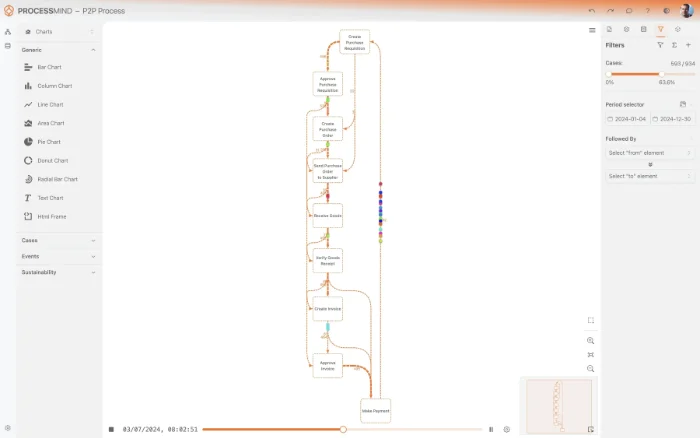
Let ProcessMind automatically generate a process map from your event data.
Why it matters
See how your process actually works, not just how it's documented.
Expected outcome
Visual process map showing all activities, paths, and variations.
Identify Bottlenecks
What to do
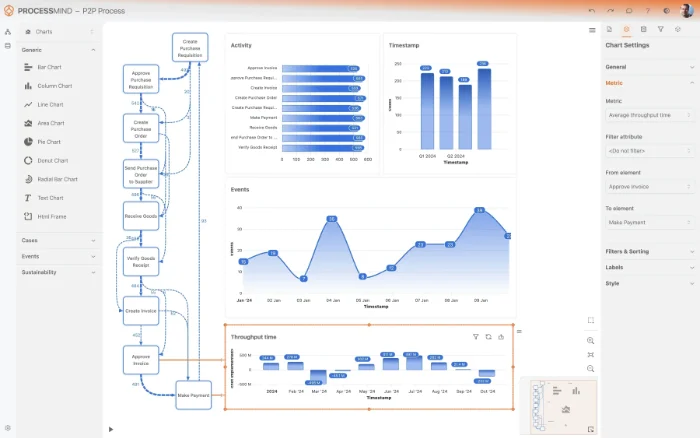
Analyze cycle times and waiting times to find where cases get stuck.
Why it matters
Bottlenecks are often the biggest opportunity for improvement.
Expected outcome
Prioritized list of bottlenecks with quantified impact.
Analyze Variations
What to do
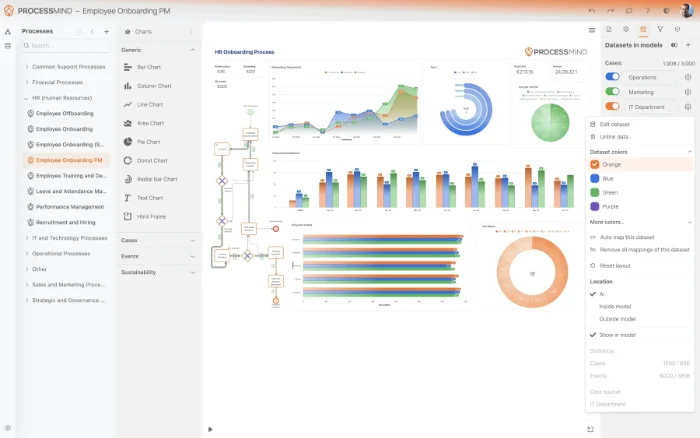
Compare different process paths to understand why some cases perform better.
Why it matters
Best practices can be identified by studying successful process variants.
Expected outcome
Understanding of which variations to encourage and which to eliminate.
Implement Improvements
Why it matters
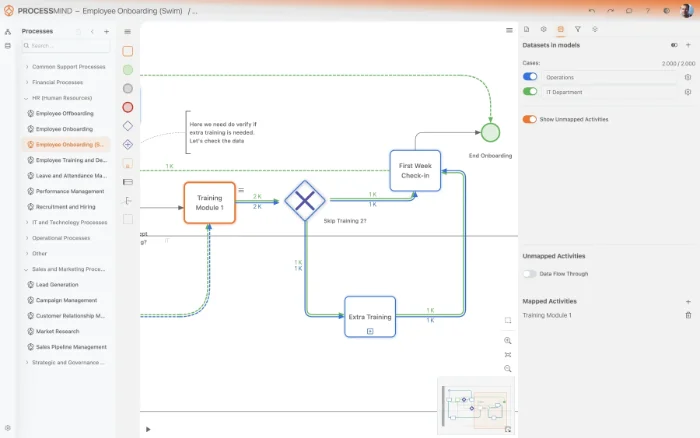
Data-driven improvements are more likely to succeed than intuition-based changes.
Expected outcome
Process changes deployed with clear success metrics defined.
Monitor and Iterate
What to do
Track metrics over time to measure impact and identify new opportunities.
Why it matters
Continuous monitoring sustains improvements and drives ongoing optimization.
Expected outcome
Measurable improvement in cycle time, quality, and efficiency.
WHAT YOU WILL GET
Discover How Your Process Really Works
- Visual process maps from your real data
- Automatic bottleneck detection
- Cycle time and performance analysis
- Actionable improvement recommendations
TYPICAL RESULTS
What Organizations Achieve
Process mining delivers measurable improvements across key performance indicators. Here's what organizations typically achieve when they apply data-driven process optimization.
Average reduction in end-to-end time
Organizations typically see significant reductions in total process duration by identifying and addressing bottlenecks.
Reduction in processing costs
Eliminating rework and optimizing resource allocation leads to measurable cost reductions.
Improvement in process adherence
Continuous monitoring ensures cases follow the correct path, reducing compliance violations.
Complete process transparency
Gain full visibility into how work actually flows, revealing previously hidden inefficiencies.
Faster resolution times
Shorter cycle times and fewer errors lead to happier customers and employees.
Results vary based on process complexity, data quality, and implementation scope. These figures represent typical improvements observed across various implementations.
Recommended Data
For customized data recommendations, choose your specific process.
FAQs
Frequently asked questions
You need an event log with three essential fields: Case ID (unique identifier for each process instance), Activity (what happened), and Timestamp (when it happened). Optional fields like User, Department, and Status enhance your analysis but aren't required to start.
With clean data, you can have your first process map within minutes of uploading. Meaningful insights typically emerge within the first few hours of analysis. Implementing improvements and measuring their impact takes weeks to months depending on your process.
ProcessMind is designed for business users, not just data scientists. The interface is intuitive, and many insights are automatically surfaced. However, extracting data from your source systems may require IT support initially.
Traditional process mapping relies on interviews and assumptions about how work should flow. Process mining shows you how work actually flows based on real data, revealing variations and exceptions that manual mapping misses.
ProcessMind works with any system that can export event data. We have specific guides for major systems like SAP, Oracle, Salesforce, and ServiceNow. For other systems, our generic template helps you structure your data correctly.
We recommend at least 1,000 cases (process instances) for statistical significance. More data provides better insights into variations and edge cases. Start with 3-6 months of data if possible.
Yes. ProcessMind uses enterprise-grade security including encryption in transit and at rest. We're SOC 2 compliant and can operate in your preferred region. You can also anonymize sensitive data before uploading.
Process mining works best for processes that are transactional and leave digital traces in your systems. If activities are recorded with timestamps, process mining can analyze them. Highly manual or unstructured processes may have limited digital footprints.
Start Optimizing Your Process Today
See your process clearly for the first time with ProcessMind
No credit card required