

Process Mining Last updated November 7, 2026
Why ProcessMind: The Story Behind the Product
What we learned at ProcessGold and UiPath, why the model and the data belong together, the loop we built around them, and the company-wide architecture we are working towards.

Why ProcessMind: What We Set Out to Build
People ask why ProcessMind exists. The short answer is one loop: mine what happened, design what should happen, and simulate the change.
We built it because we kept meeting the same gap. Process mining shows a team how work really runs. A process model says how the work is meant to run. In most toolchains those two answers sit in different products, owned by different people, and the analysis stops before anyone connects them.
The moments that convinced us were small. Someone opens a process they have worked on for years and reacts the same way every time. “Now I can see the process I’ve been working on for years.” “This is what we expected, and now we have data to check it.” “I had no idea that was happening.”
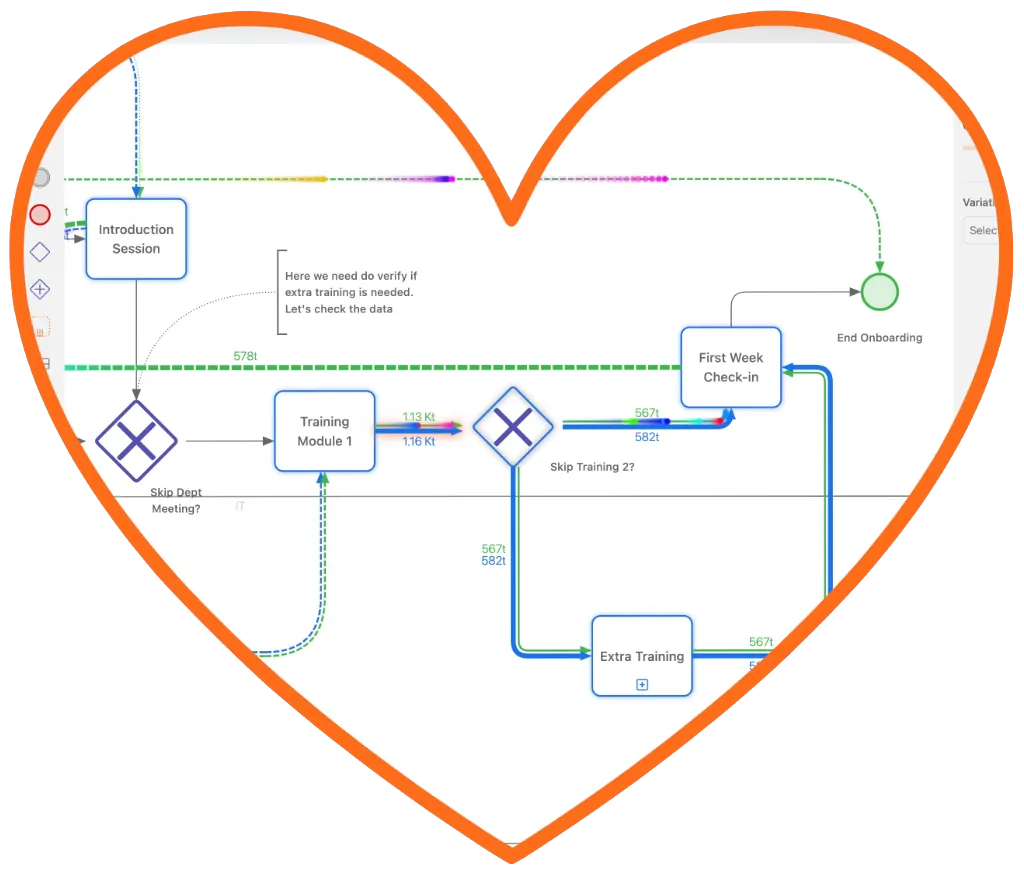
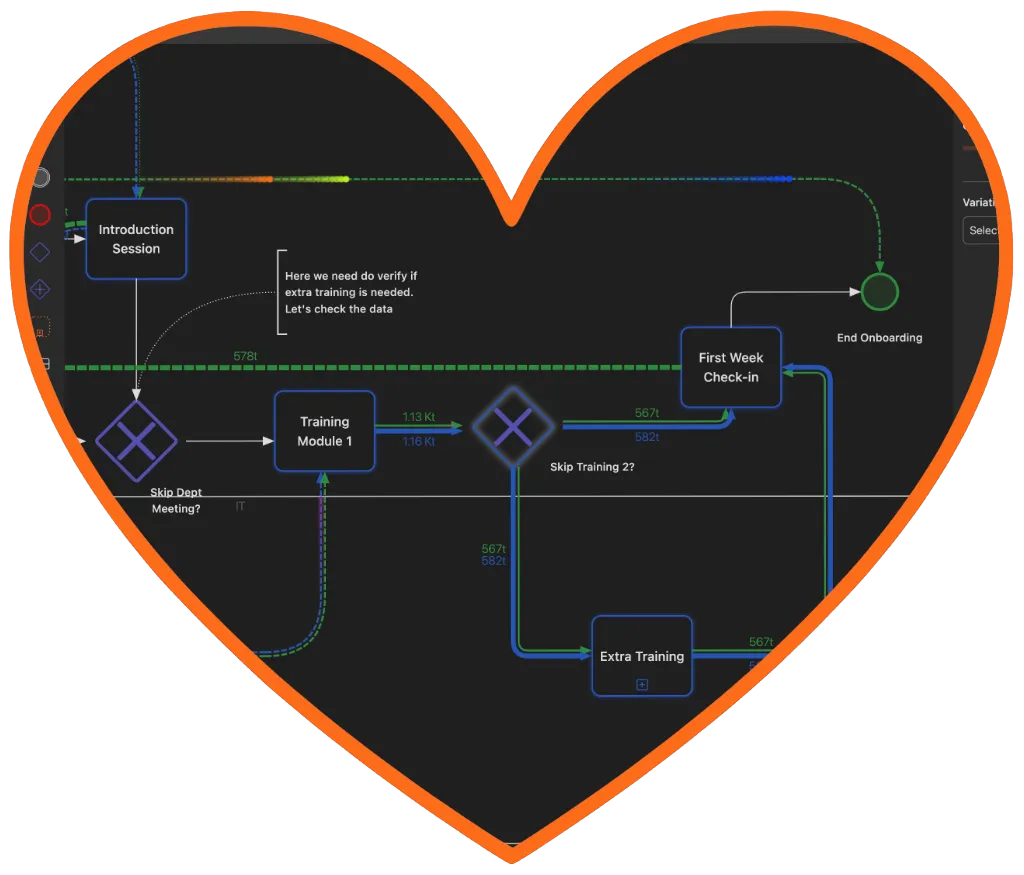
Those reactions matter because process knowledge is spread across documents, systems and people’s experience. A diagram shows the process as intended, the data shows what actually happened, and neither view alone tells you what to change next. We wanted more people to reach that moment on their own questions, without a project standing in the way.
What we learned at ProcessGold and UiPath
ProcessMind is built by the founders of ProcessGold, which UiPath acquired in 2019. Those years shaped how we think about the problem, and they are the reason the product looks the way it does.
We had seen event data show the paths work really takes, and seen that evidence answer questions no process document could. We also learned that analysis on its own rarely changes anything.
What changes a process is a shared picture: the numbers sitting on a model the team recognizes as their own, in a notation the rest of the organization already reads. That is a modeling problem as much as an analysis problem, and in most toolchains nobody owns it.
What Everyone Else Got Wrong
A toolchain of separate tools looks flexible in a comparison table and costs far more than the licenses.
We kept meeting the same three problems. Getting started took a project: a specialist, a wait, and usually a connector before anything could be loaded. Pricing arrived at program level, so access was decided by whoever could fund a business case rather than by the people closest to the work. And every question had its own tool, which is why mining, modeling and simulation so rarely met.
None of that is a technology problem. It is a packaging problem, and it decides who gets to ask a question about their own process.
The comparison between tools is usually made on capabilities. The difference that matters is how much has to be in place before the first useful answer arrives. Our experience at ProcessGold and UiPath gave us a view of both halves: what the technology can show, and how much work surrounds it before anyone sees it.
What We Decided to Build Instead
One workspace, one loop: mine the data, design the process, simulate the change.
ProcessMind is an all-in-one process intelligence platform. Mining, BPMN 2.0 modeling, simulation, dashboards and governance share one workspace and one dataset, so there are no exports to move between tools and nothing to re-import when a model changes.
AI runs through every step of that loop. It maps the columns of an upload, generates a first diagram from a description of the process, and points at where time is lost. It is part of the platform rather than a module you buy alongside it, and every plan includes an AI credit allowance, because that is what keeps the loop short enough for a business team to run.
The model and the data belong together
A data-driven view reveals the paths cases took. A process model gives you a way to describe how the work should happen. We wanted both in the same place, rather than letting an algorithm define the whole picture.
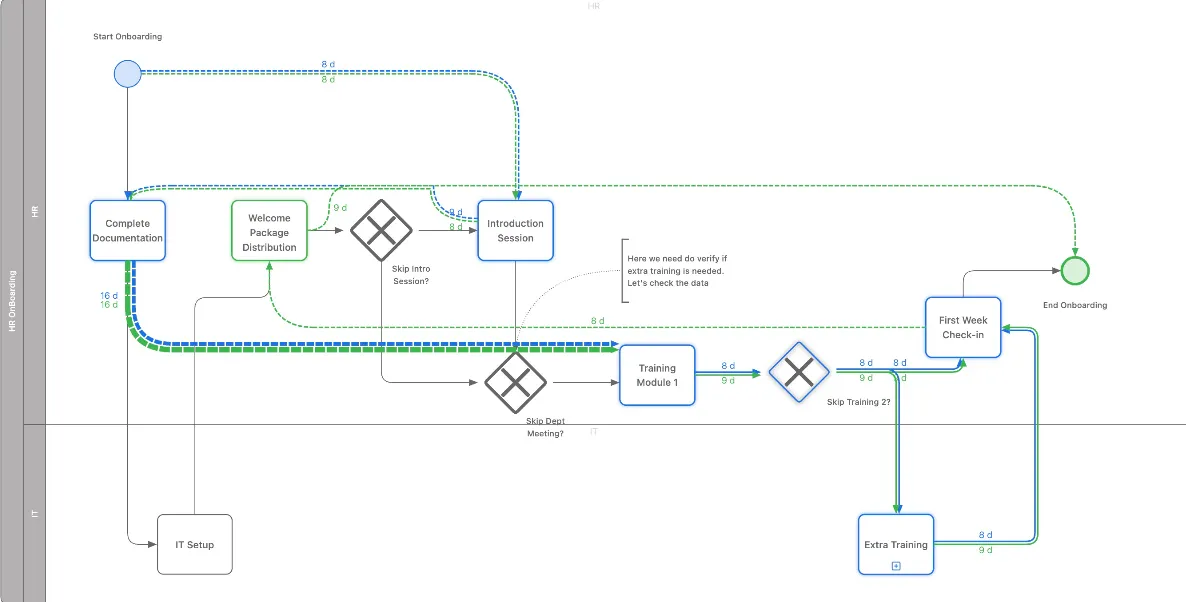
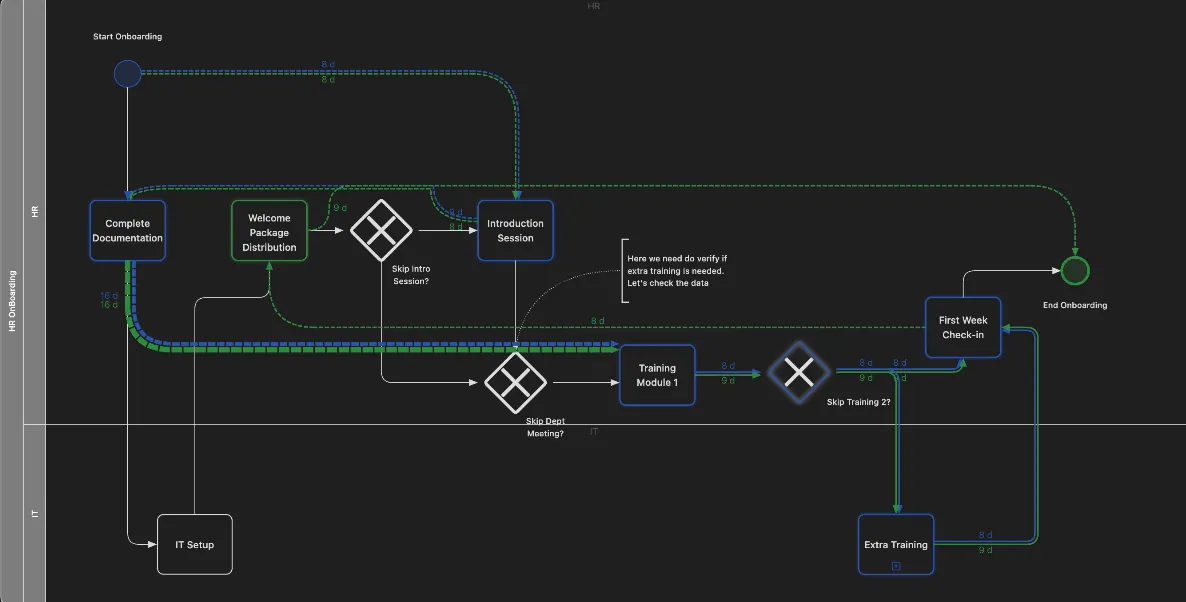
You can start from a model and validate it against data, or explore the data first and refine the model as you learn. BPMN carries more than simple splits and joins: parallel activities, Subprocesses and swimlanes are all part of the notation, and models import and export, so your process knowledge is not locked into our editor.
A team can use ProcessMind for modeling alone. If a team only needs to document a process, agree how it should run and settle who owns it, Process Foundation gives them a full BPMN editor with AI generation, automatic layout and collaboration, and Process Architecture adds the landscape, RACI and governance around it. Nothing pushes a modeling team into mining. When they do want evidence, it arrives on the model they already have, so conformance, variants and simulation do not send anyone back to a second tool. A team can stay at the level it needs and move up when a question demands it.
Your team reviews and updates the model, and it stays the reference point for the analysis. Keeping both together is the part we care about most: the knowledge stays with the people who own the process, in a form the next person can read.
Simulation is part of the same model
Analysis explains what happened. Simulation explores what could happen under different assumptions. We included it because improvement decisions involve trade-offs that historical data alone cannot settle.
The same BPMN model does both jobs. You can put a simulated result beside the real data and see the effect of a change before anyone commits to it, whether that is an extra reviewer, an earlier check or a step removed. Simulation does not make the decision or guarantee an outcome. It gives you a number to argue with. You can read more about how process simulation works.
Start from the data you already have
The best starting point is an export you already have, including a spreadsheet someone keeps on the side.
Upload it and AI maps the columns to the process, so a first answer arrives before you have decided anything about integrations. If the process does need a recurring feed later, the REST API covers it: a job your team already schedules uploads the export on its own timetable. That is a smaller step than a connector project, and it is still not the entry fee.

Published per-seat pricing, on purpose
Self-service access and per-seat pricing are the same decision as the rest of the product. You can sign up, load your own data and decide later who else needs a seat. The cost follows the people who need access, not the size of a program.
Prices are on the website. Every plan lists what it includes and what it costs in the currency you pay in, and Enterprise starts from that same list, with the agreement covering the rollout terms. A team can work out what access will cost before talking to anyone, which is the same principle as self-service one step earlier. You can compare the plans yourself.

ProcessMind runs in the cloud, so there is nothing to install and nothing to keep patched. Sign-in works with the identity provider you already use, tenants keep data and users separate, and hosting is in the EU.
Access control and process ownership are part of the platform rather than an enterprise add-on, because the people who need to look at a process are usually not the people who bought the software. You can review the platform to see how the capabilities fit your requirements.
We love our product, of course. But what we love more is helping people understand their processes and then improve them. The software is how we get to do that, not the reason we do it.
What We Got Wrong Along the Way
We do not assume a decision is right because we made it. Building ProcessMind has meant learning where our assumptions needed work.
- We expected the first view to be self-explanatory. A useful result still needs context. We have had to make it easier to see what the data shows and how it relates to the process model.
- We underestimated how much the model adds. We came from a process mining world where mining and modeling are two separate jobs, in two separate tools, often done by two different kinds of people. It is not hard to imagine them unconnected, because that is how most of the market still works. Seeing the two together, with the numbers sitting on the flow, changed how we read a process.
- We learned that flexibility needs guidance. Options are not help if you cannot tell which one fits your question. We keep working on the step between a first analysis and a useful next action.
Why We Stay a Software Company
We build software. We do not sell implementation projects, and we are not trying to become a services organization.
That choice shapes who we work with. Changing a process belongs to the people who run it, sometimes with a consultancy beside them, so we leave that work to partners. Some of them deliver projects on the platform, and some white-label it under their own brand. We keep the product, the pricing and the support. The partner gets a platform worth building a practice on, and we get into processes we would never reach alone. Each side brings something the other needs, and neither gets it by squeezing the other. That is the partnership we want. If you work that way, partner with us.
The same thinking covers research and teaching. The Academic Alliance gives universities and students the platform free of charge, because the people who will improve processes in ten years are learning the methods now.
It also keeps our incentives honest. If the software only worked with a consultant in the room, we would be selling the problem instead of the fix. It has to be useful to a team on its own. Growing by adding a person to every deal is not the company we want to run.
Who We Are
ProcessMind was built by a team with experience at ProcessGold and UiPath. That background informs the product, but it does not replace the work of listening to the people who use it. We want it to be easier for teams to share what they know, see what the evidence supports, and decide where to improve.
A tool cannot know your process better than the people who run it. Our job is to make what they know easier to share, check against evidence, and improve. You can learn more about the ProcessMind team, meet our blog authors, or visit our careers page.
What’s Next
The direction is bigger than a single process. A company’s processes already form one architecture: value streams and capabilities at the top, the processes beneath them, and the activities and systems at the bottom. In most organizations that architecture lives in a document that is out of date the day it is published, if it exists at all.
We want the models to be that architecture. Every system that touches a process sends its events into the model, through an API call today and tighter integrations as we go. Every KPI rolls up from the process to the department to the company. AI does the first pass of the analysis, so the people who run the work see what changed without asking for a report. That is what process intelligence means to us over the long term: a company that can steer on its own process data, with access for everyone who needs it, not a dashboard for the few who can read it.
The next steps are unglamorous. We need more of the formats teams actually export and more of the systems they actually run. We need better default analysis for the questions people ask most. And we need to remove more of the reasons to bring in a specialist before asking your own question.
ProcessMind is not a substitute for your judgment or your knowledge of the organization. It is a place to bring both together and test them against evidence.
Where to Go From Here
The claim on this page is worth nothing until it runs against a process you know, and you do not need a connector or a sales call to try it.