


Lean Process Improvement: A Data-Driven Guide
A practical guide to lean process improvement with DMAIC, data for each phase, an order-to-cash example, and common failure modes.

Lean process improvement gives you a structured way to find where work loses time or quality, then test changes against evidence. This guide explains how Lean Six Sigma and DMAIC support that work, what data each phase needs, and how the cycle applies to an order-to-cash process. The focus is a defensible baseline, analysis that tests assumptions, and controls that help improvements last.
Lean process improvement is more than a collection of tools. DMAIC gives you a practical structure for investigating a process and deciding what to change.
What Lean Six Sigma Is and What It Is Not
Lean, Six Sigma, and Lean Six Sigma are related, but they address different problems.
| Lean | Six Sigma | Lean Six Sigma | |
|---|---|---|---|
| Focus | Waste in the flow of work | Variation and defects | Waste and variation |
| Typical measures | Lead time, cycle time, work in progress | Defect rates and their causes | Cycle time, cost, and rework |
| Common tools | Value stream mapping, kaizen, 5S | DMAIC, control charts, design of experiments | DMAIC applied to an end-to-end process |
| Can fall short when | Speed takes priority over quality | Statistical analysis loses sight of the flow | Either focus is treated as optional |
Lean aims to remove work that does not add value, such as waiting, unnecessary handoffs, and rework. Six Sigma aims to reduce variation and defects. Lean Six Sigma combines these goals in a structured improvement effort.
Lean mapping, including value stream mapping, helps you represent how work should flow. Process data can add a view of how cases actually move through systems. Together, the map and the data give your team a basis for discussing where the process differs from expectations.
It is also useful to be clear about what Lean Six Sigma is not:
- It is not a certification program. Belts are a training format. A credential does not replace a measured baseline or a real improvement project.
- It is not a substitute for process knowledge. DMAIC structures the investigation, but your team still needs to understand the work and its constraints.
- It is not a one-time project. The Control phase gives you a way to monitor the process after the project team moves on.
- It is not limited to manufacturing. Office processes also involve waiting, rework, handoffs, and unnecessary steps.
Why DMAIC Needs Data, Not Opinions
DMAIC includes a Measure phase because you need a baseline before you can tell whether a process has improved. Without one, Analyze can turn into a debate about whose recollection is right.
Manual observation and sampling can help you understand a process, but they cover only the cases and steps you observe. In office processes, work may span an ERP, a CRM, a ticketing system, and spreadsheets. No single observer sees every case from start to finish.
When systems record a case reference, activity, and timestamp, you can use those event records to reconstruct how cases moved through the process. The work shifts from collecting each observation by hand to checking the data and interpreting the results. Process mining provides one way to examine those records across the process.
That comparison between documented and actual work can reveal two kinds of gaps:
- Steps shown in the diagram but missing from practice. A control may no longer happen, or an approval may no longer be required.
- Steps happening in practice but missing from the diagram. A workaround may have become routine without a clear owner or review.
This runs both ways. DMAIC needs data, and data on its own has never improved a process; you also need a method to turn it into change. Use the data to stop guessing, and use change management to get past a slide deck of findings.
The Five DMAIC Phases for Lean Process Improvement
DMAIC follows five standard phases: Define, Measure, Analyze, Improve, and Control. Each phase answers a different question and produces a different deliverable. These lean process improvement steps help you move from a defined problem to a monitored change.
| Phase | Question | Deliverable | Data or evidence |
|---|---|---|---|
| Define | What problem are you addressing, and how will you measure it? | Problem statement, scope, and CTQs | A clear definition of where a case starts and ends |
| Measure | How does the process perform now? | A validated baseline | Cycle time, cost, and rework per case |
| Analyze | What explains current performance? | Evidence-backed root causes | Bottlenecks, variants, and conformance |
| Improve | Which change should you test? | A tested change | Scenarios compared with the baseline |
| Control | How will you keep track of performance? | Monitoring plan and ownership | Dashboards, thresholds, and review cadence |
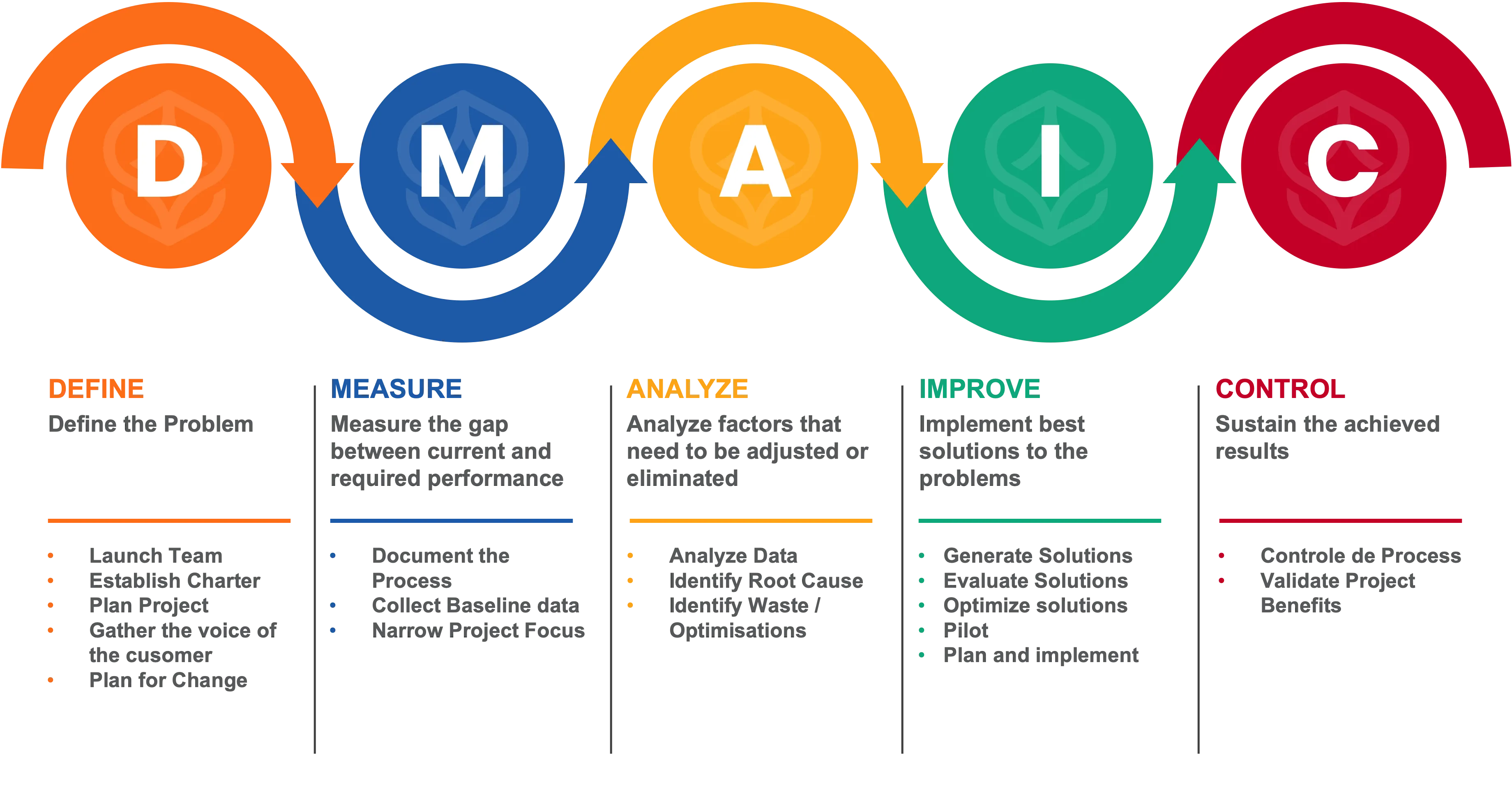
Define: Set the Problem, Scope, and CTQs
What data replaces: assumptions about which cases and activities belong in scope.
Define the problem you want to solve, the boundaries of the process, and the critical-to-quality (CTQ) measures that matter to the customer or business. Start by agreeing on what counts as one case. It could be an order, ticket, invoice, or claim. That choice determines which events you group together and affects every measure that follows.
Use process data to check whether the team’s initial view matches how work runs today. The analysis may surface variations or measures that did not come up in a workshop. Document the scope in a process map or BPMN diagram so the team can review the same picture.
A useful outcome: a scope one team can own, a case definition everyone understands, and CTQs you can measure with available data.
Measure: Establish a Baseline for Cycle Time, Cost, and Rework
What data replaces: estimates and small samples used as a stand-in for current performance.
Measure the process against the CTQs you agreed on in Define. A useful baseline can include cycle time, cost, and rework per case, depending on the data available and the project’s scope.
If the process spans multiple systems, check how you will connect their records. Joining logs on an agreed case identifier can help you follow a case across systems. Validate the join and the underlying timestamps before relying on the results: a partial or incorrect join can make a baseline look more certain than it is.
Use the baseline to describe current performance before setting a target. Keep the measures tied to the problem statement rather than choosing metrics only because they are easy to extract.
A useful outcome: a baseline the process owner can review, including the assumptions and data limitations behind it.
See how to establish a baseline from real process data.Analyze: Find Bottlenecks, Variants, and Conformance Gaps
What data replaces: workshop hypotheses that have not been checked against actual process behavior.
Analyze the evidence to understand why performance varies. Look for where delays accumulate, which process variants occur, how much volume follows less common paths, and where cases differ from the intended process.
A process variant is one of the paths cases take through the process. Comparing variants can help you see whether a delay is widespread or concentrated in a specific route. Conformance analysis compares actual behavior with the intended process, helping you identify where the two differ.
Rank potential causes by their impact and test them against the data. Strong analysis may confirm the team’s original hypothesis, but it may also show that the main constraint lies elsewhere. For a practical walkthrough, see how to analyze a process and find bottlenecks.
A useful outcome: a prioritized set of potential root causes, supported by evidence and open to challenge.
Improve: Prioritize and Test Changes Before Rollout
What data replaces: choosing a change because it is familiar or easy to announce.
Use the analysis to identify changes that address the causes you found. Compare expected impact with the effort and risk involved. Where you can, model the proposed process and simulate scenarios before rollout. This lets you explore how a change might affect the process without treating a simulation as a guarantee of what will happen.
Document the target process so the people doing the work can understand the new flow. After implementation, measure the same indicators you used for the baseline. That comparison helps you assess whether the change improved performance or introduced a new constraint elsewhere.
A useful outcome: a change tested against the baseline, with a plan to check actual performance after rollout.
Control: Monitor Performance, Dashboards, and Ownership
What data replaces: relying on occasional audits or memory to notice when performance changes.
Control is the phase that helps you sustain an improvement. Choose the measures you will monitor, set thresholds that prompt a review, and name the person responsible for responding. A dashboard can help the process owner see whether performance is changing and where to investigate.
Agree on a review cadence and what action to take when a measure moves outside its expected range. As volumes or case mix change, review whether the process and its targets still make sense.
A useful outcome: a named owner, clear review expectations, and measures that help you spot regression and decide what to do next. For more on ongoing measurement, read how to continuously monitor your process.
A Worked Example: Order-to-Cash
Here is how the five phases could apply to an order-to-cash process. The figures below illustrate one example; they are not a promised result.
Define. The project covers order-to-cash for one product family. A case starts when an order is accepted and ends when its invoice is paid. The CTQs are invoice accuracy and time to cash. Because the concern is late cash collection, payment is a more relevant endpoint than shipment.
Measure. The team joins event data from the ERP and billing system using the order number. The baseline shows a median of 34 days from order acceptance to payment. Eleven of those days fall between invoice generation and dispatch.
Analyze. The delay is concentrated in specific paths. In the example, 22% of orders go through a manual credit check that adds nine days, and one in six invoices is reissued, resetting the payment clock. Neither path appears in the documented process model.
Improve. The team considers raising the credit threshold so manual checks focus on exceptions. A simulation using historical data suggests this could remove nine days for 18% of orders without increasing bad debt in that data. The team would still need to review actual performance after implementation.
Control. The team tracks the share of orders taking the manual path and sets a threshold for review. The order desk owns the measure, and its dashboard is available to the team responsible for the process.
Common Failure Modes in Lean Process Improvement
A DMAIC project can follow the right steps on paper and still fail to produce useful change. Watch for these patterns:
- Belt-driven bureaucracy. The team spends time on project documents before checking the process or its data. Charters and stakeholder maps can help, but they are not evidence of progress by themselves.
- No defensible baseline. If Measure is skipped or based only on a survey, Analyze has little to test. Without a starting point, you cannot make a sound comparison later.
- Scope set at program level. A broad program may have no single owner, case definition, or measure that one team can influence. Narrow the scope to a process with clear boundaries and accountability.
- The improvement is chosen before the analysis. If the team has already decided what to automate or redesign, it may look only for evidence that supports that choice. Use Analyze to test the proposed cause, not to justify a predetermined solution.
- No Control phase. If nobody owns the measures after the project ends, performance changes may go unnoticed. Define the owner, thresholds, and review cadence before closing the project.
How ProcessMind Supports Each DMAIC Phase
ProcessMind can help you examine process data, document process flows, analyze performance, and simulate proposed changes. It supports the investigation; your team decides which changes to make and implements them. These lean process improvement tools add evidence to the DMAIC cycle without replacing process expertise or ownership.
| Phase | How ProcessMind can support the work | Learn more |
|---|---|---|
| Define | Explore event data to understand how cases move and clarify the case definition. | Process mining |
| Measure | Analyze process data to establish a baseline for the measures in scope. | Analyzing processes |
| Analyze | Examine process variants, bottlenecks, and differences from the intended path. | Process variants and conformance checking |
| Improve | Model a target process in BPMN and compare scenarios through simulation. | Process simulation and what-if analysis |
| Control | Use dashboards and process health views to monitor measures and identify changes that need review. | Process health |
The phases work from a shared process definition. When each phase uses different data or a different view of the process, your team may spend time reconciling those differences instead of evaluating the improvement.
For an overview of the analysis workflow, see how to analyze process data. To see how process modeling and process mining complement each other, read the combined role of process modeling and process mining.
Getting Started with a DMAIC Project
Use these steps to move from a broad improvement goal to a project your team can measure. This lean process improvement model keeps the first cycle focused on a process your team can define, measure, and review:
- Choose a process with a clear owner. If nobody owns the process, it will be difficult to assign responsibility for the Control phase.
- Agree on the case definition. Record what starts and ends a case, and identify which systems capture those events.
- Measure before you improve. Establish a baseline before workshops or redesign work set a target state.
- Keep the first cycle focused. Start with a scope your team can investigate and review, then use what you learn to decide what to examine next.
Once you have tested a change, take the improvements into implementation.
Where to Go From Here
Start your DMAIC project with a measured baseline.