

ProcessMind Pricing
How we price process mining: mixable seats, included viewers, metered usage, partner seats reusable across clients, and a calculator.
Process mining pricing is usually a quote, and a quote is a story told by the person who wants your signature.
We publish the list instead: every seat, every pack, every annual rate, in the currency of the country you choose. The pricing calculator turns it into a number before you talk to anyone at ProcessMind.
This post explains where those numbers come from, what we left out of the model on purpose, and why a public price is better for both sides of the table.
We have seen these prices before, and we think they were absurd
ProcessMind was built by the founders of ProcessGold, which UiPath acquired in 2019. In those years we sat in a lot of rooms where process mining was priced, and we watched how the number was assembled.
Some quotes were per process. Some were per connector, per server or per named user plus a platform fee. Some were one large annual figure that arrived with an implementation project attached. By the time the number reached the person who would actually use the software, the price had become a budget decision rather than a product decision.
We think several of those prices were absurd. Not because the work has no value, but because the unit was chosen to make the number bigger: a process nobody can define, a connector you may not need, a platform fee for capacity you may never reach. When the unit is unclear, a buyer cannot compare anything, so the buyer negotiates instead.
The software was often good. The pricing decided who got to use it.
We have written those large quotes ourselves. What changed for us is the conviction that a price should follow the work the software does and the people who use it, not the size of the budget in the room. If we cannot explain a price on one page, it is probably not a fair price.
We wrote the longer story in why we created ProcessMind. The short version is that we wanted the whole loop, from data to model to simulation, to be reachable for a team rather than only for a funded programme.
What makes up our process mining pricing
A process mining pricing model has to answer two questions: who uses the platform, and what does the platform process. Ours answers both, and publishes the result.
Three things make up the price:
- Seats. The people who model, govern and analyze.
- Usage. The AI actions, data processing, simulations, dashboards, exports and API calls the platform performs.
- Add-ons. Extra portal viewers, dashboard viewers, credits and environments, when a seat needs more than it includes.
Per seat pricing answers the first question, usage answers the second, and there is no implementation fee or connector fee in that list. You can start with an export you already have, and we skip out-of-the-box connectors because a connector project is a cost that arrives before the first answer.
How much does process mining cost?
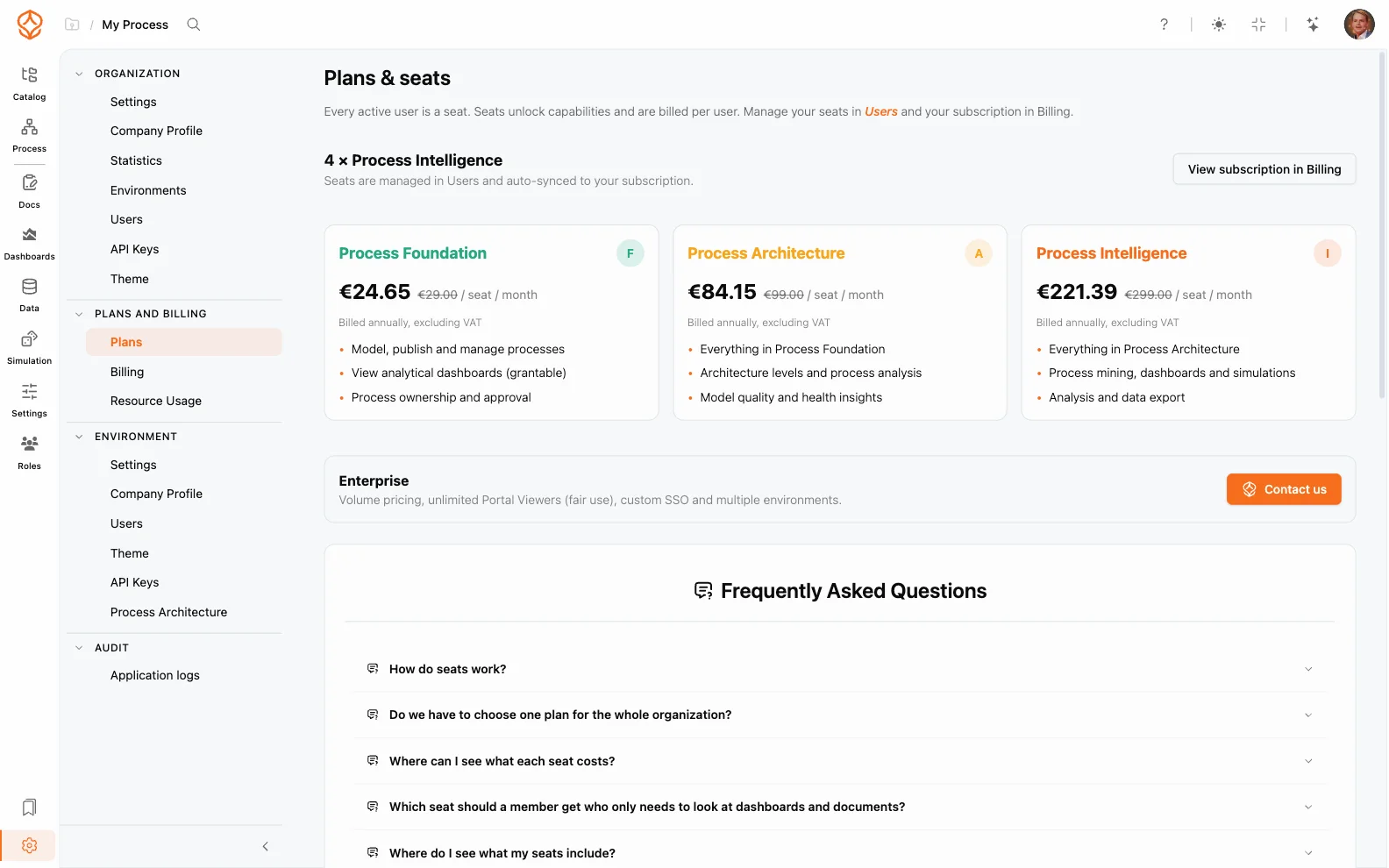
On our list, the process mining cost of a team is the sum of its seats and its add-ons, and nothing else. A single modeler pays for one seat. A process office pays for its architects and gets ten portal viewers with each one. An analytics team pays for Intelligence seats and gets three dashboard viewers on top.
The process mining price you see in the calculator is the same arithmetic applied to the seats you choose. The published price list shows the amount per seat per month for every country and currency we support, and it is the same list for a one-person consultancy and for an Enterprise agreement.
Three seat types, fully mixable
Most vendors sell one seat and then sell the useful parts again as modules. We split the seat by the work a person does, and let you mix the three types inside one organization.
| Seat | What the person does | Viewers included |
|---|---|---|
| Process Foundation | Model, document and improve processes in BPMN | None |
| Process Architecture | Own, govern and publish the landscape, with RACI and a portal | 10 portal viewers |
| Process Intelligence | Mine event data, build dashboards and simulate changes | 10 portal viewers and 3 dashboard viewers |
Standard subscriptions have no minimum number of seats and no requirement to put the whole organization on one plan. Enterprise agreements can carry a committed minimum, which the calculator shows before you talk to us. A team can run three Foundation seats for the modelers, one Architecture seat for the process owner and two Intelligence seats for the analysts, and pay for exactly that.
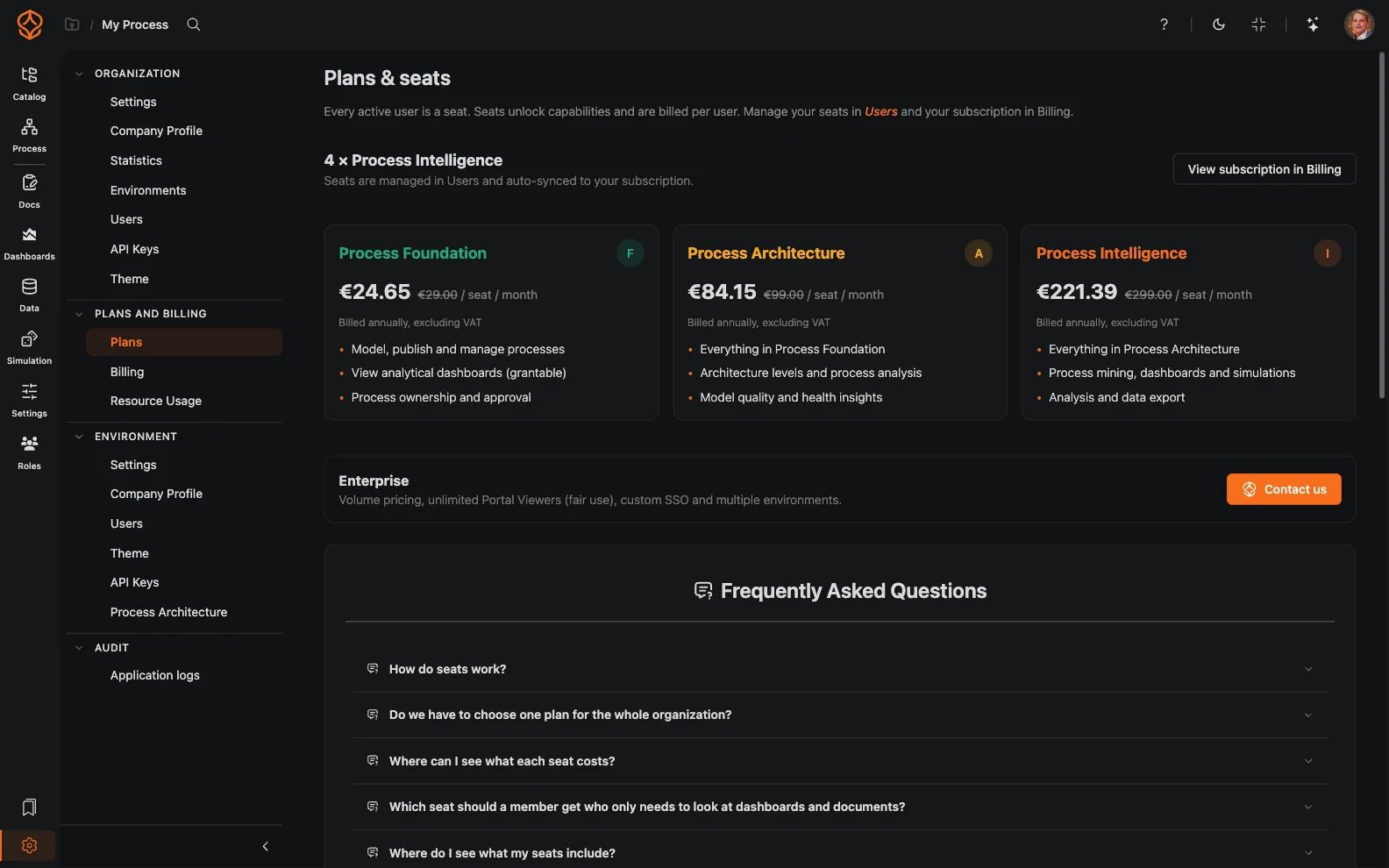
Seats are also the unit that makes the bill easy to reason about. When a person changes role, you change their seat. When a project ends, you remove the seat. Nothing else on the invoice moves.
The full definitions are in plans, seats and usage limits.
Viewers are included, not licensed per reader
Reading a process should not need its own licence. If it did, the model would stay with the people who were trained on the tool, and everyone else would keep asking for a PDF.
Every Architecture and Intelligence seat includes ten free portal viewers, and every Intelligence seat adds three dashboard viewers. They never count against paid seats, and they cover the people who read the process day to day. Beyond that included audience, capacity is paid: extra portal viewers come in packs of 100, extra dashboard viewers in packs of 10, and each extra environment includes 100 portal viewers. An excessive readership therefore carries its own cost instead of being spread across every customer. Enterprise agreements are the exception: unlimited viewers on a fair-use basis.
Including readers is also what makes the product work. A process model has value only when the people who run the process can see it: the operator who follows the steps, the team lead who checks the handoff, the auditor who needs the approved version. Put a licence in front of that reader, and the organization finds a workaround. A diagram is exported to PDF, a screenshot lands in a slide, a printed copy is pinned to a wall. Within a month there are four versions, none of them the published one, and the process office is back to answering which copy is current.
Included viewers also keep the paying seats where the work happens. Foundation, Architecture and Intelligence pay for the people who model, publish and analyze; readers consume what those people produce. It is the same logic as usage metering: cost follows activity, not headcount.
There is a commercial side we do not hide. A reader who sees a good process is the most likely person to ask for a seat, which is a better route to growth than a licence that stops the organization from reading what it already bought.
The details are in viewer users.
Usage is metered, so light users stop paying for heavy ones
A per-seat price on its own would be unfair in the other direction. Some organizations model a few processes a month. Others scan thousands of documents, ingest event data continuously and simulate every change. Under one flat price, the first group funds the second.
Every seat therefore includes a monthly pool of AI credits: 500 on Foundation, 2,000 on Architecture and 5,000 on Intelligence. AI is part of the seat rather than a separate module, so the feature is included and the allowance is what scales. Credits are pooled per organization, reset monthly and never roll over. They cover AI actions, and the same metered allowances cover preprocessing, data ingestion, simulations, dashboards, exports, the external API and MCP. The balance and the reset date are on the Usage and Credits screen.
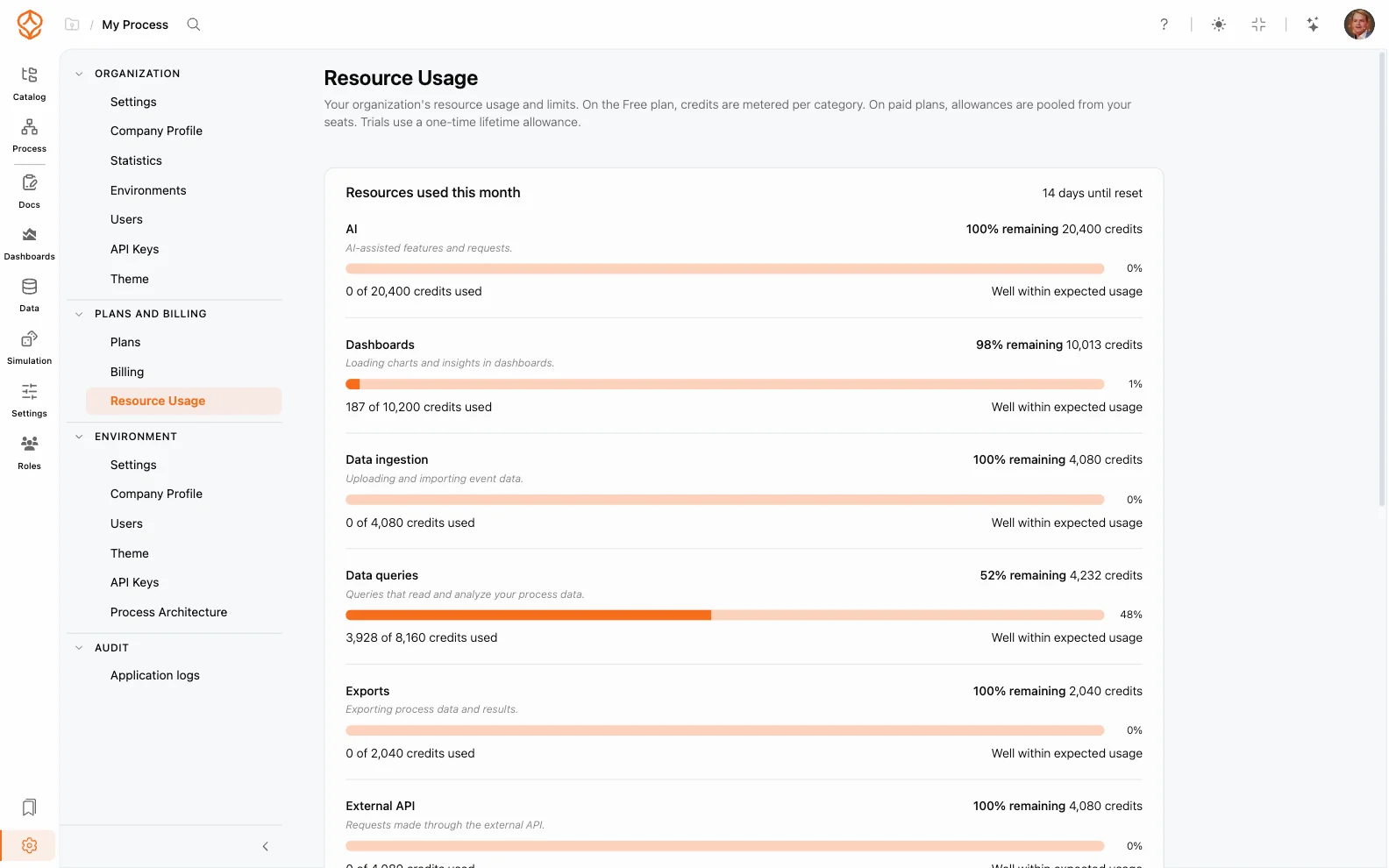
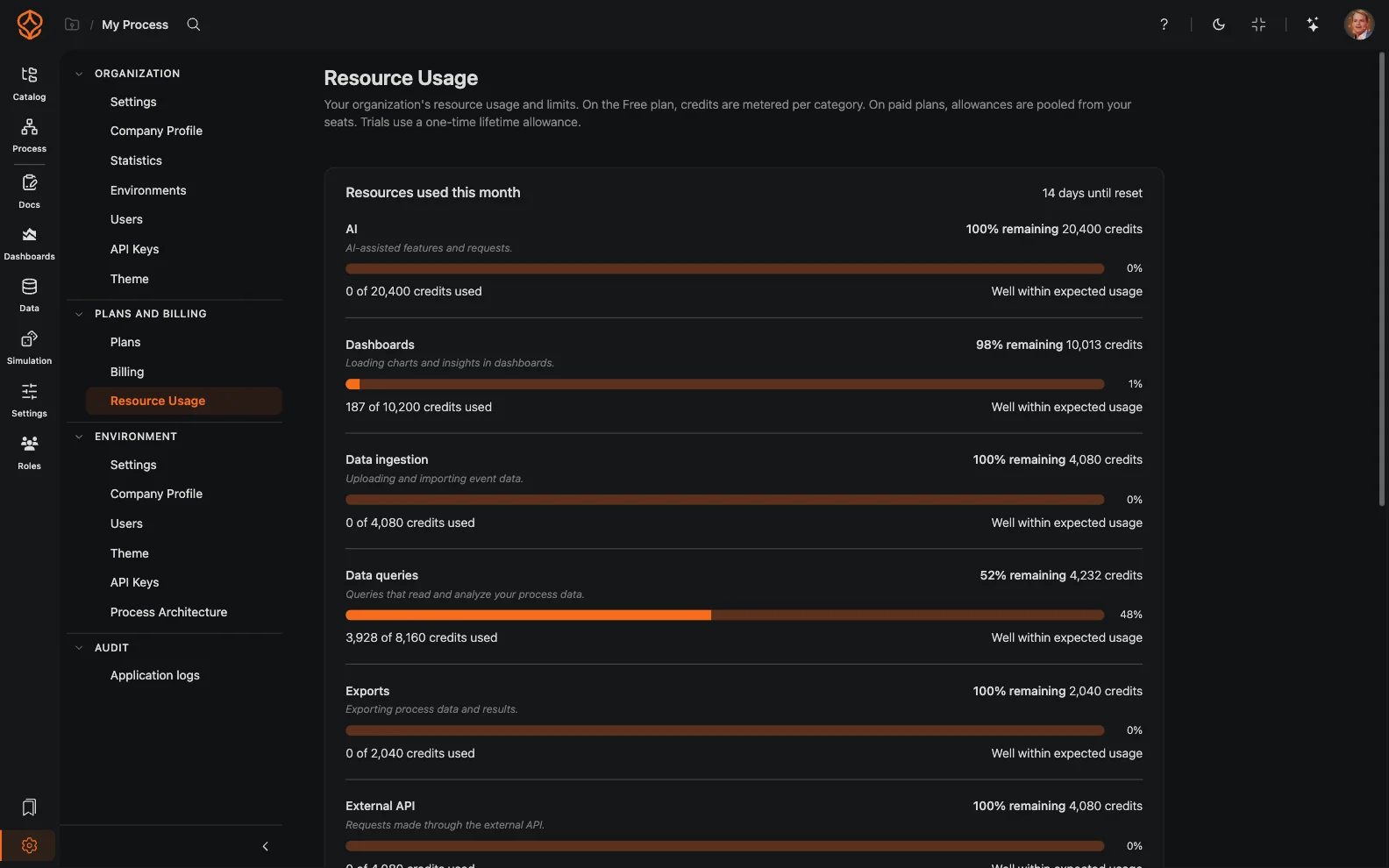
When a heavy team needs more, it buys it directly: a credit pack adds 5,000 credits per month, and a higher seat adds features and allowance together. That is the usage based pricing part of the model, and it is the only part that scales with what you actually do. A light user is not funding a heavy one.
You are never billed per credit. Credits are a metering unit, not a currency. An allowance that runs low is not a bill in progress: administrators are notified at 80% and at 100%, so a limit stays a conversation with time to have it. Read how usage and credits work.
You choose your own cost by choosing what you load
This is the part customers control most directly. Every event you load is parsed, stored, indexed and available to every query that follows. Loading a whole ERP for one procurement question does not make the answer better. It makes the bill bigger.
Selective data is not a compromise. Start with the process you want to improve, the case identifier that defines one run through it, and the columns the question needs. Add a second system when the question crosses into it. The analysis improves as coverage grows, and the cost grows with the coverage you chose.
On the Process Individual plan, a dataset is capped at 10,000 events. That cap is not only a demo limit; it is a useful constraint, because most first questions can be answered inside it. The wider lesson holds at any size: if you need a small part of the data, load a small part of the data.
The licence is one of three cost lines; the other two, data work and people, are in what process mining costs, the honest companion to this page.
Annual billing pays you back for the commitment
We value long relationships, and we price them. Monthly billing pays the list price. Annual billing starts at 15% below it, and the rate improves as your committed seat count grows, up to 50% at the largest commitments.
The discount is not a negotiation: the pricing table and the calculator show the band your seat count falls into, and what it takes to reach the next one. The discount applies to seats, while add-ons keep their own price, and it is never added on top of a partner rate.
You can switch between monthly and annual at renewal, so a longer commitment stays a decision you can revisit rather than a trap you enter once.
Partner pricing: per client, with seats you can move
Consultants and integrators have a different problem from a single organization: their work moves between clients. A pricing model that makes them buy a new set of seats for every engagement punishes exactly the behavior that makes them good partners.
Partner pricing starts at 20% and has two parts. Seats sit in one pool that you move between clients as projects start and finish. Clients are counted separately, each with its own isolated environment, 100 portal viewers and 3 dashboard viewers, for a per-client fee that steps down as the number of clients in the contract grows.
The partner rate and the annual volume ladder are compared, never added: a seat takes the better of the two, while client fees and packs take the partner rate. OEM partners can deliver the platform under their own brand, domain and terms under an OEM Partner Agreement.
We want partners to be able to show this price to their clients. A partner margin that depends on hiding the list is not a partnership we know how to grow. One that grows because the client can see what the platform costs, and what the partner adds, is the kind we want.
The partner program explains the delivery side, and the calculator has a partner and OEM track that uses the same published rates.
The calculator shows the number before anyone talks to you
The pricing calculator is the part we are proudest of. Pick the role that matches your work, and it pre-fills a business case in business terms: people who model, people who approve and publish, people who mine data, viewers, add-ons. Or skip the roles and build the package yourself.
It shows seats, viewer capacity, credit packs and environments, monthly or annual, in your currency. It highlights the discount band your seat count falls into. It covers the partner and OEM tracks too.
Two honest boundaries: the estimate excludes VAT, and it is an estimate rather than a quote. What it does guarantee is that the number you see matches the number our order system uses, because both read the same published price book.
The calculator answers the cost question; the ROI calculator answers the value question.
Build Your Estimate Now
The list is public, so the estimate is yours to build. Start with the calculator, then confirm the number on your own data.
What we deliberately do not do
Three pricing models are common in this market. Here is what we do with each.
We do not charge per process
Per-process pricing sounds precise until you ask what a process is. Is purchase-to-pay one process or six? Is a sub-process an extra? Does a process that spans three departments count once or three times? The boundary becomes a negotiation, and every improvement that widens the scope becomes a commercial conversation instead of a process conversation.
We charge for people and usage because both can be counted. You can add a process, a model or a whole landscape without asking us for a new price.
We do not advertise an all-you-can-eat price
One large number for everything is comfortable in a board paper and awkward everywhere else. It hides the unit, so nobody can tell whether the price fits, and it is usually sized for the largest programme in the room, so a small team pays for headroom it will never use.
That does not mean we refuse to quote one. Some organizations have a budget cycle or a procurement process that needs a single annual figure. We will build that quote from the same published list, price the scope it covers, and make the flat number add up. We just do not advertise it as the default, because a price list that leads with all-you-can-eat pushes every buyer toward the most expensive shape of the deal.
If a cheaper combination exists for your case, the calculator will find it before we do.
We do not hide the setup in a project
An implementation project is a cost that arrives before the first answer, and it makes the software look cheaper than the engagement. We designed the product so that setup is not a project: upload an export, let AI map the columns, import the BPMN files you already have, and start from a model or from data.
What we cannot remove is the need for people who understand the work. A process is improved by someone who knows why the exceptions exist and which change the organization will accept. No pricing model changes that, and ours does not pretend to.
Easy to pay, easy to resize, easy to leave
The experience after the price matters as much as the price itself. We optimized for the boring parts.
Payments. Online checkout is the default. The payment provider calculates the taxes that apply to your country and shows them as a separate line, so the invoice is usable by your finance team without a follow-up. Invoices are downloadable in the app. If procurement needs a bank transfer, we can arrange one for larger agreements.
Resizing. Add or remove seats from the Subscription page. On a monthly subscription the change applies immediately; on an annual subscription you see the new amount on a review screen before you confirm. If your use exceeds your seats, we notify administrators before any adjustment is applied, so a busy month does not arrive as a surprise charge.
Switching. Monthly to annual and back again at renewal, without a new contract or a call.
Leaving. Cancel from Billing and Invoices in a few clicks. A monthly plan keeps access until the end of the period, an annual plan runs to the end of its term, and your data is kept. There is a 14-day refund window after purchase. When a trial or subscription ends, the workspace waits for the admin’s choice instead of downgrading anyone automatically.
The mechanics are documented in billing and payments.
Pricing that works for one person and for an enterprise
The same model has to survive both ends of the market, otherwise one end ends up subsidizing the other.
A consultant can continue on the Process Individual plan after the trial, with one capped workspace and no viewer seats. A modeler can buy a single Foundation seat. A process office can mix seats and add portal viewers. An enterprise gets the same published list, with an agreement about rollout, environments and support. The annual ladder does the scaling, and the partner level sits on top for organizations that deliver for others.
A pricing model that only works at enterprise scale is not a pricing model. It is a filter.
Why we still offer an Enterprise agreement
Everything above is the standard model, and it is what most customers buy. Enterprise exists for the cases that model cannot describe, and we would rather name those cases than make every customer pay for them.
Truly special requirements. A dedicated single-tenant environment, many isolated environments, custom enterprise SSO, the MCP server and Bring Your Own AI, full white-label under an OEM Partner Agreement, or support terms that go beyond the standard. Each of these is a real commitment on our side: infrastructure, security reviews, upgrades and people. It is not a setting we can switch on for every account.
Keeping the standard price low. If every customer paid for the capacity and obligations that only a few need, everyone would pay more. Enterprise keeps that cost with the customer who needs it, which is the same principle as metering usage and giving viewers away.
Flexibility in how you buy. Some organizations have a budget cycle that does not line up with a monthly subscription. Others have a procurement process that needs an order and an invoice, or a term that has to fit the way they plan. An Enterprise agreement lets the contract follow the budget and the terms your finance and legal teams need.
The price does not change shape. An Enterprise quote starts from the same published list, prices seats, environments, viewer packs and credits at those rates, and adds only what the special situation requires. The annual volume discount still applies to committed seats; the scope and the initial commitment are what change.
A dedicated single-tenant environment is the clearest example. It is the same platform and the same pricing model: same seats, same features, same credit logic. It costs more because the environment is yours alone, from infrastructure to upgrades and support. We model it the same way and ask for a higher initial commitment, which keeps that cost with the account that needs it instead of spreading it across everyone else.
So an Enterprise agreement is not a second price list. It is the same list, with the special case priced honestly and the contract shaped around how your organization buys. The calculator has an enterprise track that estimates the standard parts at published rates; the agreement sets the terms for the special parts.
The price is a promise about how we work
A public price is a constraint on us. It means we cannot fund a large sales organization out of a hidden margin, recover a failed project through a change order, or make a quarter’s number by inventing a new unit. We keep the cost of selling low and put the difference into the price.
Transparent pricing is easy to announce and harder to keep. It survives only if the units are clear, the list is public and the calculator uses the same numbers as the invoice.
It also means you can decide without us, which is the point. If a total does not make sense for the work you need, tell us. The list is public so that it can be discussed, not so that it can be defended.
Compare the Plans
The price list is the same one we invoice from, so the next step is to compare the plans against the work you have.