
AI and Business Process Architecture: One Curated Truth
AI can draft, read and analyze your architecture. People still decide what is true: one curated source, approved versions, and every assistant on MCP.

An assistant can describe order-to-cash in general terms in seconds. It cannot tell you why your finance team approves one exception and escalates another, or why the warehouse overrides the safety stock rule. That knowledge lives in your business process architecture, and only if you have written it down.
The question is not whether AI will change architecture work. It already does. The question is what remains yours: the definitions, the priorities, the trade-offs and the approval. Our position is simple. We are pro-AI, and we are more pro-people. AI should remove the work around judgement, not the judgement itself.
Why AI and business process architecture need each other
Architecture without AI is a manual practice that falls out of date between reviews. AI without architecture is a fast, confident generalist.
A business process architecture is expensive to keep current when people have to collect, draw, describe and check everything by hand. AI changes the cost of the first draft and the cost of reading the whole landscape. An assistant, meanwhile, has no shortage of reasoning. It has a shortage of your process. Point it at raw tables and it has to infer the workflow. Point it at a curated architecture and it can answer from the model, the documentation, the roles and the measured reality.
That is the pairing: one side supplies reach, the other supplies truth. It is not AI plus a diagram. It is AI plus a place where the organization has written down what it means.
This is the difference between connecting an assistant to data and connecting it to process knowledge. MCP process context covers the connection itself. The harder question, and the one this page is about, is what the assistant finds when it arrives. A digital twin of an organization has the same dependency: the model and the data only become useful when they are connected to measurement and to a decision.
What one connected truth looks like
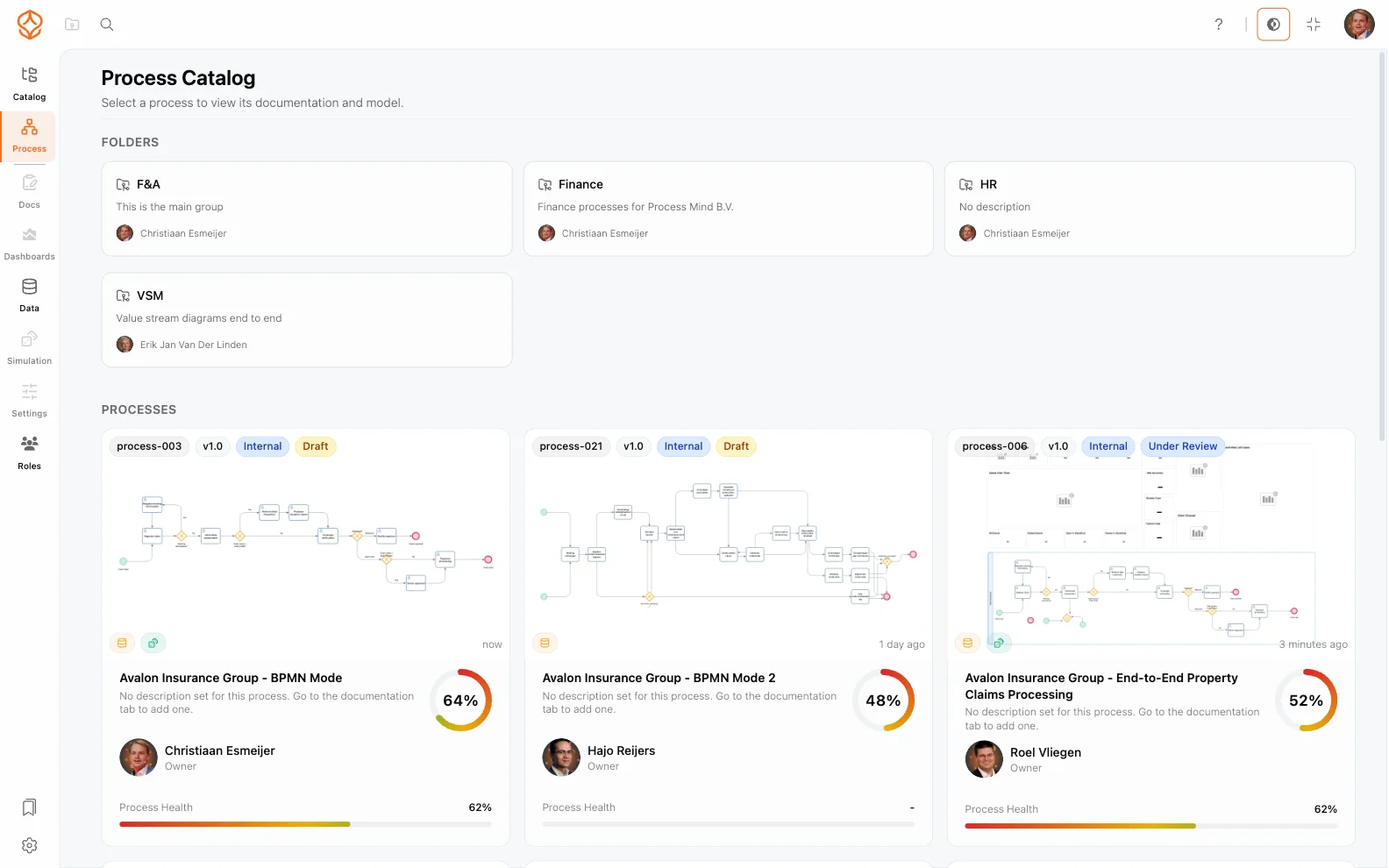
Business process architecture is the connected structure of how work runs. It holds the value streams, processes, subprocesses and activities, the roles that own them, the systems that carry them, the documents and artifacts that describe them, and the status and version of each. It is one place, not one file.
The hierarchy is how a person navigates. The connections are how an assistant navigates. A folder of diagrams can show where a process sits, but it cannot answer “what depends on this?”, “who owns it?” or “which version is approved?” Those questions need a graph, not a filing cabinet.
What you curate in one place
- The hierarchy: value streams, processes, subprocesses and activities, with configurable levels that match how your organization thinks.
- The models: BPMN 2.0 flows, gateways, events, systems and the connections between processes.
- The documentation: descriptions, policies, standard operating procedures and work instructions, attached to the activity they explain.
- The artifacts: files, screenshots and recordings stored with the process rather than in a folder nobody can find.
- The roles: owners, RACI assignments, reviewers and the people accountable for each level.
- The status and versions: draft, under review, approved, published, retired and archived.
- The measurements: event data, model quality and process health, attached to the same process record.
People sometimes call this BPM architecture, enterprise process architecture or business process management architecture. The label matters less than the connection: one address for each fact, and one answer to the question “which version is true?”
A framework such as APQC gives you a vocabulary for the hierarchy. It does not give you your processes, your owners or your exceptions. Those are yours to decide and record.
A disconnected model is still useful for a workshop. A connected one lets a person move from a value stream to an activity, and lets an assistant answer across the same path. That is what makes it worth curating.
Where AI speeds architecture up, and where it must not decide
AI is at its best when the task has a checkable answer or a first draft a person can correct. Architecture work is full of both.
AI does the work around the decision
- Drafts a first model or a first architecture from a description and your own documents
- Reads the whole landscape and summarizes a process, a value stream or a gap
- Finds inconsistencies, missing labels, unconnected elements and undocumented activities
- Proposes documentation sections and RACI assignments from what is already known
- Analyzes event data and proposes improvements worth testing
- Builds simulation parameters and compares as-is with to-be
People make the decision
- What the process should be, and which exceptions are legitimate
- Who owns, approves and is accountable for each activity
- Which trade-off is acceptable: speed, cost, risk or customer promise
- What aligns with the culture, the goals and the promises you make
- What gets approved, published, retired or archived
- What the organization is willing to defend to a customer, an auditor or a regulator
The line between those columns is not about capability. It is about authority. AI can be better than a person at drafting a model and still have no standing to decide how your company works.
In practice, the useful rule is to let AI do the work that has a review, and keep the decisions that need an owner. A draft model, a summary, a list of missing documentation and a proposed improvement all have a review. A changed approval threshold, a new owner or a retired control does not. Those are changes to the agreement, and an agreement needs the people who are party to it.
Why culture and goals cannot be delegated
A process architecture records choices about how the organization works, and those choices come from strategy and culture, not from the data.
Two companies can run the same order-to-cash process on the same ERP with the same volumes and still need different architectures. One will absorb cost to protect a delivery promise; the other will protect margin and renegotiate. One trusts local managers to approve exceptions; the other centralizes them. The models look similar. The right decisions are not.
Goals decide what you optimize: speed, cost, resilience, compliance or customer effort. Culture decides how decisions are made, who is consulted, when an exception is legitimate and what the organization is unwilling to do. None of that is in an event log, and much of it is not in a document either. It is in the people who run the process.
An assistant can learn the words you wrote. It cannot be accountable for the choice behind them. That is not a limitation a larger model will fix. Accountability needs a person who can be asked why.
We are pro-AI, and we are more pro-people. The value of AI in process work is not that it replaces judgement. It removes the collecting, drafting and checking around judgement, so the people who own the work can spend their time on the decisions. We do not want an assistant that decides how your company runs. We want one that makes your decisions visible, testable and easy to keep current.

How do you document for people and for AI?
Write for a person first. The clarity a colleague needs is the clarity an assistant needs, and a second, machine-only documentation set will drift from the first.
A person opening a process wants to know what it does, why it exists, who owns it, where the exceptions are and what to do next. An assistant reading the same process needs the same facts in a structure it can traverse. The model gives it the steps and the connections. The documentation gives it the meaning. The artifacts give it the evidence. The roles give it the authority.
That is why “write less, but write the reason” works better than a longer template. A description that records why an approval exists is useful to a new colleague and to an assistant asked whether the approval can be removed. A description that repeats the diagram helps neither.
| Reader | Surface | What it gets | Boundary |
|---|---|---|---|
| People | Process Portal | Published catalog, models, documentation and exports | Read-only; drafts and processes under review stay out of view |
| AI assistants | MCP server | Processes, models, documentation, roles and RACI, statistics, analysis tools | Scoped API key; proposals and confirm-first writes |
| Scripts | REST API | Processes, data and simulations for integrations | Same permissions and the same audit log |
Three surfaces, one source. The Process Portal is for the person who has to do the work. The MCP server is for any compatible assistant, and MCP is an open standard, so the same connection works across clients. The REST API is for scripts and integrations that move data or run simulations. None of them owns a separate copy of the architecture.
That is the whole workflow architecture: one curated source, three read paths, no second truth. The portal has no reason to publish a draft, and an assistant has no reason to read one.
The gaps are where AI starts improvising
An unwritten rule is not neutral. It is a blank that a model fills with something plausible.
An unlabeled gateway becomes a decision the assistant names for you. An unassigned role becomes “the team”. An undocumented exception becomes a happy-path assumption. A process with no description becomes a summary of its shape rather than its purpose. The assistant rarely says “I do not know”. It produces the most likely answer, and the most likely answer is built from what everyone else’s process looks like.
This is the practical meaning of control. Lock down what you know. What you leave open, the AI will decide for you, and it will do it confidently.
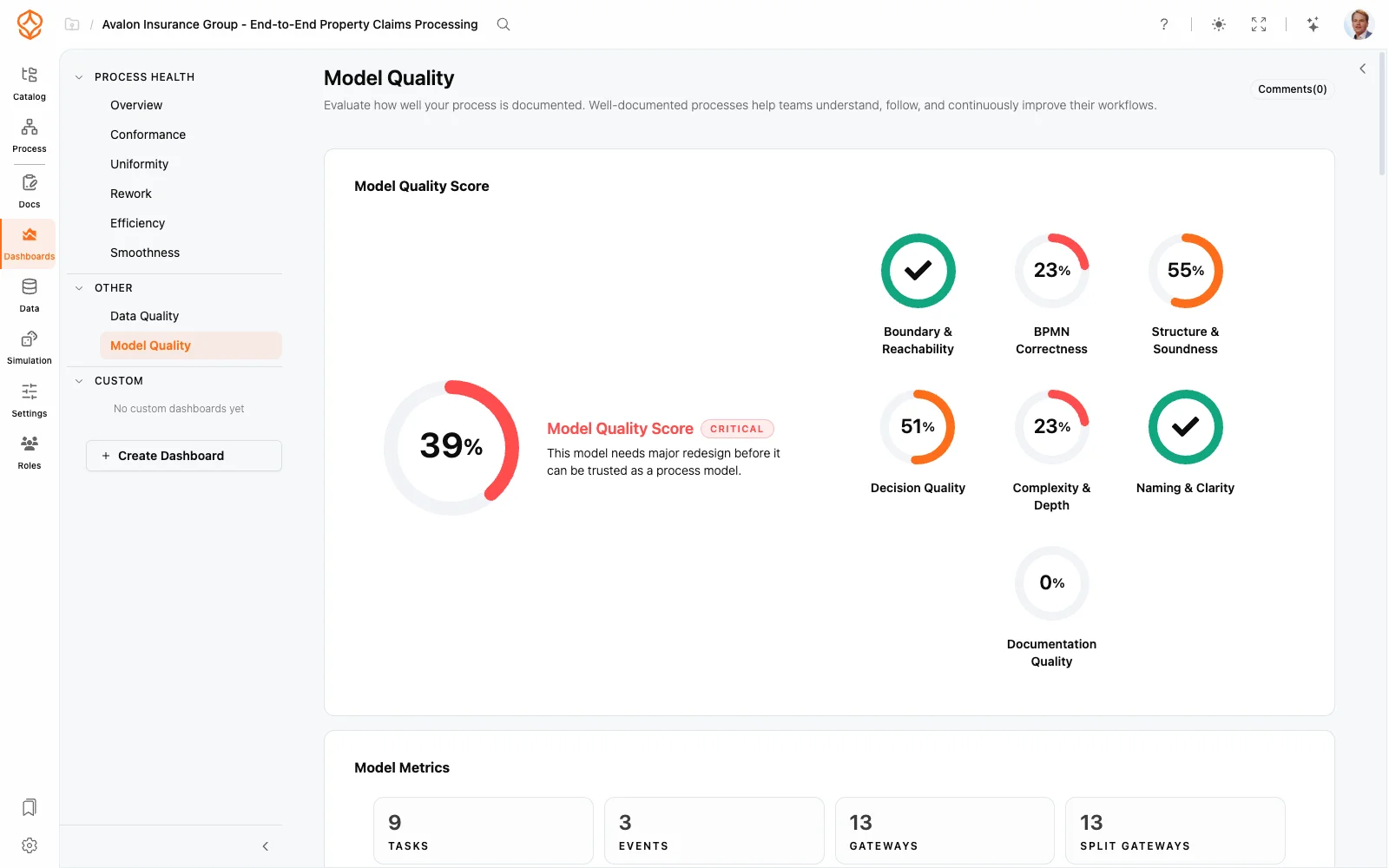
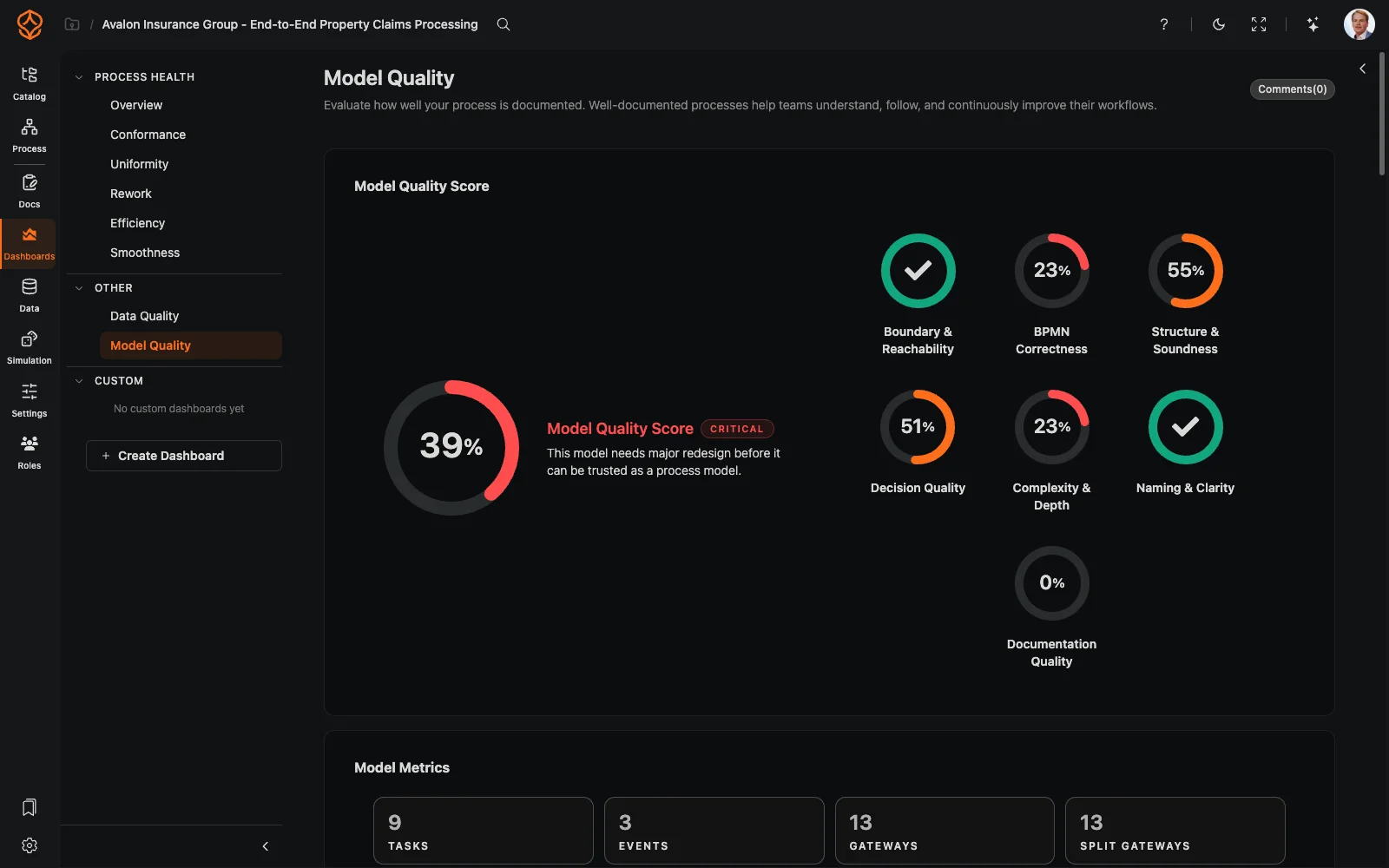
Model quality makes those gaps visible. The quality badge on the canvas shows a percentage score and the list of checks behind it: unconnected elements, missing labels, unbalanced gateways, and missing documentation or roles. Administrators can set which checks count for each architecture level, so 100% means everything that level requires.
Read the score as a knowledge to-do list, not a grade. A failed check is a decision you have not made or a fact you have not written down. The most valuable failures are rarely the drawing errors. Missing documentation and missing roles point at intent and ownership, which is exactly where an assistant has the least evidence and the most room to invent. Model quality is therefore less a report card for the modeler and more a map of what the organization has not decided yet.
A five-point completeness test for AI-ready architecture
- The objectives: what the process is for and which outcome it protects
- The operating model: which value stream it belongs to, who owns it and which systems carry it
- The meaning: what each event, status and exception actually means
- The normal pattern: what good looks like, and which variants are legitimate
- The constraints: the rules, thresholds and approvals an assistant must not cross
Versions are how you stay in control
An architecture that changes without a record is not a source of truth. It is a current opinion.
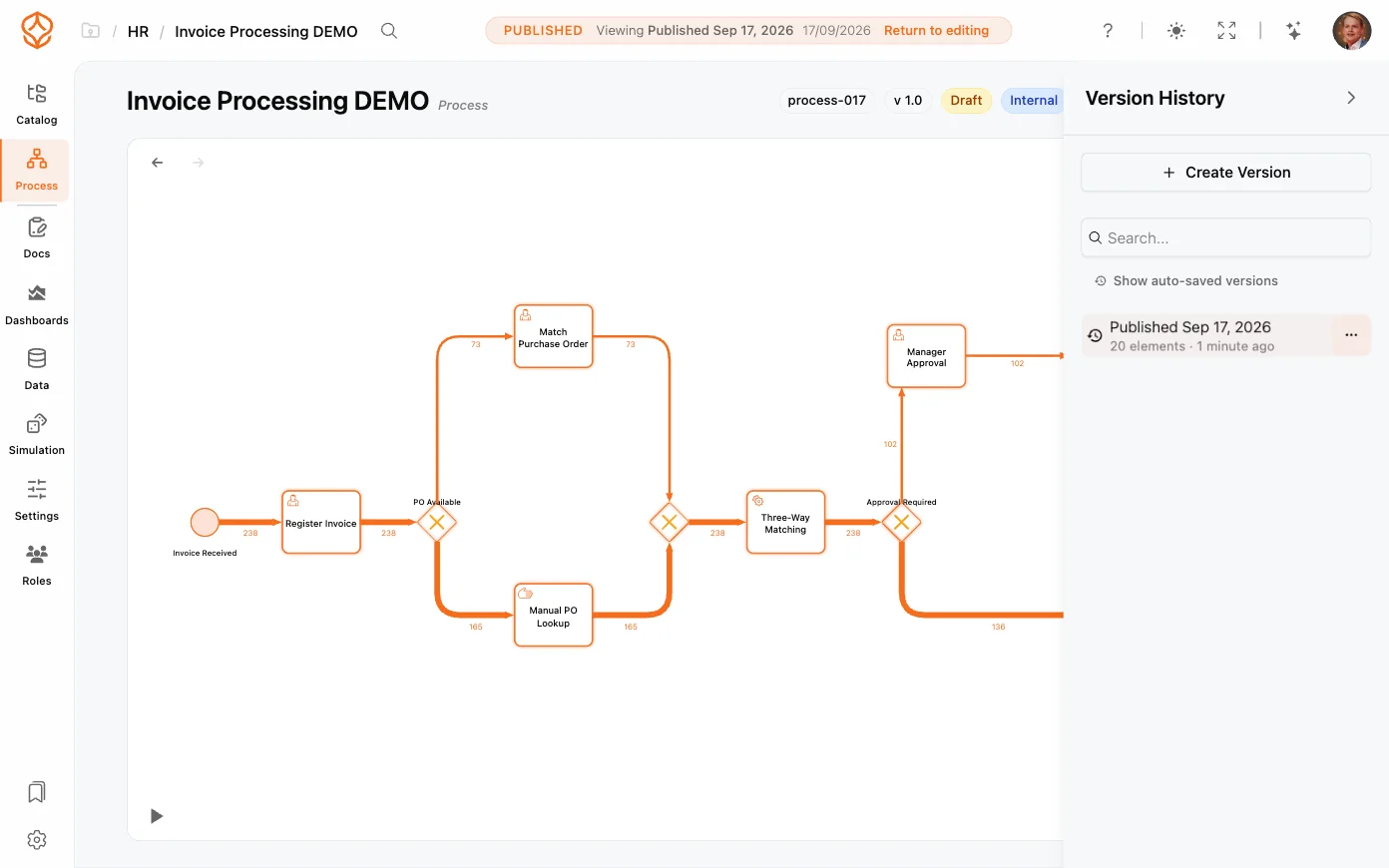
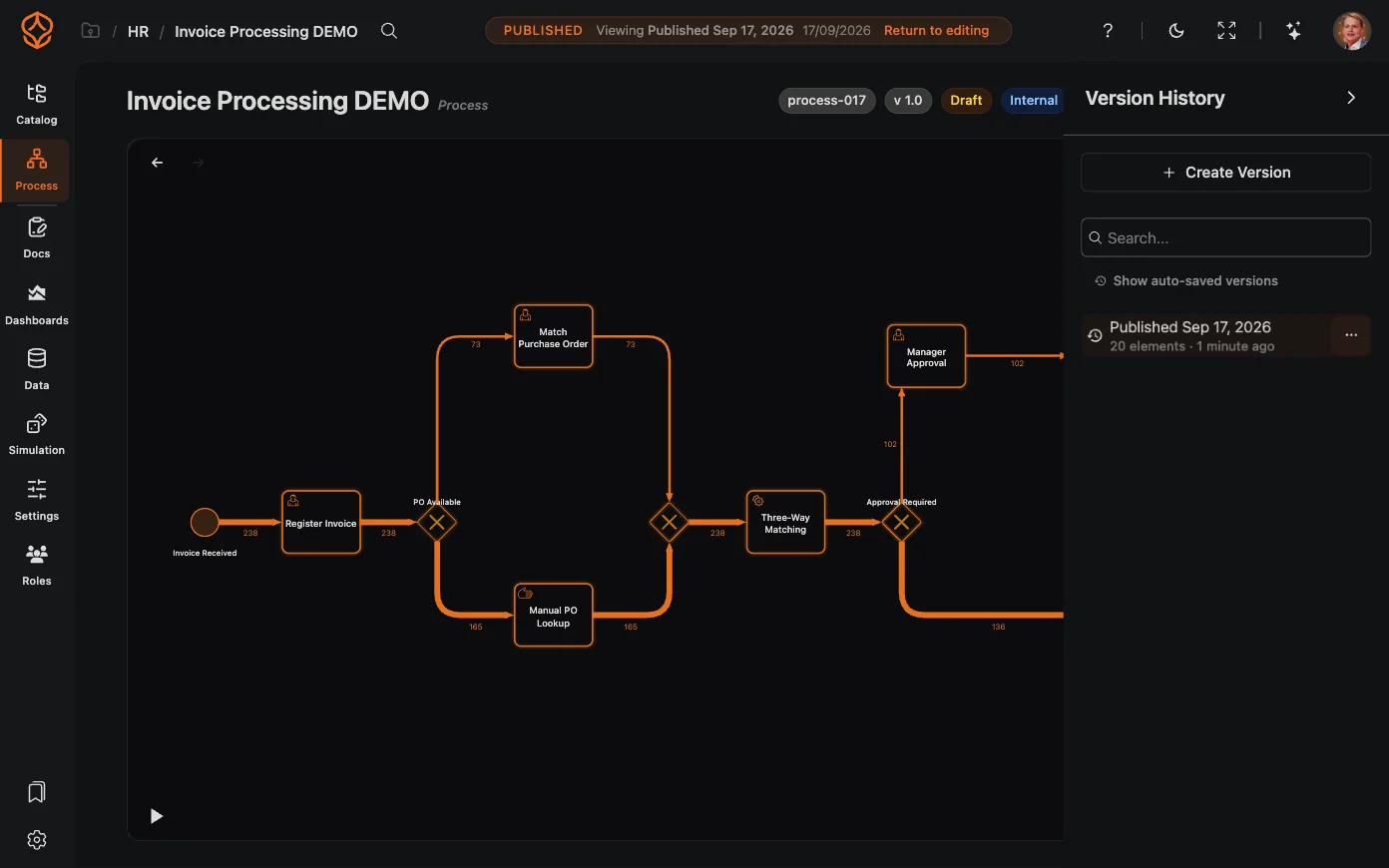
Every process carries a status: draft, under review, approved, retired or archived. Publishing creates a version snapshot, and that published version is what viewer users see in the Process Portal. A reviewer can approve with a version name and publish in the same step, and the catalog shows what is current, what is waiting for review and what is out of date. What enterprise architecture governance calls a review, a process architecture does on every change. If you already have an architecture review board process, this is the same ritual with a shorter loop.
Version history adds the part that matters when AI is involved. You can name a snapshot, compare it with the draft, review grouped changes, approve or reject groups, restore an earlier state and publish a specific version. Review decisions stay tied to the snapshots they were made against, so a later edit cannot silently inherit an old approval.
That is the rule we apply to AI. An assistant should work from the approved or published version, not from a draft that a reviewer has not seen. An AI proposal arrives as a change to review, not as an edit that becomes true because it was convenient. The version is the contract between the people who decided and the systems that read. The wider operating model behind that rule, including ownership, review cadence and change approval, is covered in process governance.
What AI can do once the architecture is approved
With a curated, approved architecture, an assistant stops offering generic advice and starts doing work you can check.
- Analyze a process and propose improvements worth testing, with the evidence behind them.
- Draft documentation for an activity from the model, the artifacts and the surrounding processes.
- Propose RACI assignments using the roles you already defined, for a person to correct.
- Answer questions across the landscape: which processes have no owner, where documentation is missing, what changed since the last approved version.
- Generate a first model, or a first architecture from your documents, for process-by-process review.
- Build simulation parameters and compare a proposed change with today’s process.
None of that requires the assistant to be trusted with the decision. It requires the assistant to be bounded by the architecture and by the approval.
The MCP server is how any compatible assistant reaches that material. On the Enterprise plan, a scoped API key exposes processes and BPMN models, documentation, roles and RACI, people and organization metadata, and process statistics, plus ProcessMind’s analysis tools. Write tools exist when the key has write scope, but they return proposals and take a dry-run preview before a person confirms. Calls are attributed to the key and appear in the audit log. Dataset uploads, data mappings and simulations stay on the REST API, because those are operations rather than decisions.
This is also where the AI Assistant fits. It answers questions about the process, references the dashboards and models behind the answer, and presents a suggested change as a diff to review. The assistant is useful because it is bounded, not in spite of it.
Agents are entering the operating model too. An assistant that acts on a process needs an owner, a scope and a place in the architecture, the same as a system or a role. If an agent can propose a change, the architecture should record who is accountable for accepting it. That is how you govern AI agents without inventing a separate framework: they become one more thing your architecture describes.
How do you start without boiling the ocean?
You do not need the whole organization in the architecture before AI becomes useful. You need one connected slice that carries a real decision.
-
Choose one value stream and a handful of processes
Pick work people already argue about, with an owner and a measurable outcome. A single approval, handoff or rework loop is enough to prove the pattern. -
Name the owners and reviewers first
Assign roles and RACI before an assistant is invited in. Authority has to exist before it can be read, and the reviewer is the person the architecture is accountable to. -
Document to the level you need
Give each activity a description, a role and a clear boundary. Skip what nobody will use; an architecture that is complete but unread is another folder of diagrams. -
Clear the quality bar
Fix unlabeled, unconnected and undocumented elements, then treat the remaining failures as an agenda rather than a defect list. -
Publish a version and connect one assistant
Ask a question whose answer you already know, and compare the answer with the workspace. A correct answer is evidence that the source is curated; a wrong one is evidence of a gap. -
Put review on a cadence
Look at model quality, the changes since the last version and the improvements AI proposed. Approve, reject or defer each one, and record why.
The first slice proves the model. The second is faster. The architecture grows with the decisions you make, not with a documentation campaign.
The architecture is the agreement
AI makes documentation more valuable, not less. A model that never mattered outside a workshop now decides what every assistant in the company can say about how work runs.
The organizations that get value from AI will not be the ones with the most agents. They will be the ones whose knowledge is explicit, owned, current and approved, with a place for people to navigate it and a way for assistants to reach it.
That is the division of labor we believe in. AI does the reading, drafting and checking. People decide what is true. The architecture is the agreement between them.
Where to Go From Here
You have a process landscape worth making explicit, and assistants that could use it. Start with one connected slice, one approved version and one question you can verify.