

Process Architecture Consulting: What a Partner Can Deliver
A partner's guide to process architecture consulting: the roles you can take, how a client landscape gets built, and how licensing and margin work.
Process architecture consulting is the work of turning a client’s scattered diagrams, documents and opinions into one landscape that everyone can read. A partner can deliver all of it on ProcessMind, or only the part the client cannot staff: the top architecture, one value stream, the modeling capacity, or the coaching that makes the client’s own architects own the result.
This page is written for consultancies, system integrators and managed service providers. If you are a client who found it: there is nothing here your partner would not tell you, and that is deliberate. We publish our prices, and we are happy to publish how partner delivery works too.
What does process architecture consulting look like for a partner?
A partner can do everything the client needs done, from organizing the work to delivering it. In practice we see four roles on the architecture side, and most partners start with one of them.
| Role you take | What it looks like | Who it suits |
|---|---|---|
| Top architect | Owns the whole landscape, defines value streams and levels, monitors progress and publishes | A programme with a sponsor and a company-wide scope |
| Value-stream architect | Owns one part of the landscape so the top architect is not the bottleneck | A large organization with several parallel teams |
| Modeler or business analyst | Turns existing documentation into models, corrects drafts with the owners, writes the procedures | The most common first engagement |
| Coach | Trains the client’s architects and owners and keeps the method consistent | Clients who want the capability in-house |
Two rules hold across all four. First, the delivery route is the same one an internal team would use: the getting started guide covers the bottom-up and top-down paths in detail. Second, the client’s owners correct the models and approve the versions. A model you wrote alone is a proposal; a model the owners corrected is their process.
What does a client get when the architecture work is done?
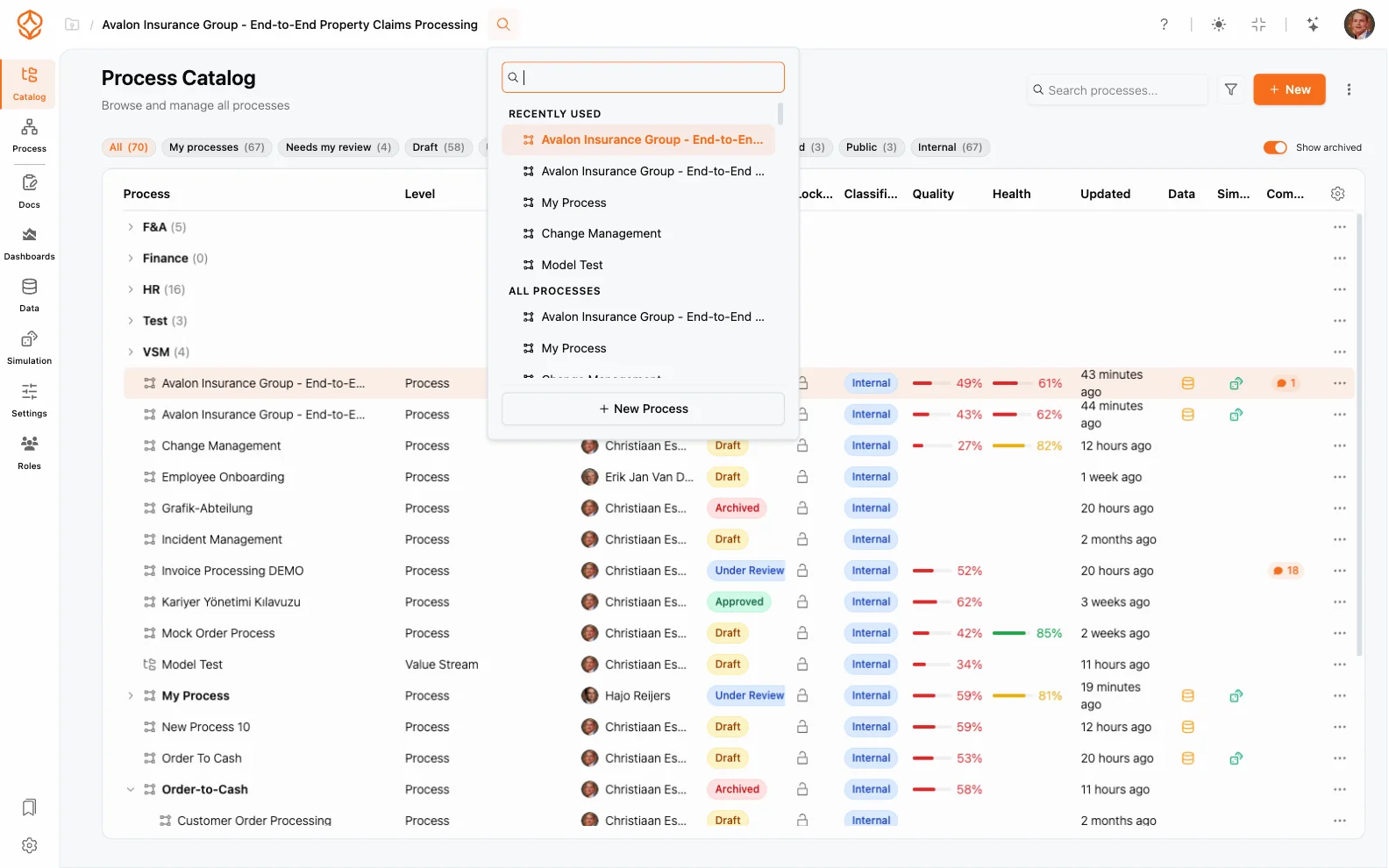
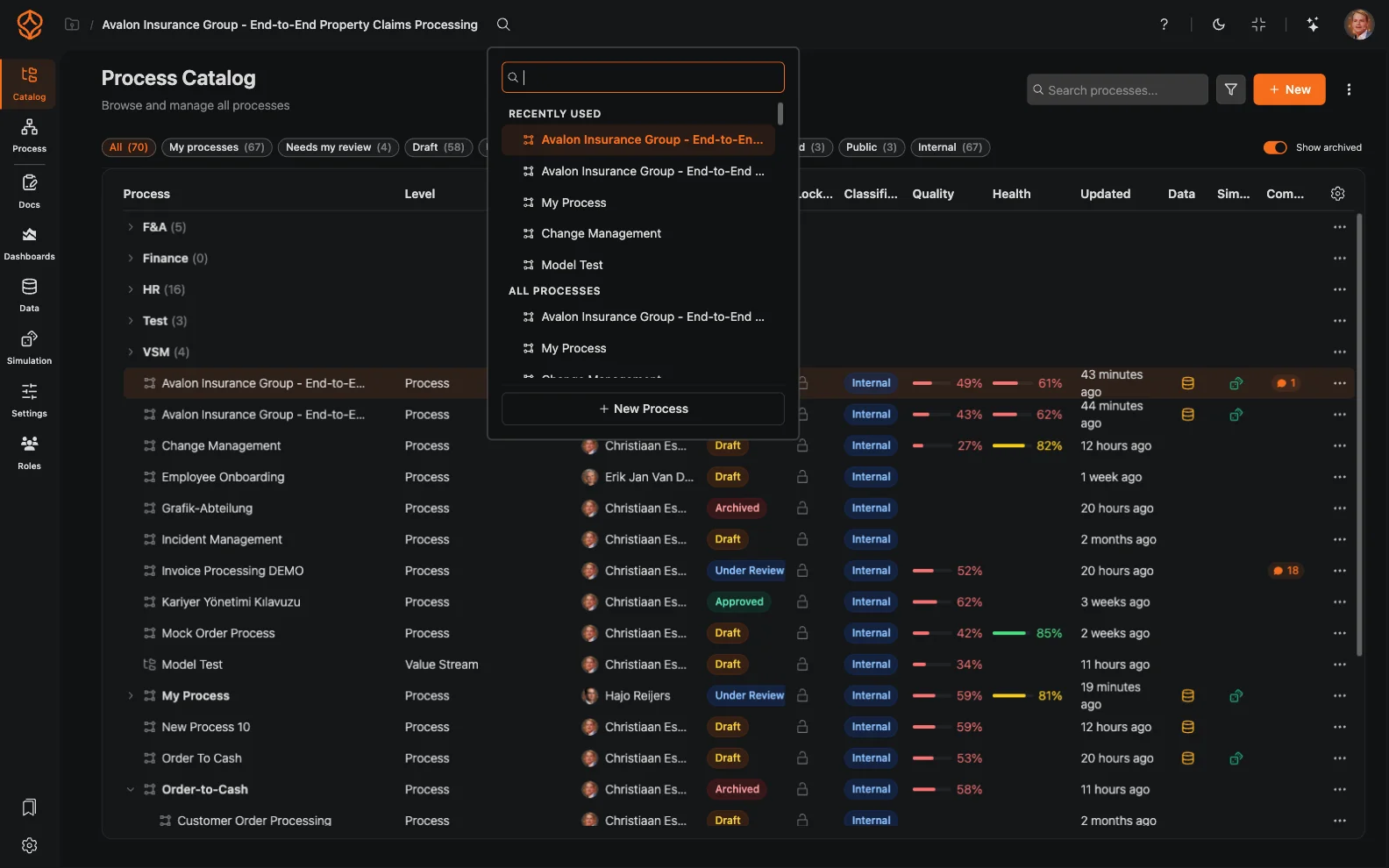
The output is not a folder of diagrams. It is a landscape the client can maintain without you, and it has five parts:
- A hierarchy from value streams to processes, with subprocesses only where they earn their place. The architecture levels are configurable, so the client’s own framework can be used rather than ours.
- A named owner per process, recorded on the process instead of in a spreadsheet.
- A model per process, honest about the exceptions, with the documentation attached to the steps it describes.
- One published version, readable by every colleague in the Process Portal without a paid seat.
- A review rhythm, so the landscape has a date against it instead of good intentions.
That list is also the acceptance test for a first engagement. If the client cannot point at each of the five, the work is not finished yet, however good the drawings look.
Can the architecture follow the client's own way of working?
A partner often helps or steers this part, and it is worth doing deliberately: the workspace is configured to the client’s framework rather than ours, so the landscape matches how their people already think about the business.
- Levels are theirs to define. Rename, add or remove them, decide which level can contain which, which levels carry a BPMN model, and which documentation fields appear at each level.
- Roles and standards follow their vocabulary. Reuse their role names in the role library and RACI, and set model quality to a strictness they can sustain.
- Documents come out in their format. Document templates decide what an export contains, so the output reads like their own procedure.
You are often the right person to steer it, because you see several clients and can tell a convention from a habit. The test is whether a client architect can explain the setup to a new colleague in five minutes, in their own words.
How does an architecture engagement run?
The shape is repeatable, which is what makes an architecture practice profitable rather than a series of one-offs.
-
Scope with a named client owner
Agree on one value stream or a handful of processes, the outcome the client wants, and the person who approves the result. A first engagement that tries to cover the company ends in twenty halfway models. -
Set up the client environment
Each client gets an isolated tenant, so their processes and documents never mix with another client’s. Create the architecture, the processes and the documentation structure there. -
Load what exists, then let AI draft
Upload the procedures and screenshots as artifacts, then use AI process generation with those files as context. A plausible draft is faster to correct than a blank canvas. -
Let the owners correct, not approve
Ask the owner of each process to change the model until it matches their reality. A review where the owner only signs off is a rubber stamp, and the client will not trust the result. -
Publish and let people read it
Publish the models to the client’s portal so colleagues read one version and feedback arrives as comments instead of side conversations. -
Set the review and hand over
Agree the next review date with each owner, show them where the queue and the version history live, and hand over the method. The client’s capability is the deliverable, not your presence.
Documentation follows the model once it exists: choose the sections in a document template and export Word, PDF or Markdown, so the procedure cannot drift from the process it describes.
How does partner licensing work for architecture work?
Partner licensing has two parts: a fee per client environment, and a pool of seats that moves with your consultants.
Per client. Every client tenant is an isolated environment with its own processes, documentation, users and data. A client tenant includes 100 portal viewers and 3 dashboard viewers, and the per-tenant fee steps down as the number of client tenants in your contract grows. The environments and tenants guide explains the isolation.
Per seat. Your consultants hold seats from one pool, and those seats follow the work rather than the client. A consultant who works on three accounts this month is still one paid seat, which is the difference between a bench you can afford and one you cannot. Architecture work uses two seat types: Process Foundation for the people modeling and documenting, and Process Architecture for publishing, governance, the catalog and the portal.
Per user. Client architects and process owners can hold seats too, and it is usually the healthier model: the client’s people do the correcting and approving, so ownership stays with them. Readers never need a paid seat, because portal viewers are included with the tenant.
Price. Partner pricing starts at 20% off the list. Seats take the better of that partner rate and the annual volume ladder, never the sum, and the tenant fees and packs get the partner rate. Everything is in the pricing calculator, and it is the same list a client sees on the pricing page.
The calculator opens on a scenario when you follow these links, and you can change every number afterwards:
- Consultant, modeling: 3 client tenants and 1 Architecture seat
- System integrator, modeling: 6 client tenants and 3 Architecture seats
- White-label or OEM: the OEM track with your own customer count
What does the commercial model look like?
You buy at the partner rate and sell at your own. That is the whole model, and it works in three ways depending on how you like to sell.
- Resell the licences with a markup. Quote the platform next to your consulting, at a price you set. The margin is yours, and it is recurring for as long as the client keeps using the workspace.
- Bundle it into a larger engagement. Many partners do not show a licence line at all: the platform is part of a larger package, and the client sees one fee.
- Use the licence to protect the follow-on work. Once a client’s landscape lives in a workspace you set up, you are the natural partner for the next value stream. The lock-in is real, but keep it fair: BPMN and document export (Word, PDF and Markdown) are published, so the client’s knowledge is never trapped. A client who knows they can leave is a client who stays.
Two mechanics improve the margin rather than the price. Volume discounts apply across all your paid seats, so the seats you already sell get cheaper as your commitment grows. And because the seat pool is reusable across clients, a new engagement does not automatically mean a new consultant seat: you pay for the people you keep, not for the number of clients you serve.
Partner accounts can also create demo environments for walkthroughs and training. They are marked DEMO in the app and are free of charge, so a sales conversation does not start with a trial you have to explain.
How do you make it look like your own?
Theming is available on every plan: logo, colors, light and dark variants, per environment. Set it up once for a client and their workspace, and their Process Portal, carry their brand instead of yours. The themes and white-labeling guide covers what can be themed; full white-label without ProcessMind marks runs under an OEM Partner Agreement.
That matters more than it sounds. A client who logs into a workspace with their own logo and their own process names treats it as part of their operation, not as your project tool. It also makes the handover easier, because the thing they inherit already looks like theirs.
Our bet is simple: the partner who can show a client their own process, in the client’s own language, is the partner who gets the next project. So we would rather give partners the transparent price, the platform and the delivery method than pretend we can deliver organizational change from a distance. Partners are how we reach processes we would never see on our own.
What do partners get wrong in architecture work?
- Doing all the modeling yourself. It produces a beautiful model the client never trusts, because they never corrected it.
- Not organizing ownership at the client. Without named owners, the work ends when your invoice does, and the next consultant starts from zero.
- Documenting the ideal process. The first pass is an honest current state, exceptions included. The improvement comes next, and it needs a baseline.
- Starting with too much scope. Twenty processes in the first wave means twenty halfway models and no agreement. Five finished processes prove the method.
- Treating publication as the finish line. A published model that nobody reviews is a snapshot. The owner and a review date are what keep it true.
What should you not promise?
Being clear about the limits is what makes the rest of the pitch credible.
Do not promise a percentage saving from the tool: improvements come from changes the client makes. Do not promise that the landscape will stay current on its own, because someone at the client has to own each process. And do not promise a complete inventory in the first month; an architecture that covers everything but is not trusted is worse than one value stream that is.
What you can promise is a repeatable way to make a client’s processes visible, agreed and published, plus a workspace that keeps the knowledge after you leave. That is a smaller promise than most consulting pitches, and it is one you can keep on every engagement.
When the client’s landscape is agreed and published, the next step is evidence. The process intelligence partner guide covers the data side: mining, dashboards, simulation and the recurring work of monitoring a process. For the pricing logic itself, including why we price per seat and per tenant rather than per process, the pricing explainer goes through it.
Where to Go From Here
You have a client whose processes are scattered across diagrams, documents and opinions, and a delivery team that can organize the work.