

Competitive Analysis Last updated November 5, 2026
SAP Signavio vs. ProcessMind: Process Mining Comparison
Compare SAP Signavio and ProcessMind across process mining, modeling, simulation, rollout, and licensing to decide which fits your SAP environment.

If you’re evaluating SAP Signavio software against ProcessMind, the key question is how closely your process work needs to fit the SAP estate. SAP Signavio brings process mining, modeling, and management capabilities together with SAP-focused content and data access. ProcessMind connects the process architecture to the event data from the systems you already run, so the models, the mining and the simulation stay in one place. The right choice depends on your SAP footprint, rollout capacity, and whether you need the broader suite.
What are you comparing?
This comparison is about more than a feature checklist. SAP Signavio and ProcessMind take different approaches to process intelligence.
SAP Signavio is part of a broader process transformation suite. Its SAP connection can be valuable when your processes run on SAP and your organization wants mining, modeling, and related process management capabilities in the same environment.
ProcessMind combines process mining, BPMN modeling, dashboards, and simulation in one platform. You can load event data from your systems, examine how work flows, and compare the results with a process model. ProcessMind does not require you to adopt an SAP-centered suite to analyze SAP data.
The practical comparison comes down to three questions:
- Do you need SAP-native extraction and SAP-oriented content?
- Do you have the people and time to roll out a broader suite?
- Is your priority an enterprise-wide SAP program or a focused investigation of a real process?
What does SAP Signavio offer?
SAP Signavio combines process management and process intelligence capabilities within the SAP ecosystem. For SAP-centric organizations, that context matters: SAP-specific content and access to SAP data can reduce the distance between process analysis and the systems where work happens.
SAP describes Signavio as supporting process modeling and mining, with Process Manager and process and journey content as part of the broader offering, plus benchmarking material and modeling governance. These capabilities can be relevant when you are coordinating process work across an SAP transformation or an S/4HANA program.
That does not mean every organization needs the full suite. The value depends on how much of the surrounding SAP environment you use, how your processes span other systems, and whether you have a team to manage the rollout.
The modules matter when you compare scope, because the name covers a family rather than one product. Signavio Process Manager is the modeling and documentation environment. SAP Signavio Process Insights covers mining and analysis with SAP-specific content and benchmarks. Governance and collaboration capabilities sit around them. The process mining Signavio sells as part of the suite is therefore mining inside a governed environment, next to the models and the process content, rather than a standalone analysis tool. Check the current module names and what each includes with SAP, because packaging changes.
How the suite is bought and supported matters too. SAP sells and supports it through its own organization and a Signavio partner network, which helps when your procurement already works that way and matters when you want to evaluate a single process quickly. If you are looking for the Signavio tool on its own, note that licensing tends to follow the suite scope you adopt rather than one module. Teams whose processes cross SAP and non-SAP systems usually find that Signavio SAP access covers part of the process, while the rest still needs preparation on your side.
One practical consequence: adopting the suite for modeling and governance means you are also buying the analysis environment, and the reverse holds as well. Decide which module you actually need first, then check whether the suite is the most efficient way to get it for your organization. If your need this quarter is one process question, the suite’s strength, shared process content across the SAP estate, is not the part you are using yet. That is not an argument against the suite. It is a reason to scope the first project narrowly and let the results decide what comes next.
What does ProcessMind offer?
ProcessMind is a process intelligence platform built around one connection: the process architecture and the mined data share a workspace. It combines process mining, BPMN modeling, dashboards and KPIs, and process simulation, so a model can be checked against the event log, animated with real cases and simulated before a change is made.
You can import an existing BPMN process, load an event log, and analyze how the process runs. In the same workspace, you can compare the model with the mined process and investigate process performance. ProcessMind works with exported event data, including data from SAP systems, so you can analyze SAP processes without adopting a broader SAP suite.
This approach can suit teams that want to start with a specific process and expand based on what they learn. It also gives you a way to work across systems when a process does not begin and end in SAP.
How do the platforms compare?
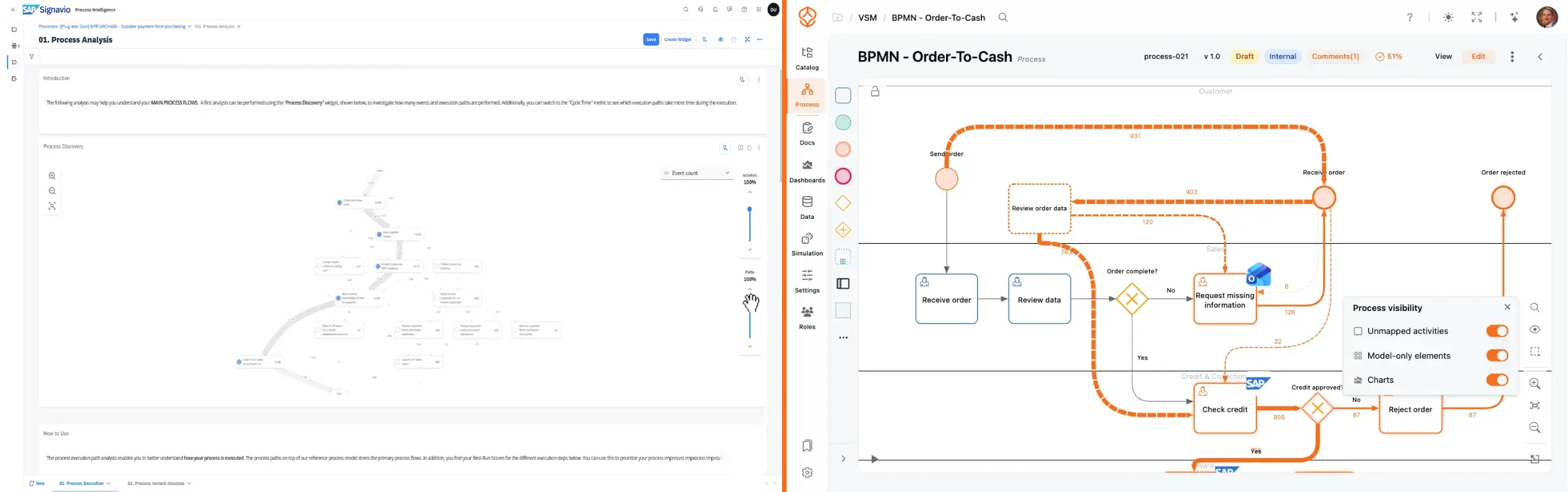
| Area | SAP Signavio | ProcessMind |
|---|---|---|
| Process modeling | Visual process modeling within the SAP Signavio suite | BPMN 2.0 modeling in the same workspace as process mining |
| Process mining | SAP-oriented process intelligence, with SAP data access as a key advantage | Analyze event logs exported from the systems you use |
| Simulation | Described as limited or external through SAP tools | Integrated, model-based process simulation |
| Process content | SAP-focused process and journey content and benchmarking material | Model and analyze your own processes using your process data |
| Approach | May fit an organization already adopting the surrounding SAP suite | One workspace where the process architecture, the mining and the simulation stay connected |
| Licensing shape | Suite and module scope affect the licensing arrangement | Published per-seat tiers |
| Best fit | SAP-centric organizations with a broader SAP process transformation program | Teams that need process insights across systems without adopting a broader suite |
The table is a starting point, not a substitute for checking your requirements. Distinguish what your organization already has in place from what it would need to implement, govern, and support.
Where does SAP Signavio have an advantage?
SAP Signavio can be a strong choice when your process work is closely tied to SAP. Its SAP context is a real advantage, not just a branding detail.
SAP data access. SAP describes process mining that reads SAP systems directly. That can matter during an S/4HANA program, where extracting and preparing data is part of the work you need to plan.
Prebuilt SAP-oriented content. Process and journey content, benchmarks, and modeling governance can help when your teams are working within the SAP estate. Assess how much of that content applies to your processes and how it fits your governance model.
A suite for a broader program. If your organization is already rolling out SAP Signavio capabilities, using the suite can keep process management and analysis within the same environment. That may be a better fit than introducing a separate platform for a program that is already organized around SAP.
Existing enterprise relationships. Your organization may already have procurement, security, and support processes in place for SAP. That can make a suite rollout easier to evaluate internally than adding another vendor. The actual effort still depends on your organization and implementation scope.
If your main goal is to support an SAP transformation and your teams can use the surrounding suite, SAP Signavio deserves serious consideration. A comparison that ignores this fit would not help you make a sound decision.
When can the suite become a constraint?
A broader suite can also mean a broader rollout. If your immediate need is to understand one process, the time and coordination required to adopt more capabilities may matter more than the license alone.
Rollout time and ownership. A suite can require coordination across process owners, IT, data teams, and governance. If you have a dedicated team and a program that spans the SAP estate, that work may be appropriate. If you need a focused answer and have limited capacity, it may be more than the task requires.
Scope beyond SAP. Many processes cross applications and teams. If your analysis needs to include systems outside SAP, check how those sources are handled and what data preparation they require. SAP-native access is useful, but it does not remove the need to account for the full process.
Suite adoption versus a single use case. If you need process mining to answer a specific question, consider whether you also need the surrounding suite capabilities. A focused platform can be a better fit when your team wants to start with one process and expand only when the results justify it.
Licensing shape. SAP describes Signavio licensing in the context of a suite and its modules. Compare the scope you would actually adopt rather than treating the decision as a simple feature or license comparison. Do not assume a suite is more or less expensive without evaluating your own scope and implementation needs.
How do mining, modeling, and simulation differ?
Process mining shows how work runs based on event data. Modeling captures how you expect or intend the process to work. Simulation lets you explore a modeled process under different assumptions. These activities answer related but distinct questions.
With SAP Signavio, the value of combining process capabilities in a suite can be strongest when your teams already use its process management environment and SAP-focused content.
With ProcessMind, mining and BPMN modeling share a workspace. You can compare the process represented in your model with the process shown by your event data. Process simulation is also integrated, so you can explore a model without treating simulation as a separate platform.
The right choice depends on how your teams work today. If your process models already live in SAP Signavio and are governed there, continuity may matter. If you want to connect process discovery, documentation, and simulation around a specific process, a shared workspace may reduce handoffs.
How should SAP-centric teams evaluate the options?
Use a real process to test the fit. A demo can show an interface, but it cannot tell you how much work your data, process scope, and team structure will require.
- Choose a process with a clear question. For example, identify where cases wait, where rework occurs, or how the actual process differs from the documented model.
- Map the systems involved. List the SAP and non-SAP systems that hold relevant event data. Confirm what you can extract and who owns the data.
- Check the data preparation effort. Compare the work needed to make the event data usable in each platform. Include data access, transformation, and validation.
- Test the process model. If you have a BPMN model, see how it fits into the analysis. If you do not, assess how your team would document the process and keep that documentation current.
- Include rollout capacity in the decision. Identify who will configure, govern, and use the platform. A tool that fits your architecture still needs an owner.
- Compare the full adoption scope. Consider the capabilities you will actually use, the implementation work, and the people required to sustain it.
This evaluation helps you distinguish a platform fit from a program fit. SAP Signavio may be the stronger program choice when your organization is already committed to the SAP suite. ProcessMind may be enough when your team needs to answer a defined process question without taking on a broader rollout.
Review ProcessMind’s published per-seat pricing to compare its licensing shape with the scope of your evaluation.
For a practical starting point, review how process mining works in ProcessMind and what you need to prepare before analyzing event data.
Which platform fits your organization?
Choose SAP Signavio when your process transformation is centered on SAP, you can use its SAP-oriented content and data access, and you have a reason to adopt the broader suite. Its value is clearest when the suite supports an existing SAP program rather than when you are buying process mining in isolation.
Choose ProcessMind when you want the process architecture and the event data connected in one place: models that are checked against reality, mining that feeds the same workspace, and simulation on the mined baseline. It can be a practical fit when you want to start with one process and let the results decide how far the platform spreads.
Neither choice is right for every SAP-centric organization. The deciding factors are your process scope, data access, existing SAP commitments, and capacity to roll out and maintain the platform.
If you are also comparing other process mining options, see how ProcessMind compares with Celonis. You can also compare ProcessMind with UiPath if that platform is on your shortlist.
Connect your process architecture to your own data
One real process is the clearest way to judge whether connecting the architecture to the data works for your team. Start with a model you care about and an event log for the same process.
Connect your process architecture to your own data
You are weighing an SAP-centric suite against connecting one process model to its own event log.