

Competitive Analysis Last updated November 5, 2026
Celonis Alternatives: Celonis vs ProcessMind
Compare Celonis and ProcessMind on capabilities, pricing and fit, then test both on the same event log.

The Short Answer
Celonis and ProcessMind both use event logs to show how work flows through your organization. The main difference is what each platform does with the result. Celonis combines process intelligence with execution management across enterprise systems. ProcessMind connects the process architecture to the mined data, so the models your team maintains and the behavior recorded in the event log stay one artifact: a live picture of the process that can be simulated before it changes. Celonis may suit large organizations with dedicated teams and complex requirements. ProcessMind may suit teams that want the architecture, the analysis and the simulation in one connection, at published per-seat pricing.
| Feature | Celonis | ProcessMind |
|---|---|---|
| Built for | Large enterprises with dedicated process teams and existing platform investments | Process owners and analysts who want to investigate a process and make changes to its design |
| How it is sold | Quoted per engagement; no published list pricing | Published per-seat subscription |
| How a project starts | Implementation and onboarding project | Upload an event log and view a process map |
| Strongest at | Process intelligence, object-centric mining, task mining and execution management | Process mining, BPMN modeling and simulation in one workspace |
What Each Platform Is
| Feature | Celonis | ProcessMind |
|---|---|---|
| Category | Process intelligence and execution management platform | Process mining, BPMN modeling and simulation platform |
| Center of gravity | Understanding processes and acting across enterprise systems | Understanding and redesigning processes |
| Notable capabilities | Object-centric process mining, desktop task mining, execution management and a broad enterprise application ecosystem | Model-driven process mining, BPMN 2.0 modeling with auto-layout and what-if simulation |
| Typical buyer | Global enterprise with an established platform investment | Midmarket and enterprise teams starting with a process they want to understand |
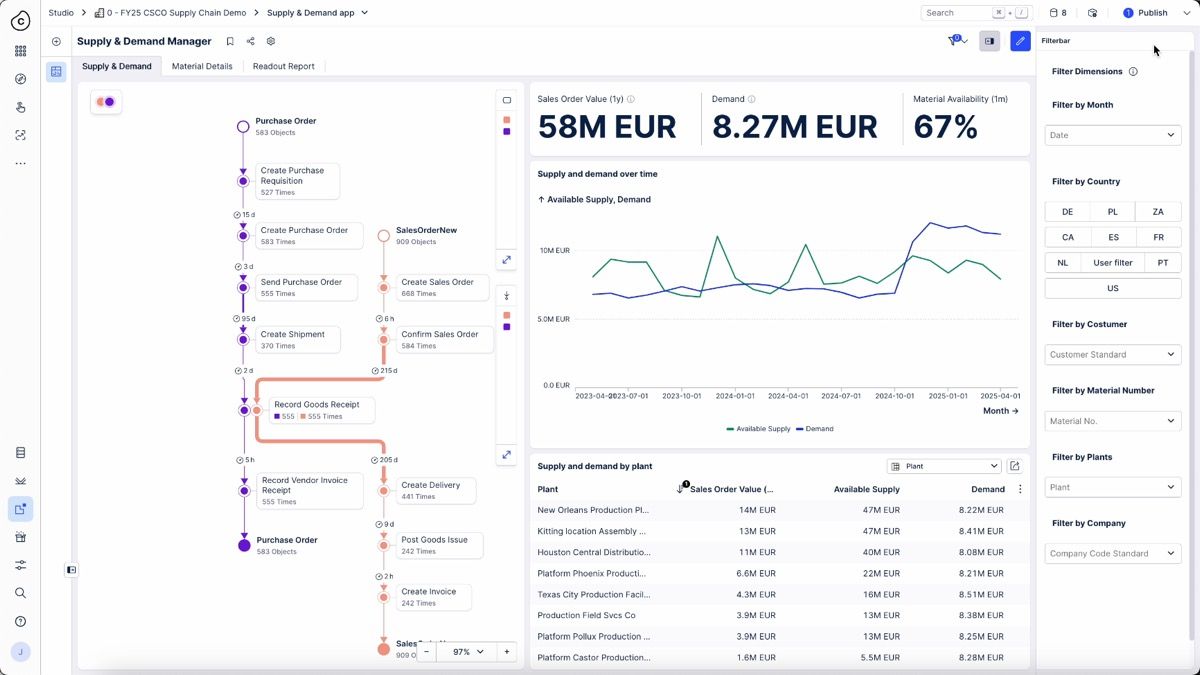
Celonis
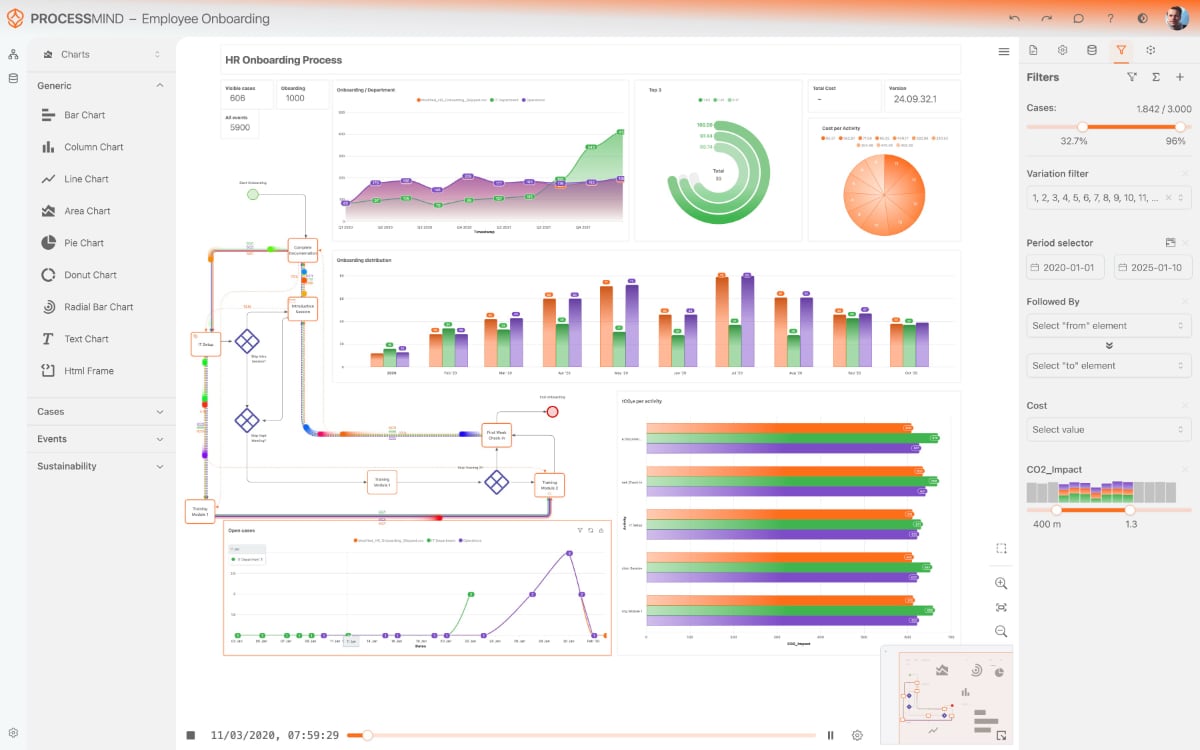
ProcessMind
Feature Comparison
This table summarizes capabilities described in the vendors’ published materials. It is not a performance benchmark: we have not tested both platforms on the same event log. The Celonis column reflects what Celonis publishes about its own product, and the ProcessMind column reflects our own platform documentation and pricing page; both were checked on 2026-09-21.
| Feature | Celonis | ProcessMind |
|---|---|---|
| Process modeling | Process modeling within its enterprise suite | BPMN 2.0 drag-and-drop modeling integrated with the mined process |
| Process mining | Object-centric process mining and AI-driven insights | Model-driven process mining with subprocesses, parallel paths and swimlanes |
| Task mining | Desktop-level task mining | Not offered; ProcessMind reads server-side event logs |
| Process simulation | Scenario-based outcome forecasting | Integrated simulation to test a change against the mined baseline |
| Execution management | Orchestrates and automates actions across enterprise systems | Not offered; ProcessMind measures, models and simulates processes rather than executing work |
| User experience | Enterprise-focused; onboarding and training expected | No-code interface aimed at analysts rather than engineers |
| Deployment | Cloud, global scale | SaaS, multi-language, multi-tenant, EU-hosted (Frankfurt) |
| Pricing model | Quoted per engagement; no published list pricing | Published per-seat tiers: Foundation, Architecture and Intelligence |
| Typical buyer | Large enterprises | Process teams in midmarket and enterprise organizations, plus white-label partners |
Where the two products differ in scope
Celonis extends beyond process mining. Its task mining captures desktop activity, which can reveal manual steps that never appear in a server log. Its execution management layer is designed to coordinate and automate actions across business processes and enterprise systems.
Those capabilities can matter when you need to analyze desktop work or act on process events across a large technology environment. They also mean you are evaluating the Celonis platform as a whole, not a single capability, and not just a way to discover process flows. Consider the requirements your team needs to support, the implementation involved and the people available to operate the system.
ProcessMind focuses on process mining, modeling and simulation, kept in one connection with the process architecture. It does not offer task mining or execution management. That scope fits when your goal is to understand how a process runs, keep the model current against the data and test possible changes before making them, rather than to automate actions across systems.
Where Celonis Is Stronger
A useful comparison should make the other platform’s strengths clear. Celonis may be the better fit in these areas:
- Object-centric process mining at scale. Celonis process mining supports analysis across several object types. If your process has no single case notion and orders, deliveries and invoices interact, this capability may be important. ProcessMind does not offer object-centric process mining.
- Task mining. Desktop-level capture can show steps that never reach a server log. ProcessMind does not offer this capability.
- Execution management. Celonis can act on processes, not just describe them. This matters when your goal includes orchestrating or automating actions across enterprise systems.
- A broad enterprise ecosystem. Celonis offers integrations and an established ecosystem. If your organization already uses the platform, existing skills and investments can make staying with it the practical choice.
- Enterprise governance features. Celonis has invested in governance capabilities for larger organizations. Check the controls against your own requirements during evaluation.
If object-centric analysis, desktop task mining or execution management is central to your project, Celonis may be the stronger fit. ProcessMind does not replace those capabilities.
Where ProcessMind Is Different
ProcessMind is built the other way round: mining and modeling are one artifact, not two products that have to be reconciled. These are the practical differences to consider:
- The architecture and the data are one connection. The process hierarchy, value streams, ownership and the BPMN models sit in the same workspace as the mined event log. A model is checked against reality with conformance checking, animated with real cases and simulated against the mined baseline, and simulation parameters are derived from your own data instead of entered by hand. That is what turns process documentation into a working digital twin of how the process runs. In most enterprise stacks, mining and modeling are separate products that drift apart.
- Mining, modeling and simulation in one workspace. The mined process and BPMN model share a workspace. You can compare actual process behavior with the model and simulate potential changes without moving between separate products.
- Published per-seat pricing. ProcessMind publishes three tiers, so you can compare plans and current prices or estimate a seat mix before talking with sales. Celonis does not publish list pricing and invites prospective customers to request a quote. That difference is about how you budget, not a claim that one platform costs less.
- Start with exported data. ProcessMind reads Excel, CSV and database extracts directly. You can begin an analysis without waiting for a connector project.
- Designed for analysts and process owners. Load data from Excel or system exports and explore the process without building the analysis in code.
- A defined product scope. ProcessMind focuses on process mining, modeling and simulation. It does not execute or automate work, and it is not a replacement for an execution platform.
- Administration without an implementation project. Add or remove users as needed, use multiple environments for test and production, and run the platform in your own language.
That focus also shows in how the analysis layer works. ProcessMind scores process health on five dimensions: conformance, uniformity, rework, efficiency and smoothness, combined into one weighted score per process, so a team can see whether a process is improving rather than only what it looks like today. A step can carry a target band with a start and stop boundary, so the discovered flow is read against the norm you agreed instead of only against last month. Data quality is reported before the analysis: the platform shows a quality percentage for the uploaded log, with freshness, attribute coverage and activity analysis, and suggests fixes for what it finds. The process health score and the data-quality checks are part of the Process Intelligence tier.
If you want to compare the subscription structure with your planned seat count, review ProcessMind pricing or use the pricing calculator.
What each platform needs before the first analysis
The platforms differ in how much has to be in place before you see a process.
Getting data in. Celonis connects to source systems and loads data into its own model, which usually means people who understand both the source system and the Celonis data model. ProcessMind reads an exported event log: an Excel or CSV file with a case identifier, an activity name and a timestamp. If you can produce that extract, you can run the first analysis yourself. For a multi-table export, create a process mining event log first; the steps are the same whichever platform you use.
Requirements on the data model. Object-centric analysis needs more than one case notion: several object types, the relationships between them, and the events that connect them. A case-based analysis needs one case identifier and an agreed definition of what a case is. Decide which shape your process has before comparing feature lists, because it determines which platform can answer your question at all.
Who does the work. With a quoted enterprise platform, plan for onboarding, training and often a partner during the first rollout. ProcessMind starts without an implementation project, so a process owner or analyst can work on the first process while a wider rollout is still being discussed.
Refreshing the analysis. On both sides this is a data question before it is a platform question. What you can automate depends on how often your source systems can produce a consistent extract, and on who is available to check it when something changes.
What a trial can and cannot tell you. A free trial on real data answers the part you control: whether your extract produces a process map, whether that map is understandable to the people who run the process, and how much cleaning the log needs. It does not show how a full enterprise rollout would behave, and it does not replace a formal evaluation.
How Each Platform Is Priced
The pricing models are different in structure. Celonis does not publish list pricing, while ProcessMind publishes per-seat prices. If you are evaluating Celonis alternatives, the practical question is whether you need execution management and task mining, because most Celonis competitors in the enterprise process intelligence category are broad platforms too.
Celonis: Celonis pricing is quoted per engagement. The company does not publish a list price; its pricing page directs prospective customers to request a quote. Ask what the proposal includes, including the license, implementation and any ongoing consulting. The Celonis license cost alone will not show the full project cost.
ProcessMind: ProcessMind publishes three per-seat tiers: Process Foundation, Process Architecture and Process Intelligence, with prices in your selected currency. Use the pricing calculator to estimate a seat and add-on mix. A 14-day free trial runs on real data, and when it ends you can continue on the Process Individual plan. Process Architecture and Process Intelligence plans include ten free portal viewers per seat.
Do not treat the published prices as a like-for-like comparison with a Celonis quote. The products have different scopes, and the Celonis contract amount depends on the engagement. For either platform, compare total cost of ownership: implementation, data preparation, consulting and the internal time needed to run the system.
Moving Between Platforms
Your event log is the portable starting point for a migration. Both platforms read event data, but analyses, dashboards and configured models do not transfer automatically. Plan to rebuild the analysis layer if you move platforms, and include that work in your evaluation.
You do not have to make a platform-wide decision before testing a specific process. Some teams run ProcessMind alongside Celonis to evaluate a focused use case. Compare the time and effort required to prepare the same event log, build an analysis and answer the same process questions.
For consultants and partners, ProcessMind can support engagements that need process mining, modeling and simulation without the broader scope of an enterprise execution platform. Consider these parts of the model:
- A focused service offering: You can deliver process mining, modeling and simulation for clients whose requirements do not call for an enterprise execution suite.
- Published pricing to plan around: Per-seat tiers help you estimate subscription costs before a scoping call. You can adjust seats as an engagement changes. Multi-tenant environments on Enterprise let you manage several client environments in one place.
- White labeling: Themes and white labeling let you present the platform under your own brand.
Visit partner with ProcessMind for details about the partner program and commercial model.
How to Choose
Use your requirements to decide which platform to evaluate:
- Start with the team that will run it. If you have a dedicated process team and the capacity to support an enterprise platform, Celonis’ broader scope may suit you. If process owners and analysts have to lead the work themselves, ask which platform keeps their models and the process data in one place, because that is the work they will repeat every week.
- Decide whether you need execution management. If the platform must orchestrate or automate actions across systems, Celonis offers capabilities ProcessMind does not. If you need to analyze and redesign a process, compare the mining, modeling and simulation workflows.
- Check how your process is represented in the data. If one case identifier covers the process, a conventional case-based analysis may be enough. If several object types interact, assess whether object-centric process mining is a requirement.
- Include desktop work in your scope. If you need visibility into steps that do not appear in server logs, evaluate Celonis task mining. ProcessMind does not capture desktop activity.
- Compare implementation and ongoing effort. Ask what data preparation, onboarding, training and internal staffing each option requires. Include those costs alongside subscription or contract pricing.
- Test both platforms on the same event log. Use the same process, time period, data fields and business questions. Record the effort needed to prepare the data and produce an answer, then compare the results with your requirements.
A Side-by-Side Test You Can Run
A feature table cannot tell you how either platform will perform on your data. Use this protocol to make the comparison reproducible:
- Choose one process and one time period. Pick a process with a clear business question, such as where cases wait or how often the process deviates from its intended path.
- Prepare the same event log for each platform. Use the same source data, case identifier, activity names, timestamps and filters. Document any transformations so you can repeat them.
- Set the same questions. For example: What are the main process variants? Where are the longest waits? Which cases follow a defined path? Keep the questions within the capabilities you are comparing.
- Record the work required. Track data preparation, configuration, training and time to the first useful answer. Note where you need specialist help or additional implementation.
- Check the answer with process owners. Confirm that the discovered flow matches how the work is understood and investigate differences. A process map is useful only when the people responsible for the process can interpret it.
- Compare the results against your requirements. Include capability fit, implementation effort, operating effort and total cost. Do not infer a general performance result from one process or one event log.
This test does not replace a full enterprise evaluation. It gives you a concrete basis for deciding whether each platform fits the process and team you have in mind.
Conclusion
Celonis and ProcessMind address overlapping but different needs. Celonis combines process intelligence with task mining and execution management for organizations that need a broad enterprise platform. ProcessMind combines process mining, BPMN modeling and simulation for teams that want to understand and redesign processes in one workspace.
Choose based on the work you need the platform to do, the data you have, the team available to run it and the full cost of implementation and operation. Neither a feature list nor a quote can answer those questions without a test on your own process.
Compare more process mining platforms and review open-source options if you are still building your shortlist.
If you want to see the workspace before loading any data, the process mining product tour walks through discovery, modeling and simulation in one place.
Where to Go From Here
Run the same event log through both platforms and compare the work required to answer the same process questions.
Compare on your own log, not on a feature table
A feature table cannot tell you how either platform behaves on your event log.