

Process Governance: Keep Process Documentation Current
Process governance assigns ownership, approval, versions and review so documentation stays true. Here is how we build each one into the platform.

Process governance defines who owns a process, who can change its model, where the approved version lives, and when you review it. These decisions keep process documentation aligned with how work actually happens, long after the project that created it ends.
That is the generic definition, and it is correct. What this page adds is the part most governance articles leave out: where each decision actually lives. In ProcessMind, ownership, approval, the published version and the review queue are features of the platform, not clauses in a policy document.
Work changes as people, systems, and responsibilities change. A diagram captures a moment; expertise often stays in people’s heads. Without clear ownership and review, documentation gradually stops matching reality.
What does process governance mean?
Process governance is the set of decisions and roles that keeps process documentation aligned with how you run the process. It answers four practical questions:
- Ownership: Which named person is accountable for the process?
- Change: Who can edit the model, and who approves changes?
- Publication: Where does the approved version live?
- Review: When do you check that the model still reflects the work?
Project governance focuses on delivering agreed scope. IT governance focuses on technology risk. Process governance applies to the processes themselves and continues after the project that introduced them.
If you can answer these four questions for your most important processes, you have a working foundation. If you cannot, teams document the same processes repeatedly, each time starting from scratch. A process architecture gives those repeated attempts one place to land.
Which four decisions should your process governance framework settle?
Use this table to prepare a first governance session. For each process, record the decision, the person responsible, and the evidence that proves the decision is in effect.
| Decision | What to agree | Failure it prevents | Where it lives in ProcessMind |
|---|---|---|---|
| Owner | Name one person accountable for the process. | No one notices or addresses poor performance. | Ownership on the process, visible in the catalog |
| Change and approval | Define who can edit the model; the process owner approves. | Changes happen informally, without a clear record. | Request review goes to the owner, owner approval, then publish |
| Official version | Choose one location for the approved model. | People rely on conflicting copies. | One published version, visible to viewers |
| Review cadence | Review after relevant changes and at least annually for active processes. | Documentation quietly drifts out of date. | Review dates and the Needs my review queue |
Keep the rules proportionate. In ProcessMind the process owner is the approver, so each change has one clear decision and a visible outcome instead of a long chain of signatures. Make the approved model easy to find, and set a review schedule that reflects how often the process changes and the risks involved. How governance and publishing work covers the workflow step by step.
The fourth column is the one most governance frameworks leave out. A decision that exists only in a document is a preference; a decision that exists in the platform is a constraint. When the owner is a field, the review is a queue item and the published version is the only one viewers can see, the rules hold after the person who wrote them has moved on.
Why does process documentation go out of date?
Documentation rot often starts with a reasonable exception. An approval step creates a backlog, so a manager agrees to skip it for certain cases. The backlog clears, but nobody formally ends the exception. The new way of working becomes routine while the model still shows the old approval step.
Once people stop trusting the documentation, they stop checking it. That makes the next change harder to spot, and the gap grows. In practice the exception is rarely written down at all, which is why the gap is usually discovered during an audit rather than during a review. The structural cause is that the model is not the record, so nothing forces a decision when the work changes. Put the model in a governed platform and the change has somewhere to happen: a version, an owner whose approval makes it official, a published state, and a review date. Governance stops being a reminder and becomes a step in the workflow.
Governance is the difference we keep seeing between teams that improve a process and teams that try and drift back. The mining projects that stall were rarely a data problem; nobody owned the result. That is why governance is built deep into the platform instead of written into a policy nobody reads.
What process governance roles and responsibilities do you need?
A practical process governance model starts with three roles. In a small organization, one person may hold more than one role, but keep the responsibilities clear.
| Role | What the role is accountable for |
|---|---|
| Process owner | Accountable for the process, decides what its model should say, and approves changes to it. |
| Process architect | Maintains the process catalog, standards, naming conventions, and modeling approach. |
| Compliance approver (only where a control requires one) | Signs off as well when a specific regulatory or financial control applies. |
Process owner responsibilities are specific: the owner decides whether a proposed change accurately reflects the work and has the authority to make that decision stick, and that decision is the approval that counts. The owner does not have to edit the model or maintain the documentation personally, and in ProcessMind they do not have to chase it either: a review is requested on the process, the owner sees it in the review queue, and their approval is what publishes the version. The architect maintains consistency across the catalog. A compliance approver is added only when a control demands a second signature, which keeps the common case at one approver. The process ownership model only works if the roles are distinguishable, which is why they are recorded rather than assumed.
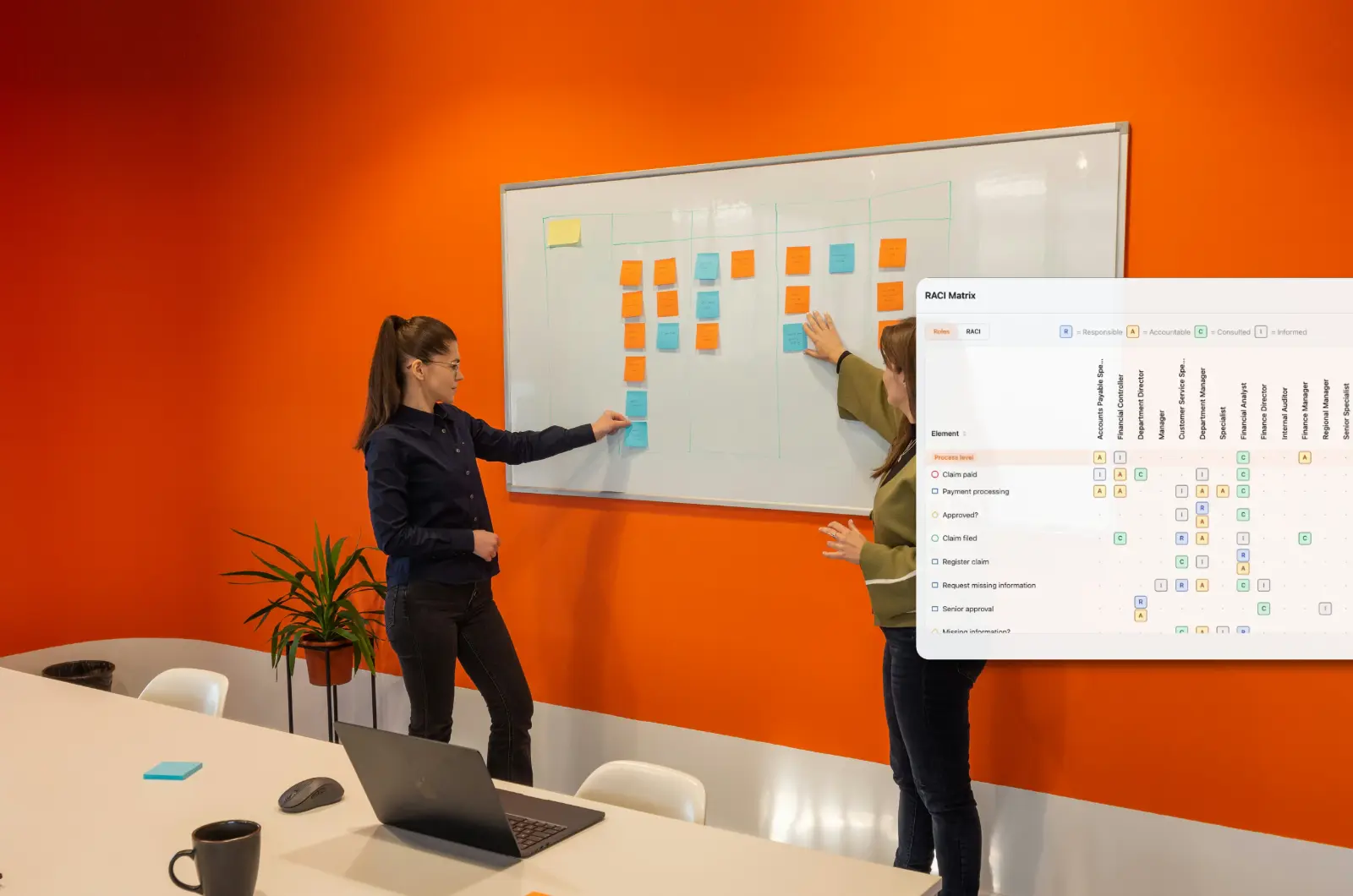
Assign the responsibilities with a RACI matrix, and start from the RACI template if you are setting it up for the first time. Keep the role library in one place so the same roles are reused across models instead of redefined per team.
Set a review cadence alongside these roles. Review when a relevant change occurs and on a schedule for active processes.
Which processes should you govern first?
Start with the processes that matter most, not every process in the organization. Prioritize processes that generate revenue, attract regulatory attention, involve many handoffs, or have changed often in the past year.
Be explicit about what is in scope. A smaller catalog with named owners, approvals, and review dates is more useful than a large catalog with owner fields nobody trusts. Mark other models as reference material until you are ready to govern them, and let the process catalog show the difference between the two. Process documentation governance begins with that line: which processes are governed, and which are only described.
Set ownership before choosing tools. A catalog can organize models, but it cannot decide who is accountable for them. Process documentation is where the model, the owner and the procedure meet in one record.
How should you govern AI-generated models?
AI-generated models need the same ownership, approval, publication, and review rules as any other model, applied more strictly. An AI draft is a plausible description of how a process might work, not evidence that the process works that way in your organization.
Keep generated models in draft status until a named process owner reviews and approves them. Record what the draft was generated from, and let the owner compare it with the existing model. After approval, follow the same review cadence you use for other documentation.
Governance pays off twice here. The same governed record that people read can be read by AI assistants through the API and the MCP server, under the same permissions. An assistant that answers from a published, approved model is answering from the process, not from a copy pasted into a prompt. See what an MCP server can expose.
ProcessMind supports AI-assisted modeling and version history. Keep generated work as a draft until it has been reviewed, and treat publication as a separate decision. For details on how versioning works, see the ProcessMind documentation on versioning.
What are five signs your process documentation is still accurate?
Governance is working when you can point at the evidence. These five checks are the ones we use, and each one is a capability in ProcessMind rather than an aspiration.
1. You can name the owner of an important process quickly. If the answer is a department, or a name you have to look up in an old email, accountability is not recorded. In ProcessMind ownership sits on the process itself and appears in the catalog, so the answer takes one search.
2. A change shows what changed and who approved it. A memory of a change is not a record. Every model has version history, and approval is a permissioned action that moves a process through draft, under review, approved and published. The audit log keeps the trail.
3. People use the published version. If colleagues keep private copies, the shared model is not trustworthy. ProcessMind publishes one version to viewers, in the platform and in the Process Portal, so there is exactly one answer to which version is current.
4. Review dates are current. Overdue reviews that nobody sees are worse than no dates at all. The catalog’s Needs my review queue lists what is waiting on each owner, so a review is a task with a name against it rather than an intention.
5. You can answer audit questions from the process record. Rebuilding evidence from scattered folders takes weeks. In ProcessMind the owner, the version, the approval and the attached documentation are one record you can export and show.
These checks matter only if they reflect the work. A completed review date does not prove that anyone read the model, which is why the roles and the review queue exist: they put a person and a moment next to the check.
None of the five needs a new tool if the platform is already where the process lives. That is the practical argument for governing processes inside a modeling platform rather than beside it: the evidence becomes a by-product of doing the work, not a report someone has to assemble at the end of the quarter.
What process governance mistakes should you avoid?
- Making approval a bottleneck. If approval is slow or unclear, people may work around it. Give each change one clear approver, the process owner, and a defined action.
- Treating a policy document as governance. A written standard records an intention; ownership, approval, publication and review put it into practice. The process governance best practices that survive contact with real teams are the ones the platform enforces, not the ones a slide deck describes.
- Setting rules without assigning owners. Each governed process needs someone accountable for applying the rules.
- Applying the same review burden to every process. Focus effort where risk, change, or business impact makes it worthwhile.
How do you put process governance into practice?
Start with one process you already own, and make the four decisions real on that model before you write any policy.
-
Name the owner
Put one person on the process, not a department. If two people share it, neither is accountable. -
Agree who edits and who approves
Keep the people who change the model separate from the person who signs it off. In ProcessMind that person is the process owner, so add a compliance approver only when a control requires one. -
Publish one version
Choose the published model as the only answer to which version is current, and give viewers that version instead of a copy. -
Set the review
Add a review date and use the review queue, so an overdue check has an owner rather than good intentions. -
Re-run the five checks
A month later, repeat the five checks above. If any answer takes more than a search, fix that one next.
ProcessMind puts ownership, approval, version history and the published record in one place, so governance is something the platform enforces rather than something a document asks for. For the ownership side, the RACI explainer and the RACI template cover how to assign the roles. For what happens when nobody owns the result, read why process mining projects stall.
Put ownership and approval on one process
Governance is only credible once it is applied. Pick one process you already own and make the four decisions real on its model.