Value Stream Mapping (VSM): Connect Strategy to Process Performance
Learn how digital value stream mapping connects end-to-end process architecture, real process data, and improvement work in ProcessMind.
Value Stream Mapping (VSM) makes the complete flow of value visible: from a customer need, through the processes and handoffs that fulfill it, to the final outcome. ProcessMind adds the missing connection between the map and reality by linking value streams to process architecture, objects, elements, owners, and actual performance data.
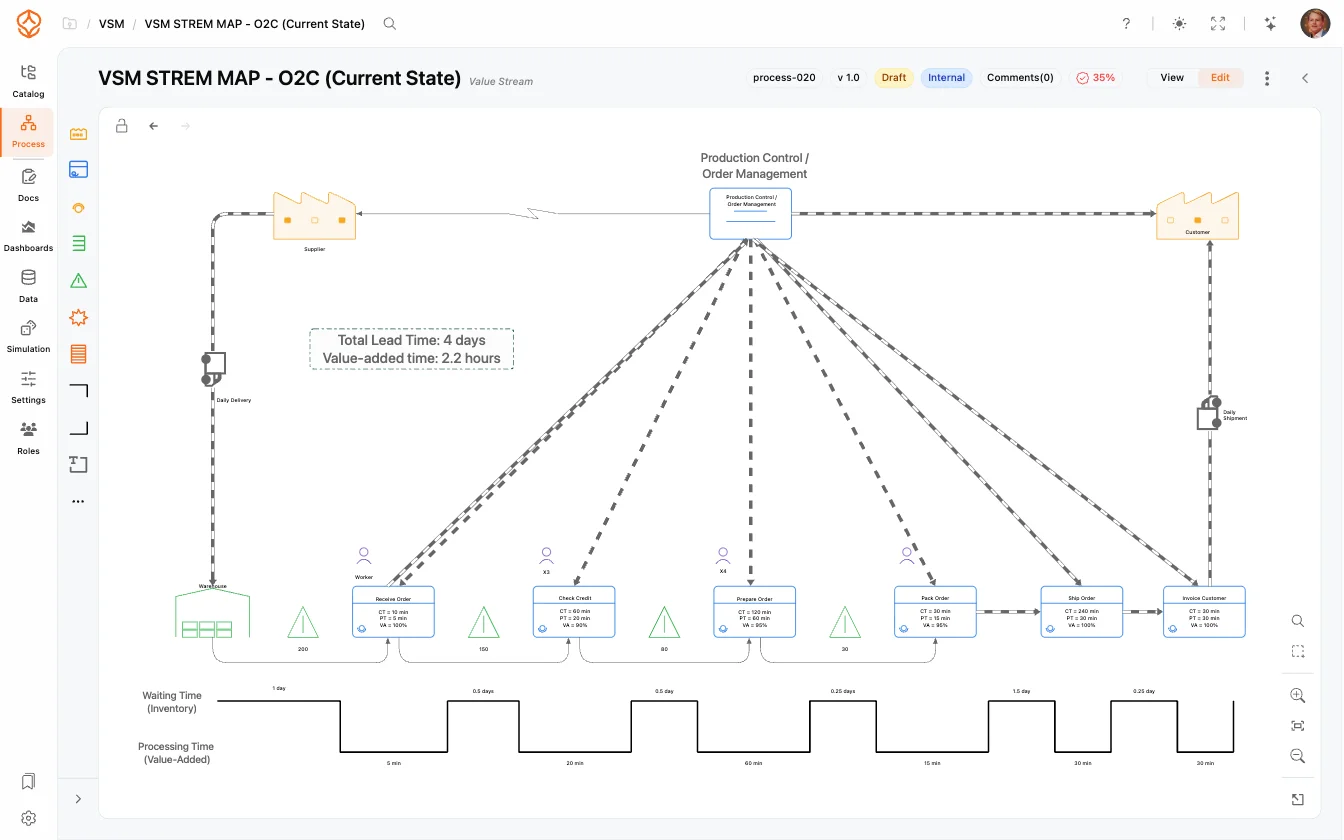
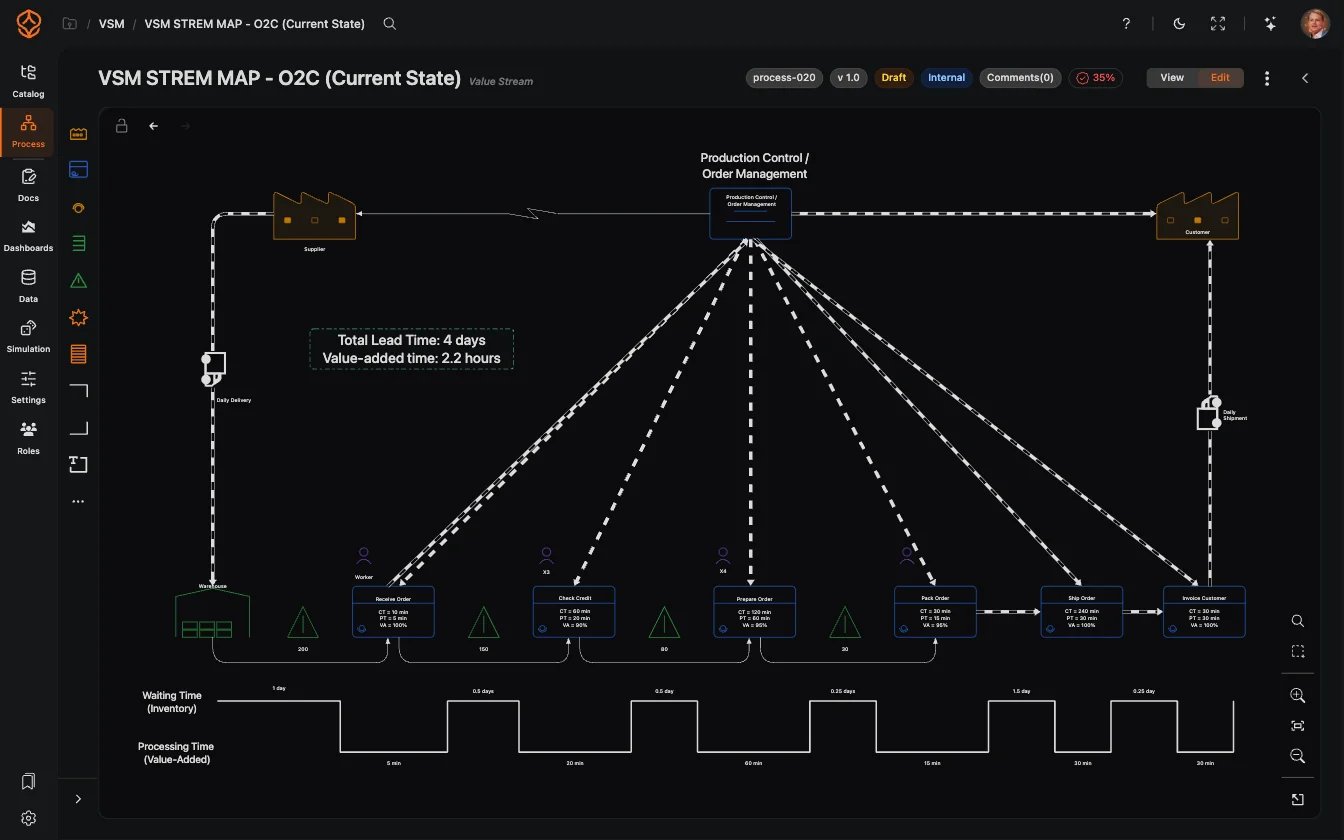
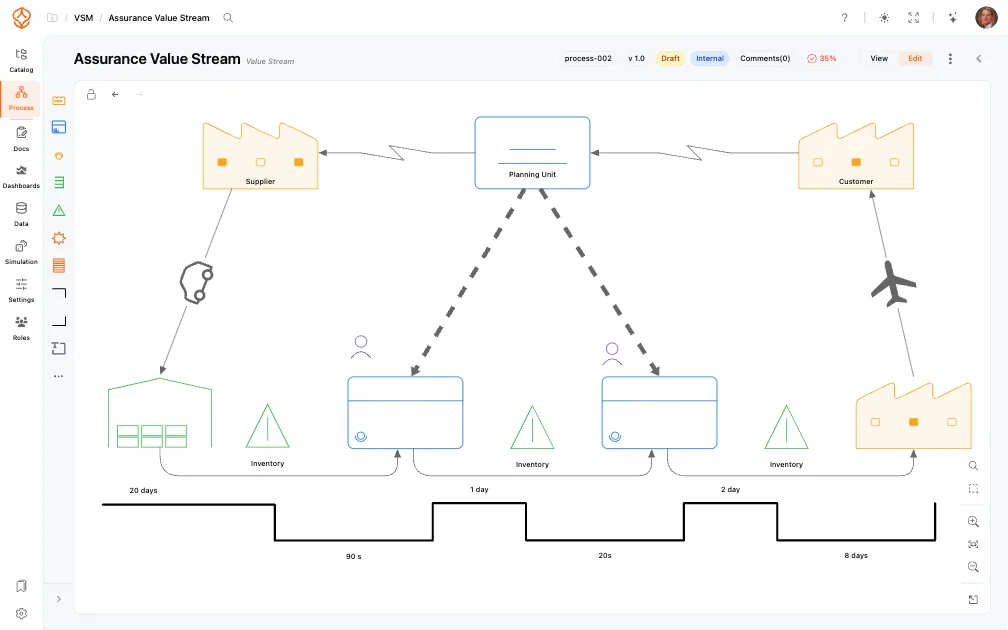
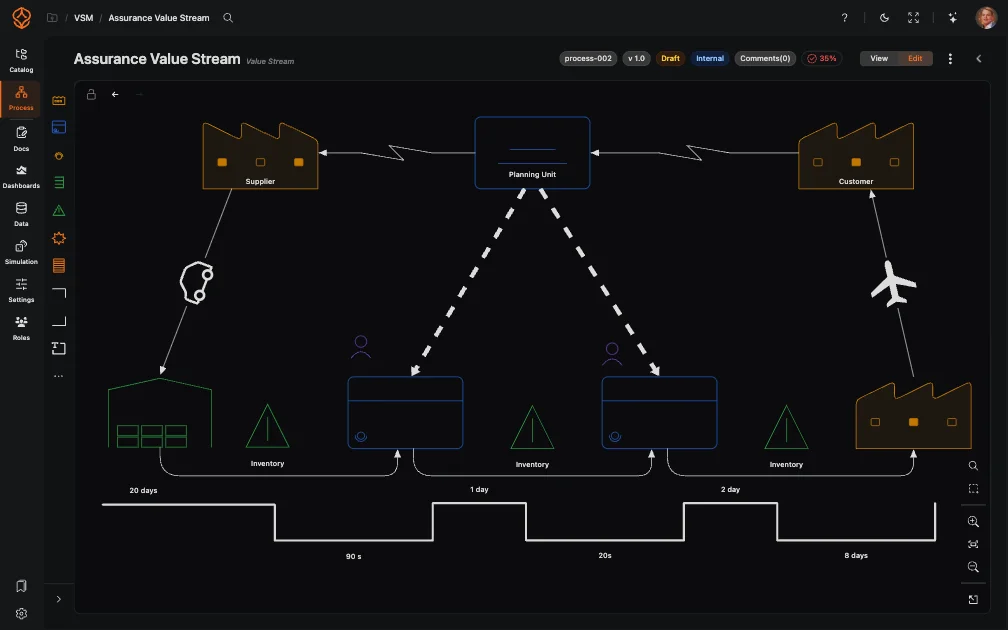
Value Stream Mapping is a Lean improvement technique for understanding how work, information, and materials move through an organization. A traditional map typically shows the customer, suppliers, major process steps, information flow, inventory or queues, and a timeline comparing total lead time with value-added work.
The goal is not to create a prettier flowchart. The goal is to see the whole system from the customer’s perspective and identify where value is created, where work waits, where handoffs add friction, and where rework or variation consumes capacity.
VSM started in manufacturing, but the same thinking applies to procure-to-pay, order-to-cash, customer onboarding, IT service delivery, claims, product development, and other knowledge-work processes. In each case, the value stream crosses organizational boundaries and is larger than one team’s process diagram.
Workshop-based maps are useful because they bring people together and capture how a process is understood. But a static diagram has limits:
ProcessMind turns VSM into a connected digital model. A value stream can contain or link to processes at different levels, from an end-to-end L1 value stream down to detailed L2–L5 process elements. Those elements can be connected to the objects they create, update, approve, or hand over, as well as the systems, teams, roles, policies, and documentation around them.
A useful value stream answers three questions:
This distinction matters because one value stream can involve several related objects. An order may create a shipment and an invoice; a customer case may involve multiple interactions, tasks, and approvals. Mapping only a single case path can hide those relationships. ProcessMind helps teams keep the end-to-end value stream in view while connecting the underlying process elements and the objects they affect.
Start with a clear product, service, or outcome. Decide where the value stream begins and ends, such as from customer request to delivery or from incident reported to incident resolved. A focused scope keeps the map useful and makes improvement measurable.
Capture the major stages and connect them to the processes that perform the work. Organize the model in a consistent hierarchy so stakeholders can move from a high-level value stream to the process elements that explain how work is done. Record the responsible owners and the RACI roles while the cross-functional team is aligned.
Link the processes to the objects they handle and the systems where events are recorded. Add policies, work instructions, and other artifacts to the relevant process elements. These connections make the map more than a picture: they create a shared operational reference that people can navigate and maintain.
Use process mining to compare the designed flow with the actual flow. Measure lead time, cycle time, waiting, rework, variants, throughput, and bottlenecks. The result is a fact-based current-state view that shows which handoffs and queues deserve attention first.
Create a target flow with fewer unnecessary handoffs, clearer ownership, and a better balance between demand and capacity. Use improvement markers for opportunities such as automation, standardization, policy changes, or system integration. Prioritize by customer impact and measurable performance, not by diagram complexity.
Use ProcessMind simulation to test staffing, arrival volumes, routing, and process changes against the current baseline. This helps teams understand likely trade-offs before changing the live process and supports a more credible future-state business case.
Publish the approved architecture, assign review responsibility, and monitor process health over time. A value stream map should be revisited when ownership, systems, policies, or performance changes. Continuous improvement works best when the map, the evidence, and the improvement backlog stay connected.
VSM commonly distinguishes value-added time from waiting and other non-value-adding time. In a digital map, teams can go further and connect metrics to the process elements that influence them:
The right measures depend on the value stream. The important principle is to connect each measure to an outcome, object, process element, and owner so it can lead to action.
VSM provides the shared language and customer-centered scope. Process mining provides evidence of how work actually flows. Combining them closes the gap between a workshop’s assumptions and operational reality:
That loop helps teams move from “we think this is the problem” to “we can show where the problem occurs, who owns it, and which change is most likely to improve the outcome.”
For product details and step-by-step guidance, see the Value Stream Mapping documentation.
Avoid mapping only one department, confusing activity with customer value, or stopping after the current-state workshop. Maps also lose value when they are too detailed at the top level, rely on estimates when data is available, or have no owner for the future state. Keep the value stream outcome clear, link detail progressively, validate with evidence, and review the model as part of normal process governance.
ProcessMind combines process architecture, value stream mapping, process modeling, process mining, dashboards, and simulation in one workspace. Build the map collaboratively, connect it to the objects and elements that make the work real, and use operational data to decide where improvement will matter most.
Connect processes, objects, and performance data in ProcessMind. Map, analyze, and improve your end-to-end value streams.
Process Mining Insights and Strategies
Learn how digital value stream mapping connects end-to-end process architecture, real process data, and improvement work in ProcessMind.
Learn what drives process mining performance through real benchmarks and data strategies for faster uploads and processing. See why Parquet beats CSV.
Compare process improvement methodologies, from Lean and Six Sigma to Process Mining and simulation. Choose the right approach for your organization.
Learn how Process Mining identifies high-value automation opportunities, supports robotic process automation, and helps you avoid automation-first mistakes.
Get instant access with no credit card and no waiting. Turn the way your organization works into clear, connected process designs.
Build your process architecture, define ownership and controls, and align roles and responsibilities across every level.
Start your free trial and create one reliable foundation for governing, managing, and continuously improving your processes.
We use cookies to improve your experience, personalize content, and analyze traffic. By clicking "Accept All," you consent to our use of cookies.