Transformation/Role
Finance and Shared Services Process Improvement
Year
Location
Global
Company Size
Any size

Disclaimer
The use cases in this library are practical guides based on typical process-improvement engagements. Figures and outcomes are typical expectations, not a specific customer's verified results, nor a promise of future results.
Finance and Shared Services Process Improvement
Shared services teams handle high volumes of transactions and requests across accounts payable, accounts receivable, reporting, and other finance operations. Process mining shows how work flows today, while process mapping and simulation help you assess potential changes. Together, they give you evidence to improve cost per transaction while keeping service level targets in view.
Why is it hard to prove improvement in shared services?
Centralizing work makes transaction volumes easier to see, but averages can hide where time and effort go. Rework between business units and the service team, duplicate approvals, aging backlogs, and uneven workloads can all affect cycle time and cost per transaction.
You also need to show that proposed changes justify the investment. A business case based on assumptions alone may not hold up in a finance review. A measured baseline and clearly stated scenario assumptions give you a stronger basis for decisions and charge-back discussions.
How does process mining help shared services?
Process mining uses event data from your systems to show how cases actually move through a process. You can examine process flows, cycle times, handoffs, rework, and deviations from the expected path.
To apply process mining to shared services, start with a service where you can identify each case, its activities, and timestamps. Compare results across business units, request types, or other relevant dimensions to see where performance differs. This helps you target process improvement at specific causes instead of relying on a single average.
Learn more about Process Mining.
What is the three-step approach?
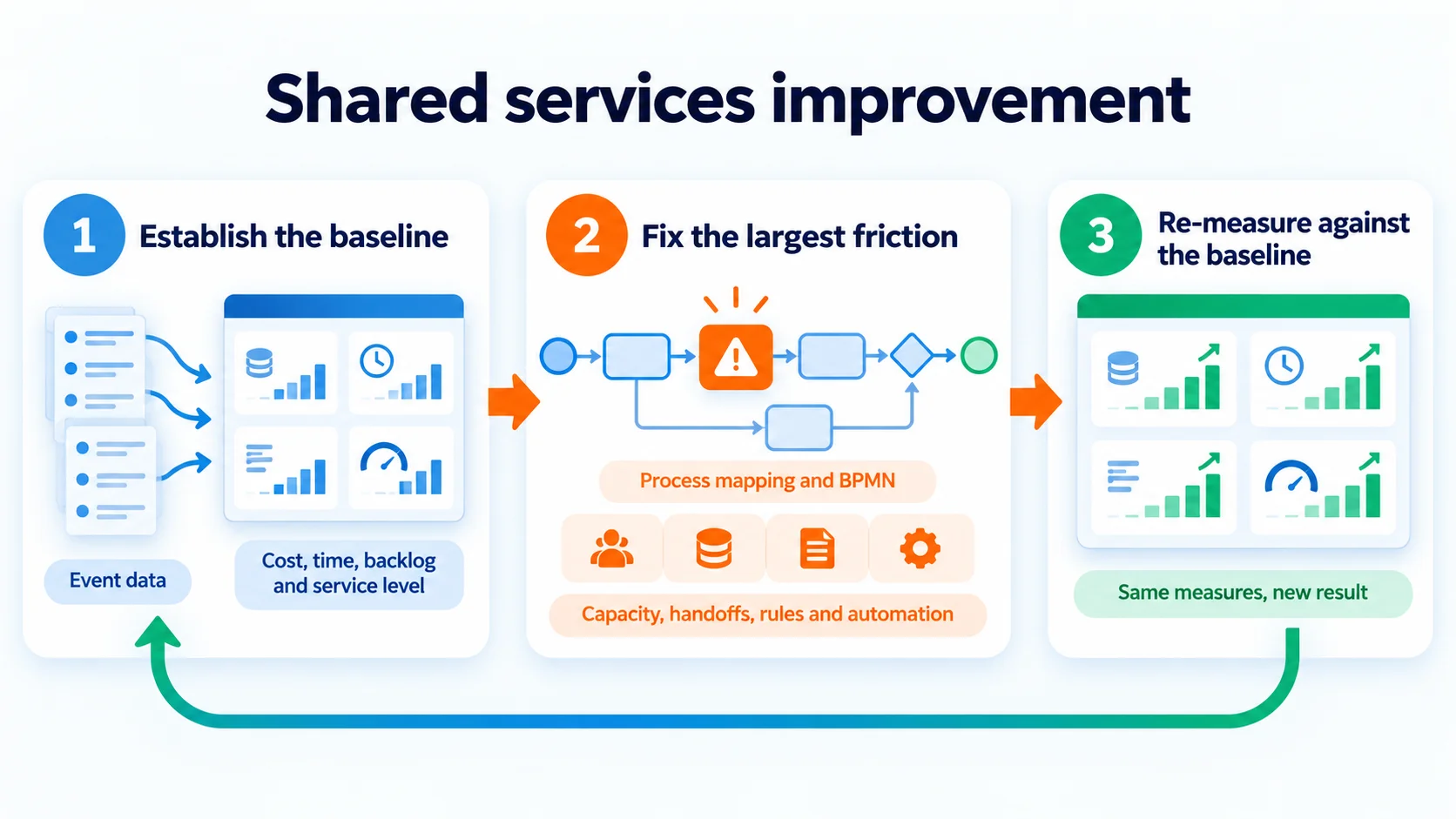
Follow three steps to move from evidence to a decision:
- Mine the current process. Analyze ERP, financial management, or operational data to establish a baseline. Track measures such as cost per transaction, cycle time, backlog, and service level.
- Map improvement options. Document the current process and proposed changes with process mapping and BPMN. Align finance, operations, compliance, and IT on what would change and who owns each step.
- Simulate scenarios. Compare options such as added capacity, fewer handoffs, revised approval rules, or automation. Review the expected effects on cycle time, resource demand, and compliance before deciding what to test.
Explore process mapping and process simulation.
How do you make the numbers stand up to a finance review?
Start with a baseline you can explain. State which process and period you analyzed, how you defined a case, and which costs and service measures you included. Separate observed results from estimates for proposed changes.
For a charge-back or business case, document the assumptions behind each scenario, such as expected volumes, staffing, and process changes. Compare each scenario against the same baseline and show the effects on both cost per transaction and service levels. This makes it easier to discuss trade-offs without presenting a modeled outcome as guaranteed.
[CtaStartTrial custom_title=“Build a baseline for one service” custom_content=“Use your existing ERP or ticketing exports to examine a focused process and establish current-state measures.”]
Where can process mining reveal friction in shared services?
Look beyond total volume and average cycle time. Cycle times in shared services can vary by business unit, request type, or exception path. Process analysis can help you investigate patterns such as:
- Rework between the service team and business units: incomplete requests return for correction and re-enter the queue.
- Duplicate approvals: local rules may remain in place after work moves to a central team.
- Aging backlogs: a stable queue size can still include cases that have waited too long.
- Work assigned by availability: cases may go to whoever is free rather than the right skill set or region.
- Exceptions outside service-level reporting: exception paths may not appear in the same measures as standard cases.
These patterns are starting points for investigation, not proof of a cause. Validate what the data shows with the people who manage the process.
What results can you expect?
Results depend on your data, process complexity, and the changes you implement. Teams typically use this approach to:
- Reduce transaction cycle times by 20–40% by addressing avoidable waiting and rework.
- Improve capacity planning and reduce manual effort to lower operating costs.
- Make process deviations and control gaps visible.
- Improve reporting timelines by clarifying ownership and addressing bottlenecks.
- Build a business case using baseline KPIs and scenario comparisons.
These are typical outcomes, not guarantees. Dashboards and KPIs can help you track whether improvements hold over time.
How should you get started?
Choose one high-volume service with a clear business impact, such as invoice processing, payment handling, month-end close, or a service request. Identify the case ID, activity names, timestamps, and business dimensions you need for analysis.
Connect the relevant data in ProcessMind, establish a baseline, and review the process flow with the people who manage it. Then choose one or two improvement scenarios to model and simulate. A focused analysis can help you decide what to test next without starting with a large transformation program.
Build the baseline for one service
Start with a service you need to explain, improve, or include in a charge-back discussion. Measure its current performance before deciding which changes to pursue.
Related Use Cases
Process Mining for Auditors

Business Process Improvement Consulting with ProcessMind

Teach Process Mining with Real Event Data
Enterprise Architecture for Process Teams

Design better processes. Build a connected architecture. Stay in control.
Get instant access with no credit card and no waiting. Turn the way your organization works into clear, connected process designs.
Build your process architecture, define ownership and controls, and align roles and responsibilities across every level.
Start your free trial and create one reliable foundation for governing, managing, and continuously improving your processes.